Private landholders control 60% of the Australian continent – so let's get them involved in nature protection
- Written by Benjamin J. Richardson, Professor of Environmental Law, University of Tasmania
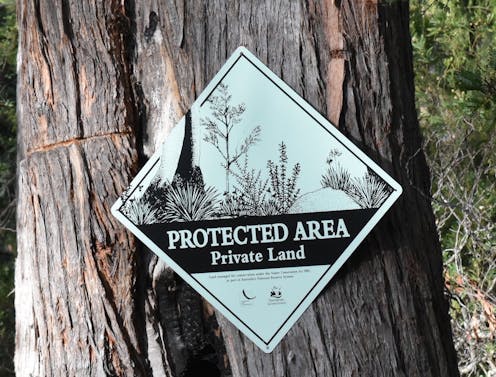
As the federal government attempts a major overhaul of national environment law, all options must be on the table to prevent the fast deterioration in Australia’s natural places. And more than ever before, the efforts of private landholders should be front and centre.
About 60% of the continent is owned or managed privately – and 70% to 90% of inadequately protected wildlife is found mostly on such land, which includes farms, pastoral leases and mines.
But through what legal mechanism can private landholders be engaged in biodiversity conservation? A key tool, we believe, is a legally binding agreement known as a “conservation covenant”. Under such deals, a private landholder agrees to manage their land for conservation – mostly for altruistic reasons but sometimes in exchange for money or other incentives.
Conservation covenants have been used in Australia for many decades, to a limited extent. But with a few policy changes, they could play a bigger role in helping Australia meet ambitious global goals for conserving and restoring nature.
A once-in-a-generation chance
Many of Australia’s ecosystems are severely degraded. In 2020, the independent Samuel review found national laws were failing to protect our natural assets and the regime needed an overhaul. In response, the federal government released a “nature positive” plan. It’s currently consulting with key stakeholders on a major new law to enact the plan.
This once-in-a-generation law change provides an opportunity for the Commonwealth to stimulate action by private landholders. Not only would this improve the state of Australia’s environment, it would also help ensure we meet our international obligations. In 2022, Australia pledged to place 30% of the continent under conservation protection and start restoring 30% of degraded areas by 2030. But just a few years out from the deadline, we have a lot of work to do.
For example, only 22% of Australia’s landmass is currently protected. By 2030, about 61 million hectares must be added to the conservation estate if Australia is to meet its target.
Strong laws and policies are needed and conservation covenants offer a way forward for private land. A conservation covenant is a legally binding commitment landholders make to restrict how their property is used. Crucially, it binds not only current but future landholders, and operates in perpetuity.
Read more: 5 things we need to see in Australia's new nature laws
The story so far
Covenants have been used occasionally to conserve bushland in Australia since the 1930s. Their use grew from the 1970s as states such as Victoria adapted covenants for conservation use. Some states created independent organisations, such as Victoria’s Trust for Nature, to negotiate covenants with landholders and help them manage their properties.
In Queensland, conservation covenants known as “nature refuges” exist on pastoral leasehold properties. Elsewhere, landowners have also used covenants to achieve wins for both nature and their business, such as Western Australia’s Balijup farm and Tasmania’s Huon Bush Retreats. In these cases, the covenants have helped protect natural values that boost agriculture or eco-tourism.
Despite their potential, covenants are currently reported as safeguarding only about 1% of the continent – and not necessarily those parts in greatest need of help. Change is needed.
How to improve covenant schemes
Much can be done to ensure conservation covenants do more of the heavy-lifting when it comes to environmental protection. In many cases, this should involve the Commonwealth collaborating with the states, which primarily regulate covenants.
The federal government is establishing a nature repair scheme which aims to encourage private spending on biodiversity projects. But the law underpinning the scheme is silent on the potential role of covenants. The law should promote covenants as a way to ensure nature repair efforts meet high legal standards. This would provide confidence to private investors that conservation gains will be made over the long term.
Many existing covenant agreements lack sufficient financial support for landholders, such as council rate rebates and assistance for pest control and fencing. Such support is needed to attract a wider range of landholders and to fund ongoing conservation and restoration work.
Existing covenants are generally used to protect high-value conservation land where ecosystems are healthy. Rarely are they used on degraded land needing restoration, such as overgrazed paddocks or former mining sites. Further refinement of covenants may be needed so they can accommodate restoration.
Many landowners initially opt for a non-binding conservation commitment, such as the “Land for Wildlife” program running in several states. While such state-level programs have merit, in many cases, it’s important to support landowners to transition to a more robust tool, such as a covenant, to ensure the nature improvements have lasting impact.
One solution is for the states to offer a variety of covenants so landholders can choose the one that best fits them and their property. This includes offering covenants to sites undergoing active restoration. Victoria’s BushBank program, which combines payment for biodiversity and carbon values, is a promising step in the right direction. The question of how covenants might apply to Indigenous-owned land also must be considered.
In addition, climate change must be recognised as a key consideration when designing covenants. There’s no guarantee of protection for nature, even with a covenant, if climate change is ignored.
This means responsible bodies and landowners should be required to review and, if necessary, update management plans after bushfires, droughts and other significant climate-related events. And covenants should support lands already restored to become more climate-resilient, such as through planting more suitable vegetation.
The future of nature conservation in Australia must involve a much bigger role for private landholders. This includes the protection and management of high-quality native habitats as well as restoring degraded ecosystems.
Authors: Benjamin J. Richardson, Professor of Environmental Law, University of Tasmania