More than a century on, the battle fought by Australia's suffragists is yet to be won
- Written by: Clare Wright, Associate Professor in History, La Trobe University
When Kerryn Phelps claimed her historic by-election win on the weekend, she called the triumph a “a victory for democracy”, signalling “a return of decency, integrity and humanity to the Australian government”.
As well as taking a progressive stand on social issues, Phelps vowed to represent all those who were disgusted by the internal brawling and destructive power plays of Australia’s elected officials. One commentator rejoiced that people who were “tired of the spineless and incompetent politicians who are intent on destroying the joint” were finally getting their moment in the sun. “Hear us roar,” the journalist cheered, channelling a mutinous Helen Reddy.
Was Phelps aware that her roll call of values and virtues — decency, integrity, humanity — harked back to a much earlier age of grassroots political activism led by women?
The idea that institutional outliers are the new brooms that can sweep clean the filthy floors of national legislatures has a far-reaching lineage. “Cleansing the Augean stables” has long been an allegory for ridding an administration of corruption. Most recently, we have seen what can happen when a perceived underdog promises to “drain the swamp” of American government, as Donald Trump did.
Trump was hailed as the hero of the marginalised and silenced — those buried by the sludge of Washington — for being a man of steel, able to leap petty bureaucrats (and nasty women) in a single bound.
But the “new brooms” metaphor for scrubbing the halls of power has more often been gendered female. This is particularly true in Australia, where white women had a singular advantage: they were the first in the world to win the right to stand for parliament, a paradigm-shifting reform that was ushered in by the passage of the Commonwealth Franchise Act in 1902. Pre-figuring Phelps, Australia’s trail-blazing political reformers at the turn of the 20th century were fully enfranchised women intent on using their new super power to puncture the fetid pustule of federal parliament.
Read more: Quotas are not pretty but they work – Liberal women should insist on them
One of the arguments against women’s eligibility to sit in parliament was that parliament, like the pub, was “no place for a lady”. “If such were true,” countered Nellie Martel, who stood for election to the Senate in 1903, “women should be sent there to purify it, and it certainly required cleansing.”
The notion that women would “purify politics” through their inherent female qualities of munificence, rectitude and sobriety — as well as maternal skills of negotiation, conciliation and care — was central to the suffragists’ moral claim to political equality.
Vida Goldstein, who also ran for the Senate in 1903, adopted a light-hearted way to describe the need for women’s direct parliamentary representation:
Man seems to be constitutionally unable to keep things tidy.
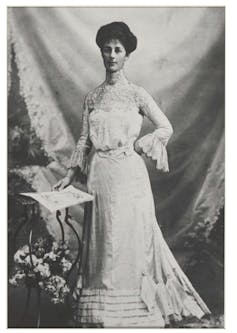 Vida Goldstein.
NLA
Vida Goldstein.
NLA
As I write in my new book, during her 1903 campaign for the Senate Goldstein joked that it had always been woman’s lot to tidy up after men: “He leaves the bathroom in a state of flood, his dressing-room a howling wilderness of masculine paraphernalia, his office a chaos of ink and papers” — and this disorderly boor was equally “untidy in the nation”. No wonder the “national household” was in such “a terrible state of muddle”. Women’s vote and their presence in parliament would, according to Goldstein, lead to a more principled approach to “national housekeeping”.
Such gendered metaphors and stereotypes were not challenged by Edwardian-era women’s rights advocates. It was a later generation of feminists whose demand was to be liberated from the role of “angel of the hearth” or spiritual redeemer — God’s Police, the hand rocking the cradle and wielding the broom.
Suffrage campaigners of the early 20th century proudly accepted their “natural” function as civilisers of the civilisers. (It’s sobering to remember that the same act that gave Australia’s white women their leading global edge also disenfranchised all Indigenous Australians on the grounds that, as Senator Alexander Matheson argued in debating the Franchise Bill, “if every one of these savages and their gins [were put] upon the federal rolls” the nation would be “swamped by aboriginal votes”).
In settler-colonial White Australia, suffragists simply wanted the political power to make the white man’s burden woman’s burden too.
But the first-wave feminists would be rolling in their largely unmarked graves to know that women joining the ranks of parliamentarians barely changed their male colleagues’ outlook and demeanour at all. Some women (Margaret Thatcher, for example) revelled in the opportunity to play the hawk and had no qualms about ruffling geopolitical and domestic feathers in the most noxious fashion. Other women have found it more difficult to adopt moves from the playbook of toxic masculinity: belligerence, bellicosity and bullying.
Recently, we’ve seen female MPs in Australia call time’s up — or at least time-out — on such on-field antics, particularly when the aggression is directed at women themselves. In August this year, Liberal MP Julia Banks announced her decision to quit federal politics, citing the “cultural and gender bias, bullying and intimidation” of women in parliament.
Read more: A 'woman problem'? No, the Liberals have a 'man problem', and they need to fix it
It’s worrisome that the prevailing culture of sexism has changed so little in over a century of parliamentary politics being a gender-inclusive workplace. “We were subjected to ridicule, contempt, abuse and to anything but flattering cartoons,” lamented Nellie Martel after her 1903 Senate campaign. The limits of participatory democracy are sorely tested by such cultural intransigence.
Despite Kerryn Phelps and her support crew being dressed in suffragette purple — the symbolic colour of courage — she did not claim her victory as a win for women as such. Rather, as a seasoned and astute campaigner, Phelps flew the flag for the non-party vote. By running as an independent, she was able to channel the disaffection and discontent of a cosmopolitan community.
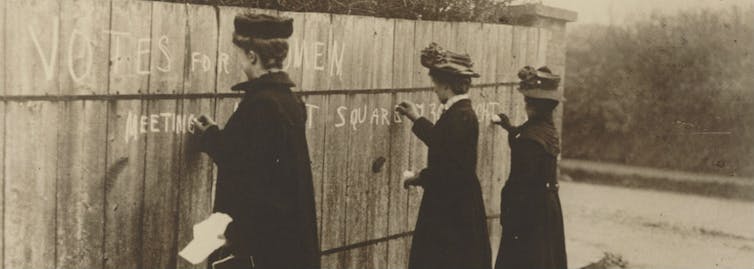 Suffragettes graffiti on a wall to make their feelings known, 1900-1910.
NLA
Suffragettes graffiti on a wall to make their feelings known, 1900-1910.
NLA
This call to grassroots activism was also a hallmark of the Federation-era feminists. Vida Goldstein deplored what she called “the ticket system” of politics. In her view, the party machine led to “disastrous consequences”: feeble candidates, selfish and greedy egoists, mere “log-rollers” who had been trundled into parliament purely because they were on the party’s ticket. Oftentimes, such politicians were “men of doubtful character, men whose social life is a scandal” and who could be found “intoxicated” in parliament.
The teetotalling Goldstein ran for parliament as an independent five times – in vain. Contemporaries believed she would have easily won if she’d stood for the Labor Party. Women, it transpired, voted more along class than gender lines.
It may well be that neither female voters nor female politicians turned out to be the democratic disinfectants that the women who fought for the franchise expected. Perhaps, the degree of muck and debris to which they were exposed as fully enfranchised citizens was more insidiously entrenched than they could have imagined from outside the stable.
Or, maybe, women just aren’t that fond of cleaning. But one insight from the Federation era of hope and optimism still rings true. Goldstein was ever at pains to:
… give honour where honour is due: to the men of Australia, who have grown so far in democratic sentiment that they can tolerate the idea of living with political equals.
Living with and as political equals is surely the most potent solution for reform.
Clare Wright is the author of You Daughters of Freedom: The Australians who won the vote and inspired the world, by Text Publishing.
Authors: Clare Wright, Associate Professor in History, La Trobe University