

A brief look at the long history of First Nations fashion design in Australia
- Written by: Treena Clark, Chancellor’s Postdoctoral Indigenous Research Fellow, Faculty of Design, Architecture and Building, University of Technology Sydney
Aboriginal and Torres Strait Islander readers are advised this article contains names and images of deceased people, and links to old newspaper stories and research papers using outdated and potentially offensive terminology.
The ABC’s series The Way We Wore takes a look at stories of Australian fashion design and style.
First Nations people participated in the series and spoke about various periods and tales, looking at forced clothing policies during the Stolen Generation period, the contribution of Flinders Ranges/Adnyamathanha knowledge to the creation of the RM Williams iconic boot, and the emergence of First Nations fashion design from the 1970s and at Parisian fashion shows in the 1980s.
Yet, left out from the show was the rich backstory of our First Nations fashion design industry.
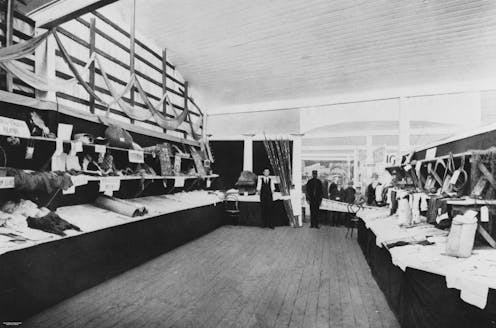
Prior to Parisian fashion shows, First Nations people showcased handmade clothing and accessories at 1800s international and national exhibitions, often as unpaid labour.
Earlier still, the making and crafting of animal and plant cloaks, skirts, belts, shoes and accessories were the original fashion designs.
Traditional clothing and adornment
Climates, materials and stories guided traditional fashion design.
Items were crafted from natural materials that eventually returned to the environment.
Footwear was made from animal skins, furs, and feathers, human hair and bark.
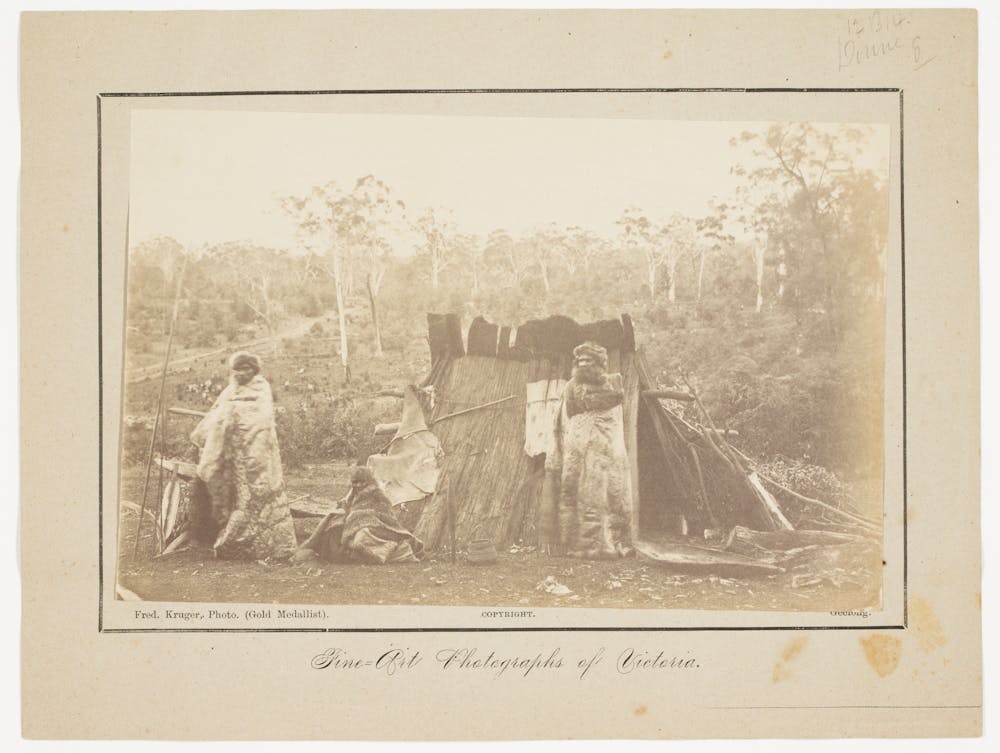
Cloaks were made from animal skin and plants, often inscribed with designs that reflected a person’s identity.
Intricate jewellery and accessories included head ornaments, necklaces, mourning caps, belts and bags, some made from highly traded pearl shells and rare seashells.
Today, we are seeing a resurgence around the country of these adornments and the role they play in healing, wellbeing and cultural practice.
Showcasing at trades and exhibitions
First Nations women and girls who lived on reserves, missions and schools were forced to learn sewing and many produced goods including hats, bags, baskets, jewellery and rugs.
These items were crafted from cultural or Western methods, using both traditional or introduced materials.
From the mid-1800s, their work was often produced for various tourist trades and national and international exhibitions.
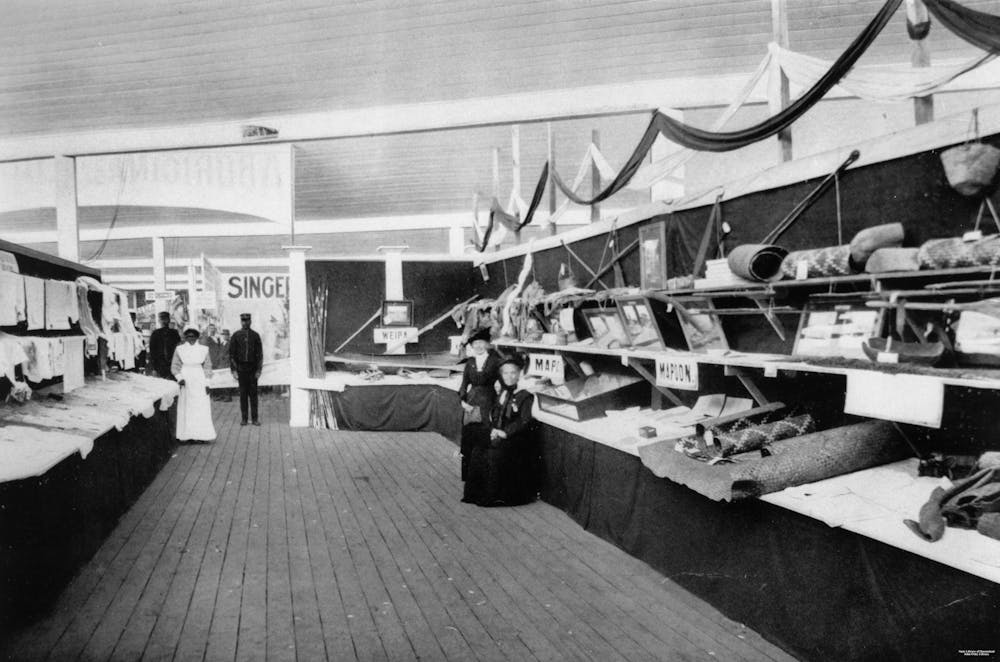 The Aboriginal Court at the Brisbane Exhibition, 1914.
State Library of Queensland
The Aboriginal Court at the Brisbane Exhibition, 1914.
State Library of Queensland
One Melbourne CBD shop stocked woven baskets and bags from Victoria’s Coranderrk Reserve.
Sydney’s La Perouse Mission sold shell baskets in the city and later exhibited them at the Sydney Royal Easter Show and in London.
At the 1888 Melbourne Exhibition, the Queensland section presented pearl jewellery from Thursday Island and the Torres Strait.
While some of the women and girls from these institutions received pay for their work, many did not.
Emergence of fashion within the craft industry
From the 1930s, non-Indigenous textile artists and fashion designers started producing First Nations-inspired designs using motifs such as boomerangs, shields and “hunting stick figures”, without the permission or input from First Nations artists.
Partly in response to this popularity, craft centres within the missions and reserves established their own industry and several hired First Nations people to design cultural textiles and fashions.
Some of this early work in the 1940s included bags with traditional weaving styles, practical linens with cultural designs and unique Ernabella scarves.
As the newspaper The Sun reported from the Mount Margaret Mission in 1941:
One of the most interesting exhibits in the exhibition of Aboriginal handicrafts and school children’s work at the Y.W.C.A. to-day is a bag woven from wool in a native stitch. It has been adapted from old aboriginal work which is usually seen only in tribal grass weaving.
Children’s work from these institutions were often exhibited in Australia and internationally. There was particular overseas interest in turning art from the Carrolup Native settlement onto textiles for fashion garments.
The business of First Nations textiles and fashion
Economic and cultural autonomy became more attainable for First Nations people from the 1950s.
Bill Onus produced cultural furnishing fabrics with non-Indigenous artist Paula Kerry for his Melbourne Aboriginal Enterprises store.
First Nations women from the Coffs Harbour area started mass-producing fashions for the tourist trade using non-Indigenous designs in the mid-1960s.
By the late 1960s, First Nations designed textiles became a fully-fledged fashion industry.
In 1969, Tiwi Island clothing production and textiles had launched through Bima Wear and Tiwi Designs.
A few years later, other arts centres started crafting textiles for fashion designs.
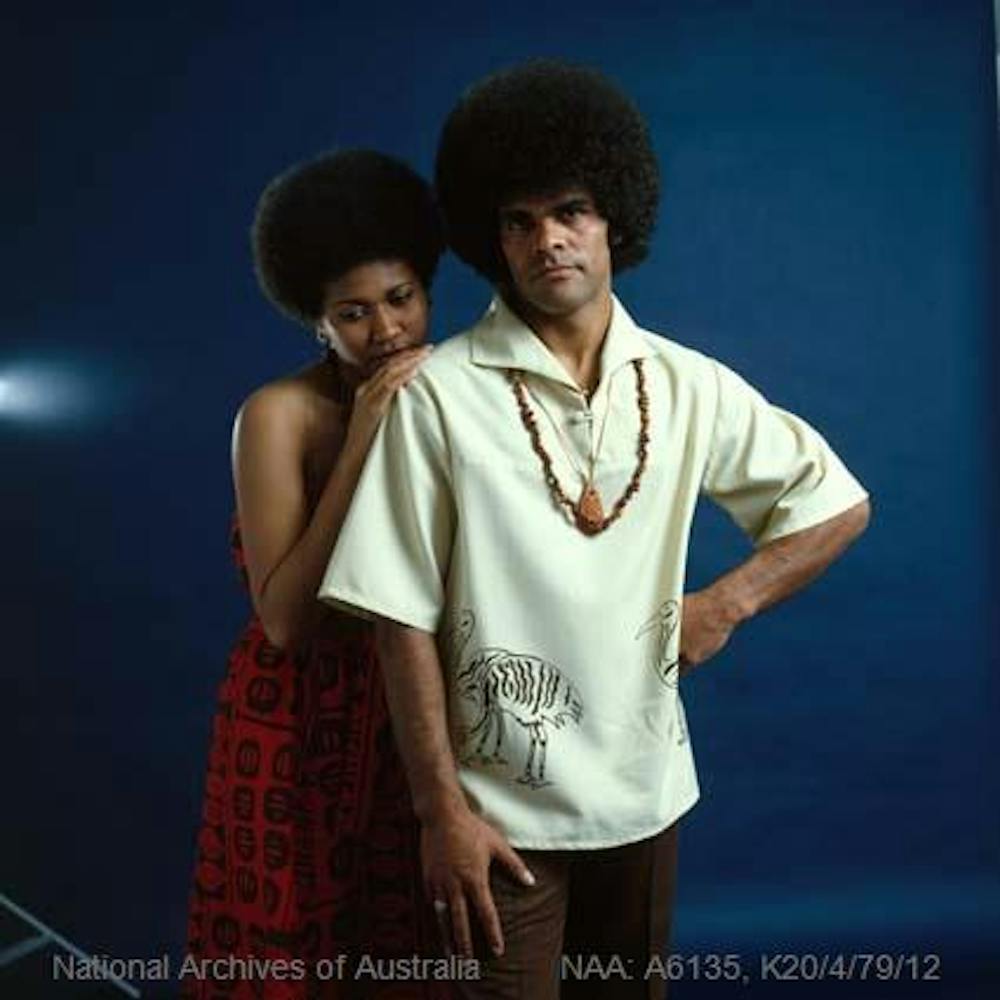 Tiwi (Aboriginal) fashion designs, 1979.
© Commonwealth of Australia (National Archives of Australia) 2023., CC BY
Tiwi (Aboriginal) fashion designs, 1979.
© Commonwealth of Australia (National Archives of Australia) 2023., CC BY
Throughout the 1970s, fashion shows paraded these textiles and some First Nations people wore the designs at formal events.
Bronwyn Bancroft, the owner of the Sydney store Designer Aboriginals, and Euphemia Bostock and Mini Heath presented their garments at the Parisian Au Printemps Department Store in 1987.
The 21st Century and beyond
By the start of the new millennium, Robyn Caughlan, in collaboration with Benjamin Mach, was the first Indigenous designer to contribute to a fashion collection at Australian Fashion Week.
Two decades later at Australian Fashion Week 2023, Denni Francisco’s brand Ngali was the first Indigenous label to present a standalone collection.
Today, many First Nations labels promote their designs internationally in Paris, Milan, London, and New York. There are now several First Nations fashion bodies to support them in the industry.
These bodies connect with national and international fashion weeks and art fairs, and have insight into cultural appropriation and Intellectual Property Rights.
For First Nations people, fashion and style are significant channels through which culture, identity, healing and social change can be communicated and practised.
Learning about the foundation of First Nations fashion design is vital to understanding Australian history and advocating connection, wellbeing, expression and sustainability.
Read more: ‘Cultural expression through dress’: towards a definition of First Nations fashion
Authors: Treena Clark, Chancellor’s Postdoctoral Indigenous Research Fellow, Faculty of Design, Architecture and Building, University of Technology Sydney


















