

At a time of giving and receiving, our many Australian mistletoes do it too
- Written by: Gregory Moore, Senior Research Associate, School of Ecosystem and Forest Sciences, The University of Melbourne
The airwaves and shopping centres have been filled with Christmas songs and carols. Apparently mommy was seen kissing Santa underneath the mistletoe. Harry Potter’s first kiss was also under a twining white-flowered mistletoe.
Magic, mystery and symbolism surround mistletoes. Their popularity at Christmas comes from their evergreen foliage symbolising life without end.
The festive traditions relate to the English mistletoe, Viscum album, and American mistletoe, Phoradendron leucarpum. These traditions may not apply to our species, but the mystery and magic certainly do.
Australia has nearly 100 species of mistletoes – 75 of them in the plant family Loranthaceae – which are not to be confused with the northern hemisphere species. They occur across the country, except in Tasmania. They are parasitic plants, though for many species their biology is not fully understood.
My interest in mistletoes stems from the many native species that live on common trees such as eucalypts, elms, plane trees, liquidambars, oaks and common fruit trees. Being parasites, mistletoes have often been seen as receivers or even takers, rather than givers, which is hardly in the spirit of the festive season. However, recent research has revealed they are givers too!
Read more: How we brought mistletoes back to the trees of Melbourne – while warding off hungry possums
The mystery and magic of our mistletoes
Indigenous communities were well aware of the sweet sticky fruits and the medicinal benefits certain mistletoe species provided. They also used mistletoes as a general indicator of the condition of Country and as part of fire management. Some may have used the foliage in their cleansing and welcome ceremonies too.
You may be thinking it’s a mystery why you haven’t noticed these plants more often. That’s explained by a bit of mistletoe magic.
Many of our species have a brilliant camouflage. Their leaves mimic those of the host tree (a phenomenon called crypsis). So mistletoes such as Amyema miguelli and A. pendula have leaves that resemble those of eucalypts, but they become conspicuous when they flower.
Mistletoes are hemi-parasites, which means they have green leaves and photosynthesise like other plants, but take water and nutrients from their hosts. They do this by tapping into the transport system inside the host plant and diverting some of the water and nutrients it contains.
So what do they give back?
Mistletoes shed more leaves more often than other plants of comparable size. These leaves contain valuable elements and compounds. This shedding creates a litter layer and compost that enriches the soil and increases the biodiversity not only in the soil but in the environment around them.
It isn’t just other plants that benefit from these gifts. The numbers of different insects, spiders and fungi present in the leaf litter goes up significantly where mistletoes are present. So too does the diversity of birds and other animals.
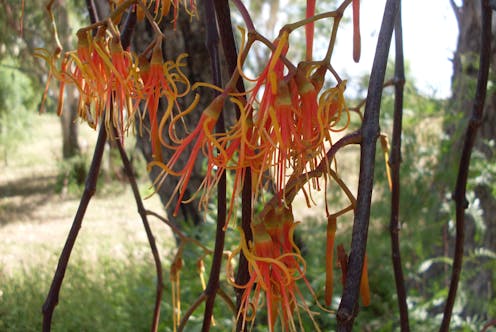
Many native mistletoes have spectacular and colourful flowers. These are an important source of food for many insect and bird species.
This means mistletoes are important for the biodiversity of the ecosystems that contain them.
There is more mistletoe magic! Mistletoes often have a dense foliage, which creates a cooler microclimate in their vicinity. Mistletoes also continue to transpire water when other plants have ceased due to dry conditions, which further cools the air.
There is evidence that birds and mammals nest in the denser cooler mistletoe foliage in preference to other more abundant plants growing around them. Animals also take refuge within and under mistletoes when it’s very hot. This benefit for native wildlife may be all the greater as climate changes.
Read more: Mistletoe: the kiss of life for healthy forests
Too many mistletoes can harm their host
We tend to notice mistletoes when flowering and bird feeding peak, or when their evergreen foliage stands out against the bare branches of deciduous host trees. We can then be surprised at how many mistletoes are growing in the canopy of a tree in our garden.
In some parts of Australia, the number of mistletoes can increase over time such that large numbers on a single host can sap the tree’s vigour. Branches beyond the point of mistletoe attachment die back, particularly on older trees and in drier seasons. When there are more than 20 mistletoes per tree, both its growth rate and flowering are reduced.
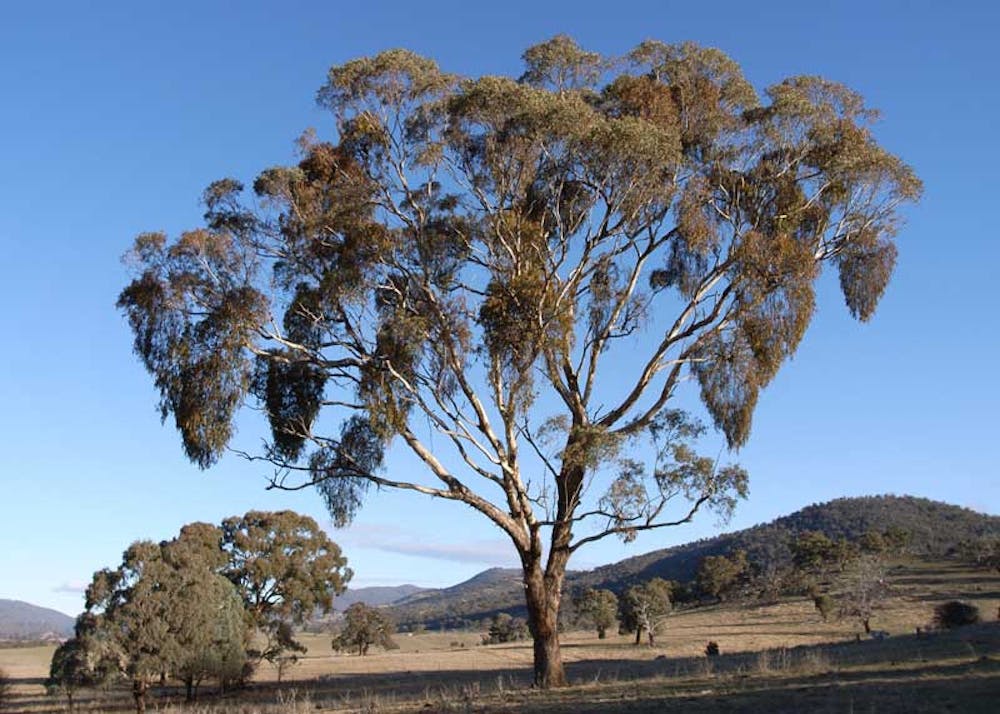
In hot dry conditions, high mistletoe numbers can lead to the deaths of older, stressed trees. Changes to fire regimes and the clearing of native vegetation are likely causes of increased mistletoe infestation.
For your garden trees, some appropriate mistletoe control may benefit not only your trees but the mistletoes too. Mistletoe control requires a sophisticated approach because of their importance for local ecosystems.
A large tree with a full canopy in good condition can cope with about four to six mistletoes. Survey mature trees to ascertain mistletoe numbers and take steps to control some, but not all, of the mistletoes if infestations are excessive.
To remove mistletoe, cut the connection to the host tree as close as possible to the branch or trunk without damaging the host. In some cases there may be more than one connection and so several cuts may be required. Sometimes nature will take control as mistletoes can die from excessive water loss during heatwaves.
A home-grown Christmas tradition
Not all mistletoes grow in tree canopies. Some are root parasites. They include the cherry ballart, Exocarpos cuppressiformis, and the spectacular Western Australian Christmas tree, Nuytsia floribunda.
The latter is renowned for its abundant brilliant yellow-orange flowers over the Christmas period. Early settlers used the cherry ballart with its conifer-like foliage as a Christmas tree with or without its red “cherries” as decoration. The “cherries” are not true fruits, but swollen fruit stalks - another bit of mistletoe magic and mystery.
Authors: Gregory Moore, Senior Research Associate, School of Ecosystem and Forest Sciences, The University of Melbourne


















