

Seeing a lot of mobile speed cameras on your summer road trips? Here's how they work
- Written by: Simon Raftery, Research Fellow at the Centre for Automotive Safety Research, University of Adelaide
As you’re driving around this summer holidays, there’s every chance you’ll see a strange-looking white or yellow box on the side of the road.
It might have cameras protruding overhead, or be emblazoned with road safety slogans.
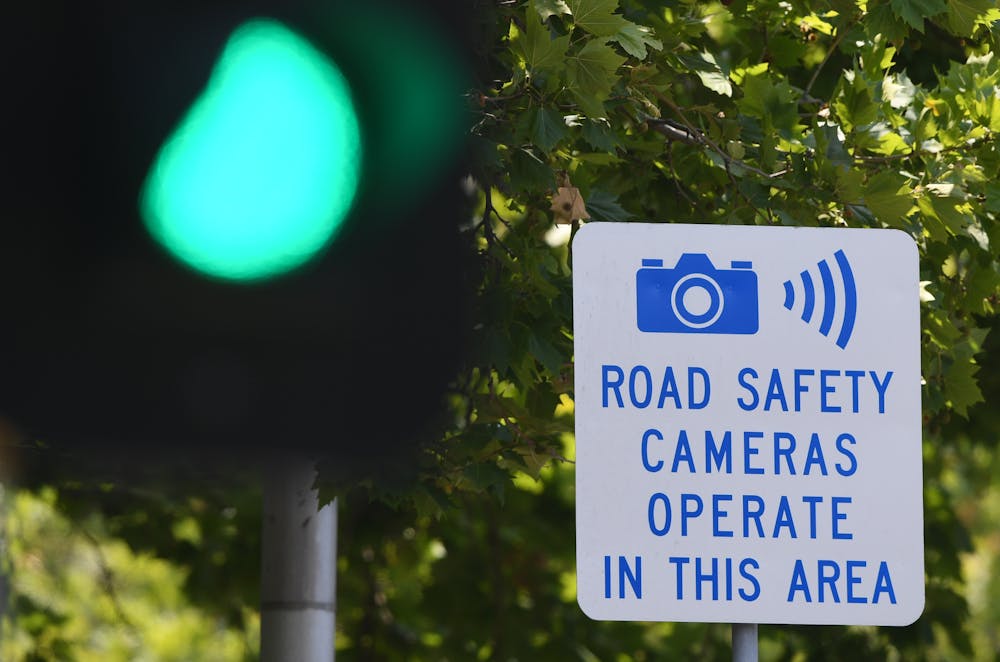
It’s a mobile road safety camera. It’ll catch you out doing everything from speeding, to using your phone while driving, to failing to wear a seat belt.
So how did these cameras come about, and how do they work?
Read more: How to never get a speeding fine again — and maybe save a child's life
Road toll refusing to budge
In Australia, around 1,200 people die in car crashes every year.
The number of people seriously injured has risen from 34,000 in 2011 to around 39,000 in 2019 (although this may partly be explained by changes in the way admissions to hospital are reported).
Alarmingly, these numbers are showing no sign of decline.
It is widely recognised that behaviours such as speeding, drink or drug driving, fatigue, distraction and dangerous driving increase the risk of a crash.
Failing to wear a seat belt can lead to more severe injuries when a crash occurs.
To reduce the trauma on our roads caused by these behaviours, we need to increase compliance with the road rules and encourage safer driving. The use of safety cameras for enforcement has become a crucial part of the road safety response.
A short history of safety cameras
Safety cameras were first used in Australia in 1985 with the introduction of speed cameras in Victoria.
Since then, the use of safety cameras has grown to include fixed red light and speed cameras, mobile speed cameras (that can be moved to different locations), and point-to-point cameras (also known as average speed cameras).
In the past three years, mobile phone detection cameras have been introduced in New South Wales, Queensland, Victoria, the ACT and Tasmania, and will soon be operating in South Australia. They have also been trialled in Western Australia.
Currently, Queensland and Tasmania are the only states to also use these cameras for seat belt enforcement, although NSW intends to do so in 2024.
Safety cameras, whether looking at speed or other dangerous driving behaviours, can be either fixed or mobile.
Fixed cameras are permanently located at one spot and operate around the clock. They have primarily been used to target speeding and red light running.
Mobile cameras, those roadside trailers you might see, can be moved from one location to another and can be deployed virtually anywhere at any time. They are mainly used to target speeding and can also be mounted on a vehicle or tripod.
Trailer-based safety cameras can be left unattended in place for longer periods and are usually equipped with security devices such as alarms and security cameras. They also have a secure housing (that’s sometimes bulletproof) to protect against tampering and vandalism.
Typically, they’re placed in areas with a history of crashes or where speeding, distraction, restraint use, or safety are of concern.
So how do they actually work?
Safety cameras use radar or laser to detect and measure vehicle speeds. Sensors embedded in the road are used to detect red light running.
Depending on how they are set up, safety cameras can monitor multiple vehicles across multiple lanes and approaching from opposite directions.
They use high-definition cameras that are effective in different lighting and weather conditions, including night, fog and heavy rain. Some are able to identify and enforce speed limits for different types of vehicles (like heavy vehicles).
They may also use automated number plate recognition capabilities that allow them to detect or identify so-called “hot list” vehicles that are of interest to police (stolen, unregistered, unlicensed owners, for example).
Fixed and mobile cameras enforce speeds in their immediate vicinity, while point-to-point cameras measure the average speed of vehicles between two points and as vehicles pass the camera locations at the beginning and end of the zone. Currently point-to-point enforcement is fixed, but it is likely that portable cameras will also be used in the future.
Mobile phone detection cameras make use of high-definition cameras and infrared lighting that allow them to see through the windscreen and determine when someone is illegally using a mobile phone. They can also determine whether they are wearing their seat belt correctly.
These cameras can also measure vehicle speed and use number plate recognition to monitor vehicles. It means they can help enforce pretty much everything. They can be either fixed or mobile.
Do they work to improve driver behaviour?
Research indicates safety cameras do just what the label implies: improve safety.
A systematic review of the effects of different types of speed cameras suggests they are effective at reducing average speeds and the number of vehicles speeding, and, more importantly, reduce serious injury and fatal crashes by around 20% each.
Studies examining the effectiveness of mobile phone cameras are yet to be undertaken. However, NSW experienced a substantial decline in mobile phone use in the three years following their introduction.
Read more: Speeding is more common among people regularly exposed to content encouraging speeding
Enforcement data also shows that the cameras are an efficient and effective method ofdetecting infringements.
Merely relying on common sense, courtesy or self-interest will not be enough to reduce the trauma caused by bad driver behaviour.
Safety cameras work. They will continue to play an important part in reducing these behaviours and making our roads safer for everyone.
Authors: Simon Raftery, Research Fellow at the Centre for Automotive Safety Research, University of Adelaide


















