

COVID is surging in Australia – and only 1 in 5 older adults are up to date with their boosters
- Written by: Adrian Esterman, Professor of Biostatistics and Epidemiology, University of South Australia
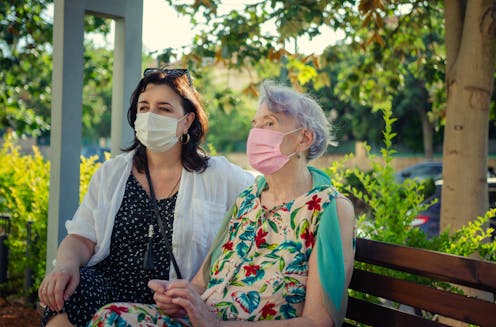
Do you have family members or friends sick with a respiratory infection? If so, there’s a good chance it’s COVID, caused by the JN.1 variant currently circulating in Australia.
In particular, New South Wales is reportedly experiencing its highest levels of COVID infections in a year, while Victoria is said to be facing a “double wave” after a surge late last year.
But nearly four years into the pandemic, data collection is less comprehensive than it was, and of course, fewer people are testing. So what do we know about the extent of this wave? And importantly, are we adequately protected?
Read more: I have COVID. How likely am I to get long COVID?
Difficulties with data
Tracking COVID numbers was easier in the first half of last year, when each state and territory provided a weekly update, giving us data on case notifications, hospitalisations, ICU numbers and deaths.
In the second half of the year some states and territories switched to less frequent reporting while others stopped their regular updates. As a result, different jurisdictions now report at different intervals and provide varying statistics.
For example, Victoria still provides weekly reports, while NSW publishes fortnightly updates.
While each offer different metrics, we can gather – particularly from data on hospitalisations – that both states are experiencing a wave. We’re also seeing high levels of COVID in wastewater.
Meanwhile, Northern Territory Health simply tell you to go to the Australian government’s Department of Health website for COVID data. This houses the only national COVID data collection. Unfortunately, it’s not up to date, difficult to use, and, depending on the statistic, often provides no state and territory breakdowns.
Actual case notifications are provided on a separate website, although given the lack of testing, these are likely to be highly inaccurate.
The Department of Health website does provide some other data that gives us clues as to what’s happening. For example, as of one month ago, there were 317 active outbreaks of COVID in aged care homes. This figure has been generally rising since September.
Monthly prescriptions for antivirals on the Pharmaceutical Benefits Scheme were increasing rapidly in November, but we are not given more recent data on this.
Read more: We're in a new COVID wave. What can we expect this time?
It’s also difficult to obtain information about currently circulating strains. Data expert Mike Honey provides a regularly updated snapshot for Australia based on data from GISAID (the Global Initiative on Sharing All Influenza Data) that shows JN.1 rising in prevalence and accounting for about 40% of samples two weeks ago. The proportion is presumably higher now.
What’s happening elsewhere?
Many other countries are currently going through a COVID wave, probably driven to a large extent by JN.1. These include New Zealand, Spain, Greece and the United States.
According to cardiologist and scientist Eric Topol, the US is currently experiencing its second biggest wave since the start of the pandemic, linked to JN.1.
Are vaccines still effective?
It’s expected the current COVID vaccines, which target the omicron variant XBB.1.5, are still effective at reducing hospitalisations and deaths from JN.1 (also an omicron offshoot).
The Australian Technical Advisory Group on Immunisation (ATAGI) updated their advice on booster shots in September last year. They recommended adults aged over 75 should receive an additional COVID vaccine dose in 2023 if six months had passed since their last dose.
They also suggest all adults aged 65 to 74 (plus adults of any age who are severely immunocompromised) should consider getting an updated booster. They say younger people or older adults who are not severely immunocompromised and have already had a dose in 2023 don’t need further doses.
This advice is very confusing. For example, although ATAGI does not recommend additional booster shots for younger age groups, does this mean they’re not allowed to have one?
Read more: What are the new COVID booster vaccines? Can I get one? Do they work? Are they safe?
In any case, as of December 6, only 19% of people aged 65 and over had received a booster shot in the last six months. For those aged 75 and over, this figure is 23%. Where is the messaging to these at-risk groups explaining why updating their boosters is so important?
Should we be concerned by this wave?
That depends on who we mean by “we”. For those who are vulnerable, absolutely. Mainly because so few have received an updated booster shot and very few people, including the elderly, are wearing masks.
For the majority of people, a COVID infection is unlikely to be serious. The biggest concern for younger people is the risk of long COVID, which research suggests increases with each reinfection.
What should we expect in 2024?
It’s highly likely we will see repeated waves of infections over the next 12 months and beyond, mainly caused by waning immunity from previous infection, vaccination or both, and new subvariants.
Unless a new subvariant causes more severe disease (and at this stage, there’s no evidence JN.1 does), we should be able to manage quite well, without our hospitals becoming overwhelmed. However, we should be doing more to protect our vulnerable population. Having only one in five older people up to date with a booster and more than 300 outbreaks in aged care homes is not acceptable.
For those who are vulnerable, the usual advice applies. Make sure you’re up to date with your booster shots, wear a P2/N95 mask when out and about, and if you do get infected, take antivirals as soon as possible.
Authors: Adrian Esterman, Professor of Biostatistics and Epidemiology, University of South Australia


















