Less than 10% of Australian scorpions are known to science. We've added two new species to the list
- Written by Bruno Alves Buzatto, Lecturer, Flinders University
Scorpions are among the most ancient of land animals. Fossils indicate they were roaming the Earth more than 400 million years ago. For perspective, the non-bird dinosaurs became extinct about 65 million years ago.
Scorpions trivialise the 100-million-year reign of the dinosaurs — they saw them come and go and are still here today. In fact, the external anatomy of scorpions has changed little, based on what we’ve seen from 400 million-year-old fossils.
While formally describing a new scorpion species from the Pilbara region of Western Australia, we discovered another species with identical external morphology (shape and structure). The only way to tell the two species apart was by looking at the morphology of the male reproductive organs.
You’d think that is a very small difference, but it’s not uncommon for telling apart species in other groups, like spiders and millipedes. But these are the first scorpion species distinguished solely by male reproductive anatomy.
Our find, published in the Australian Journal of Zoology, hints significantly more scorpion species await discovery in Australia than previously suspected.
A widespread and popular group
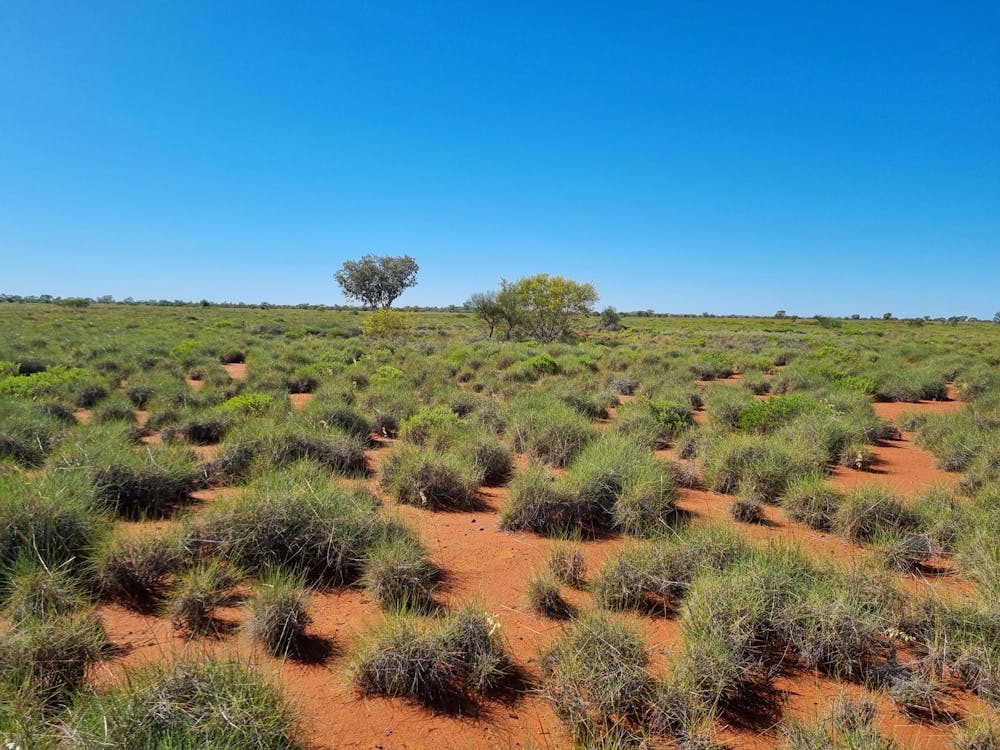
Most Australians think of scorpions as exotic desert animals. But they are fairly widespread, ranging from salt lakes in central Australia to ancient rain forests in Tasmania.
Surprisingly, our estimates (based largely on unpublished DNA sequence data we have access to), indicate that less than 10% of Australia’s scorpion species have been scientifically described or named. Describing them means scientifically documenting and applying a unique scientific name to a new species while following the International Code of Zoological Nomenclature.
The scorpion genus Urodacus is endemic to mainland Australia and represents one of the largest radiations (increases in diversity) of scorpion species on the continent. Most Urodacus species live in deep spiralling burrows, enabling them to survive in arid ecosystems. In some habitats, these scorpions are a significant part of the ecosystem and comprise much of its biomass.
Despite their reclusive habits, Urodacus are popular exotic “pets” and are among the most popular invertebrates offered by online stores in Australia. There’s also a large community of scorpion enthusiasts.
Trading of scorpions is dependent on an unknown level of harvesting from natural populations. Some Urodacus species are known to live for 15–20 years, but in captivity, their longevity is usually less than a year.
With minimal knowledge about the diversity and distributions of Australian scorpions, the potential for serious impacts to their conservation is high. Traded scorpion species are often unnamed, and some may also live in very small areas.
For example, the two new species we described, Urodacus uncinus and Urodacus lunatus, are restricted to creeks and drainage lines, with a known area of as little as 50 square kilometres. Such small distributions make species particularly vulnerable to habitat loss, which is a growing threat in Australia.
Surprisingly, there is no regulation for scorpion ownership in most Australian states, although you need a permit to keep them as pets in the Northern Territory and Queensland. Collecting them from the wild is only regulated in conservation areas.
We don’t know enough about our scorpions
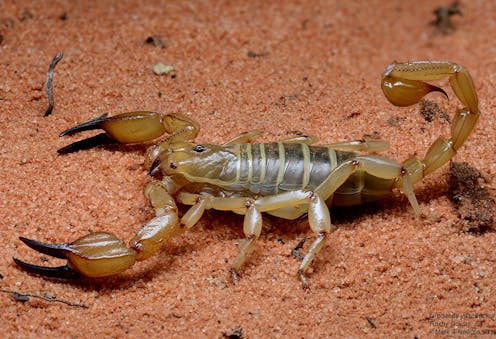
The two new species we just described are large (more than 7cm long) yellow scorpions. Males of both species have a striking enlargement in the tip of their “tails”, with a swollen venom gland and a sting that is more strongly curved than in any other known species of the genus.
The task to fully document and understand the diversity of Australian scorpions is colossal. Approximately 3,000 scorpion species are known worldwide, but in Australia only 47 species are currently described and named. Based on our estimates, we think there could be at least 500 scorpion species here.
Only 13 new Australian scorpion species have been described in the last 45 years. At this rate, many are likely to become extinct before they are even named.
Further research on Australian scorpions will also reveal more of these animals’ incredible biology. One example is their curious reproduction. Scorpion mating rituals include a dance during which males of some species even sting the females as part of the courtship.
Sperm transfer occurs via what could be described as a “detachable penis”, placed on the ground by the male. During mating, part of this organ breaks off in the female reproductive tract and functions as a “mating plug” that prevents the female from remating until the babies from the last mating are born.
Burrowing scorpions give birth to live young that are gestated for up to 18 months within an organ somewhat like a uterus. After birth, mother scorpions carry their babies on their back until they disperse to live a largely solitary life.
Undiscovered secrets
These fascinating behaviours are only a small portion of scorpion natural history discovered to date and they are likely to harbour many more as yet undiscovered secrets.
Next to nothing is known about Australian scorpions, which is surprising given their diversity and ecological importance. More research on Australia’s scorpions is urgently needed to help recognise and protect threatened species and their habitats.
Expanding our knowledge about native scorpions would also help with the regulation of wild collections and allow captive breeding to further develop more responsible pet ownership as a force for conservation, rather than a risk.
Read more: Ever wondered who'd win in a fight between a scorpion and tarantula? A venom scientist explains
Authors: Bruno Alves Buzatto, Lecturer, Flinders University