Do they see what we see? Bees and wasps join humans in being tricked by illusions of quantity
- Written by Scarlett Howard, Lecturer, School of Biological Sciences, Monash University
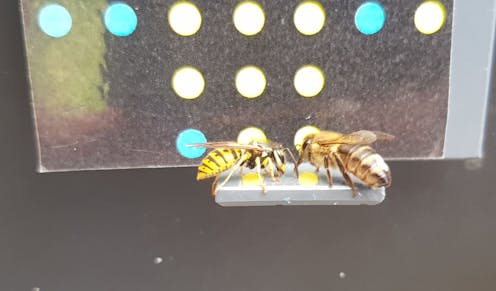
If you’ve ever been tricked by a visual illusion, you know the feeling of disconnect between what your eyes perceive and what is actually there. Visual illusions occur due to errors in our perception, causing us to misperceive certain characteristics of objects or scenes.
As it turns out, many non-human animals also experience these effects, including illusions of item size, brightness, colour, shape, orientation, motion or quantity. We study these illusions and the differences between animals as it can tell us how visual systems evolved.
Our latest study, published in iScience, shows that European honeybees and European wasps see illusions of quantity in a similar way to humans.
An illusion perceived by several species
The study of visual illusions provides interesting windows into how brains operate. Visual illusions are perceptual errors, which likely enable us to process complex natural information efficiently.
The Solitaire illusion causes a misperception of quantity based on the configuration of dots in an image. Those who perceive the illusion will overestimate the quantity of dots when they are clustered together and/or underestimate the number of dots when unclustered.
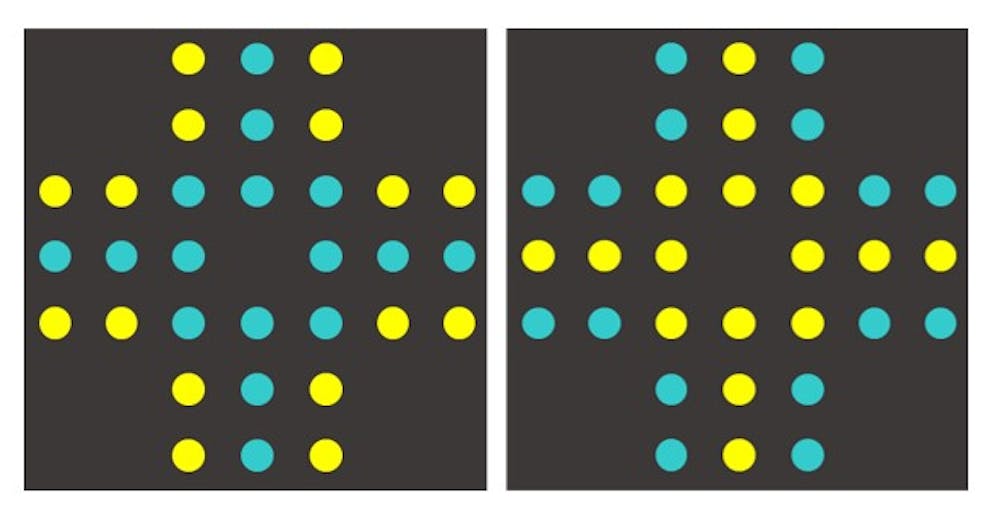
We know the Solitaire illusion is perceived by humans, capuchin monkeys, guppies and bumblebees. Chimpanzees, rhesus monkeys and domestic dogs do not appear to perceive the illusion. Interestingly, in humans age appears to impact the perception of the Solitaire illusion – younger children are less susceptible than older children.
A possible evolutionary reason humans and other species may experience this misperception of quantities is it may allow us to process and compare large numbers of items more efficiently and quickly.
For quantities greater than about five, fast decisions may be more important than absolute accuracy, which would require manual, sequential counting.
Read more: One, then some: how to count like a bee
Testing honeybees
Some insects, including bees and wasps, are very “motivated” to participate in behavioural experiments. European honeybees and wasps are central-place foragers: they will return to the location of a high-quality food source.
We provided freely flying bees and wasps with a reward of sugar water for participating in experiments. This allows us to train and test individually colour-marked insects throughout a day, with them returning by their own choice.
We have used this method to show honeybees can perform a variety of numerical tasks such as understanding the concept of zero, discriminating between quantities, performing simple addition and subtraction, matching symbols with quantities, and categorising quantities as odd or even.
Honeybees are also known to perceive some spatial, movement and colour illusions. These past skills make them an ideal candidate to study and see if they are fooled by illusions of quantity.
Wasps are far less tested than honeybees for their behaviour and cognition, but recent studies show they are also capable of advanced learning.
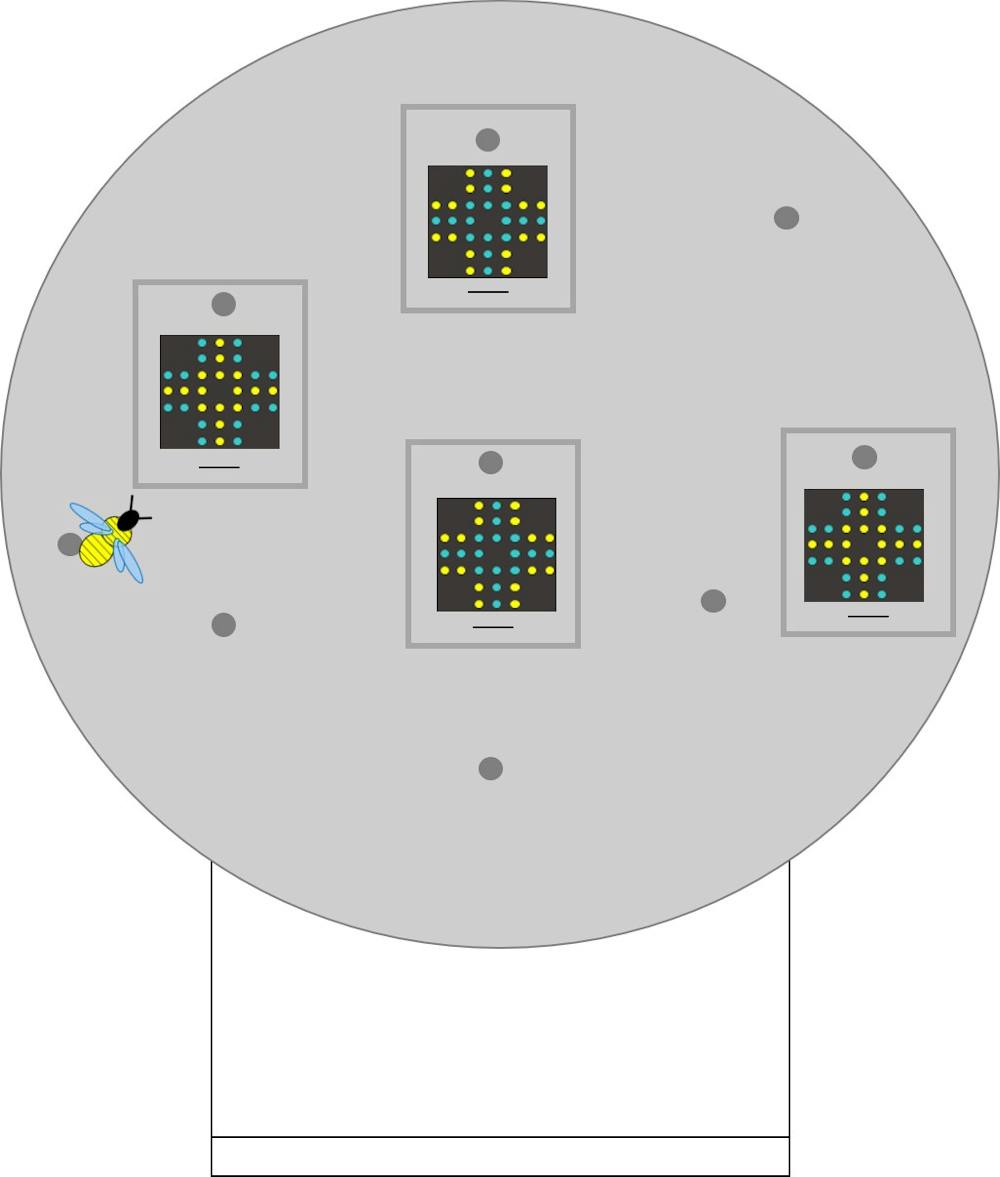 The circular rotating screen used to present stimuli to insects during training and testing. Insects were trained one at a time and rewarded with a sugar water drop for landing on the correct stimulus option during training.
Scarlett Howard
The circular rotating screen used to present stimuli to insects during training and testing. Insects were trained one at a time and rewarded with a sugar water drop for landing on the correct stimulus option during training.
Scarlett Howard
Bees, wasps and the Solitaire illusion
We tested the European honeybee (Apis mellifera) and the European wasp (Vespula vulgaris) using an identical method for both species.
We presented each insect with images containing blue and yellow dots. For 70 trials, the insects were trained with a sugar reward to visit an image with a higher quantity of yellow dots versus blue.
We then presented them with the Solitaire illusion – one image with the yellow dots clustered in the middle and the blue dots unclustered, versus one image of the opposite.
The images actually contained an identical number of blue and yellow dots. So, if the insects perceived the illusion, they would choose the option with the yellow dots clustered in the centre, revealing an overestimation of the quantity of yellow dots.
We found both honeybees and wasps perceived the illusion in a similar way to humans, capuchin monkeys and guppies.
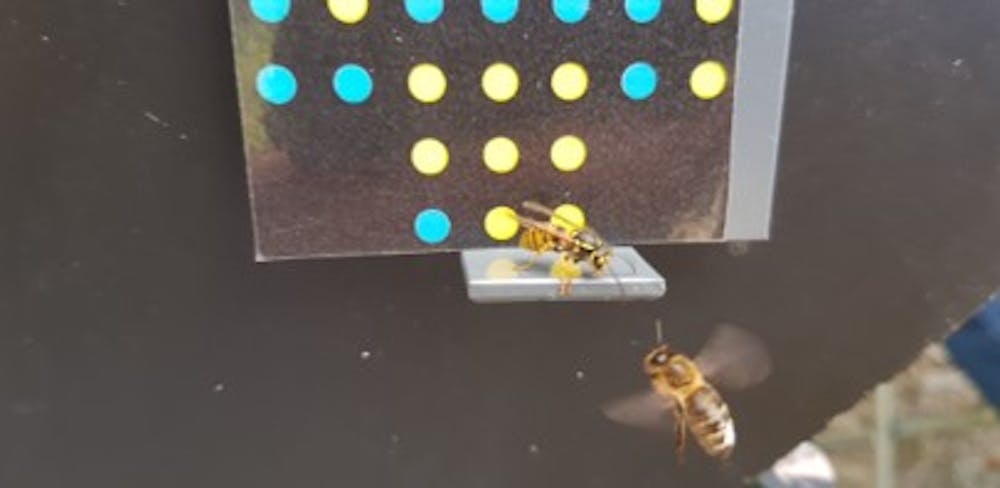 A bee and wasp in front of one of the training images.
Scarlett Howard
A bee and wasp in front of one of the training images.
Scarlett Howard
Is there an evolutionary clue here?
We now know the perception of the Solitaire illusion occurs across a range of species including humans, non-human primates, fish and insects. There are also primates and other mammals that appear not to perceive the illusion.
This could suggest two potential evolutionary pathways of experiencing the illusion.
One is convergent evolution, where different species separately developed the ability to perceive this illusion due to the requirements of their environment.
The other pathway is that the perception occurred through conserved evolution, where a common ancestor perceived the illusion, and subsequently some species either retained or lost the illusion perception.
One important consideration is that while the Solitaire illusion is considered an illusion of quantity, it could also be perceived as an illusion of colour area, size, line length, or perimeter. More research will be needed to determine whether the illusion induces the misperception of quantity or other cues that correlate with quantity.
Read more: Which square is bigger? Honeybees see visual illusions like humans do
Authors: Scarlett Howard, Lecturer, School of Biological Sciences, Monash University