

Google AI


Modern Australian

What's it worth to work from home? For some, it's as much as one-third of their wage

  • Written by: Lynette Washington, Research Fellow, UniSA Business, University of South Australia

What's it worth to work from home? For some, it's as much as one-third of their wage

A significant proportion of Australian workers – about one-fifth – would be prepared to sacrifice between 16% and 33% of their salaries for the right to work from home, which works out at A$12,000 to $24,000 of those workers’ salaries.

But a much larger proportion, more than one half, would be prepared to sacrifice nothing, being either not strongly convinced about the benefits of working from home or actively preferring to go into the workplace.

Surprisingly, our findings are consistent with those of other surveys conducted both during and before the pandemic, suggesting the widespread move to working from home during COVID hasn’t changed preferences.

Before COVID, on the day of the 2016 Australian census, only 2% to 8% of the workforce in major Australian cities worked from home.

During COVID, on the day of the 2021 census 21% worked from home. A Bureau of Statistics survey conducted amid lockdowns in late 2020 found 31% worked from home most days.

Our survey of 1,113 workers from Australia’s 17 largest urban areas was limited to those in jobs whose tasks could be done either remotely or in central locations.

What we found

We offered the workers surveyed a choice of eight job arrangements with different salary ranges calculated with reference to their current salaries, and different degrees of flexibility about working from home.
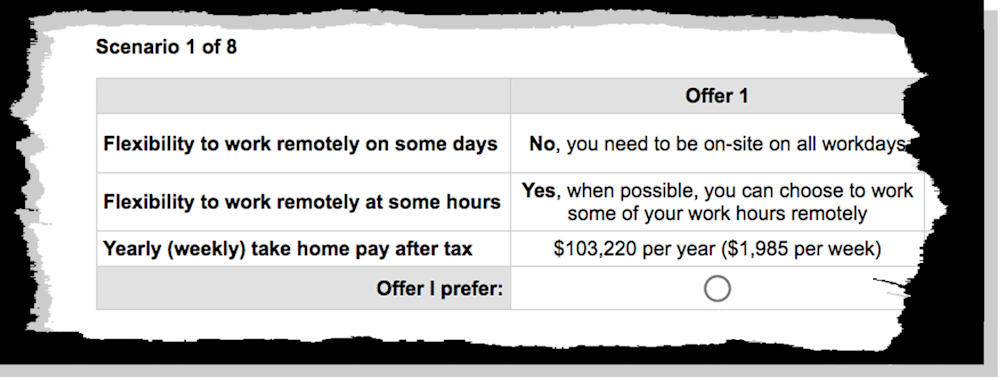
Extract from survey form We also asked about attitudes to remote working, experience with remote working, commute patterns and age, gender, education and household size. We found most workers – 55% – weren’t prepared to sacrifice salary for the right to work remotely. Most of these (31% of all workers) didn’t see significant benefits to working from home. But a substantial proportion, 23.5% of all workers, while seeing benefits to their productivity and health and wellbeing from working from home, were concerned about what it would do to their organisational relationships, learning opportunities and prospects for advancement. Interestingly, workers who had the most experience of working from home before the pandemic raised these concerns most often. Workers with the least experience of working from home pre-pandemic were the least likely to be concerned about its impact on their careers and work relationships. This might be because before the pandemic we didn’t have great work-from-home policies and procedures to support remote workers. Read more: Remote working improves the lives of female managers - but at a cost Gender matters, age matters Women valued the ability to work from home far more than men, on average 28% more. This indicates that women are more likely to make a trade-off between long-term career prospects and the benefits of flexible work. In terms of age, workers in their 30s and 50s valued the ability to work from home the most while workers in their 20s valued it the least. This might be because workers in their 20s at the start of their careers are the most likely to value direct interactions with their colleagues and supervisors. Knowledge workers value remote work the most Middle and high-income earners in white-collar “knowledge economy” jobs were the most likely to value working from home. They were willing to forgo $12,000 to $24,000 of their annual salary to have the ability to do it some of the time. Workers in low-wage clerical or administrative jobs in sectors such as retail and training were among the least likely to value working from home. They were also among the most concerned about its impacts on their relationships with colleagues and opportunities for learning and advancement. Workers in small firms also placed low values on the ability to work from home, perhaps because these firms lacked the technological capacity to fully support it. Read more: The shift to working from home will be difficult to reverse Opinions split on productivity About half of the workers surveyed thought they were less productive at home. About another quarter found no impact. The final quarter found a significant improvement in both the quality and quantity of their work. Many said that while their working from home might cut the amount they got done per hour, it didn’t cut the total amount they got done because the flexibility it offered allowed them to catch up at other times. High and medium-wage professionals were the most optimistic about their productivity at home, and workers in low and medium-wage service jobs the least optimistic – a pattern that mirrored what they were prepared to sacrifice for the right to work at home. How to become an employer of choice Our findings suggest many employers of knowledge economy workers might be able to attract and retain high-quality staff by offering the ability to work from home in lieu of higher salaries. But this will not be the answer for all employers looking to retain the best staff. With many workers wary of what could happen to their career prospects if they stayed at home, and 55% of workers placing no value on remote work, some employers will need to find other ways to attract the best workers. Many workers value both face-to-face relations and flexibility. Finding the right balance will become increasingly important now that COVID has shown us how many of our jobs can be done from home. Authors: Lynette Washington, Research Fellow, UniSA Business, University of South Australia

Read more https://theconversation.com/whats-it-worth-to-work-from-home-for-some-its-as-much-as-one-third-of-their-wage-217554

Why the Spring School Holidays Are a Great Time to Visit Coffs Harbour

The spring school holidays are a good time to spend a few days on the Coffs Coast. The weather is starting to warm up, there is plenty to do outdoor...

What to Do When an Older Car Is No Longer Worth Keeping in Melbourne

Ever looked at another repair quote and wondered whether your old car is still worth the trouble? It is a common turning point for Melbourne motoris...

Your Baby's First Year: A Local Guide to Feeding, Sleep, and When to Get Extra Support

Ask ten parents in a Brisbane mothers' group how their baby is feeding or sleeping, and expect ten different answers.  Someone's baby sleeps throug...

Kitchen and Laundry Makeover Ideas That Don't Require a Full Renovation

Full kitchen renos are expensive — and most people don't actually need one.  They need the kitchen to stop looking like it's stuck in 2009, or they...

How Technology Is Reshaping the Modern Australian Commercial Kitchen

The commercial kitchen has always been shaped by technology. Refrigeration changed how ingredients could be stored, modern ventilation transformed k...

The Number on a Roller Blind Fabric That Nobody Explains

Somewhere in the fabric book, next to the colour name, there is a percentage. Three per cent. Five per cent. Ten per cent. Nobody explains it, most c...

What’s Trending in Men’s Jewellery This Father’s Day!

Finding a Father’s Day gift that feels personal, stylish and genuinely wearable is not always easy. While socks and novelty mugs have traditionally ...

Road Signs: Understanding Their Role in Clear and Effective Signage

Effective signage and display hardware can help businesses communicate information, promote products and organise customer or visitor movement. Road...

Bottle Label Printing: Key Factors to Consider Before Your Next Packaging Run

Effective packaging begins with understanding the product, bottle material, artwork and production requirements when planning bottle label printing. H...

Planning a Long-Distance Move With Interstate Movers Melbourne

Moving between states involves more planning than a typical local relocation. Along with packing and transporting household belongings, you need to...

Understanding the Role of an I/O Controller in Industrial Automation

Modern industrial systems depend on accurate communication between sensors, machines and control systems. An I/O controller can help manage this commu...

How the Right Mining Hose Supports Demanding Operations

Mining environments place considerable demands on equipment used for material transfer, water management and processing. Hoses operating in these co...

Simple Ideas for Making Social Gatherings More Memorable

We have all been to those parties where everyone just stands around the kitchen island, staring at their phones, waiting for someone else to make a mo...

Outdoor Wall Lights: Improving Exterior Lighting Around Your Home

Lighting can influence how a room looks, feels and functions, so the right fitting should be selected according to both appearance and practical req...

Commercial Office Cleaning: Combining Routine Office Cleaning With Melbourne Service

Keeping a workplace clean requires a service that can accommodate everyday tasks as well as the particular needs of the business. Professional comme...

Caravan Sales in Queensland: How to Find the Right Caravan for Sale QLD

Caravan ownership is about more than having somewhere to sleep while travelling. For many Queenslanders, it is one of the best ways to explore regio...

What Sir Walter Buffalo Turf Actually Costs in 2026 (And Why Quotes Vary So Much)

Two quotes landed on a Hills District homeowner's kitchen table last spring for the exact same 80-square-metre backyard. One said $12 a metre. The o...

Nearly 1,300 NSW Hospital Beds Are Occupied By People Who Are Ready To Go Home

1,276 people in NSW hospitals have been medically cleared for discharge but remain in hospital because they're still waiting for NDIS or aged care sup...
















