

1 billion people left dangerously exposed to heat stress by gaps in climate monitoring
- Written by: Emma Ramsay, Postdoctoral Research Fellow, Nanyang Technological University, and Research Affiliate, School of Biological Sciences, Monash University
2023 was the hottest year on record. Humidity is rising too. Heat and humidity are a dangerous combination, threatening all aspects of our lives and livelihoods.
Climate change is pushing humid heat dangerously close to the upper limits of what people can survive. Parts of the world are on track for conditions beyond the limits of human tolerance.
Yet our new research shows poor weather station coverage across the tropics leads to underestimates of heat stress in cities. This means global climate change assessments probably overlook the local impacts on people.
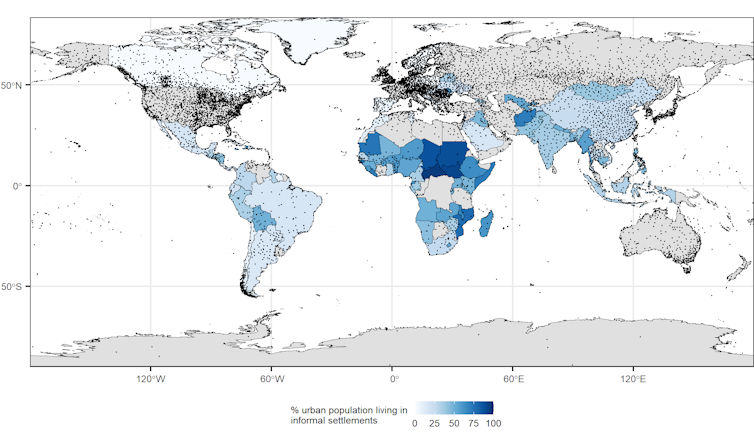
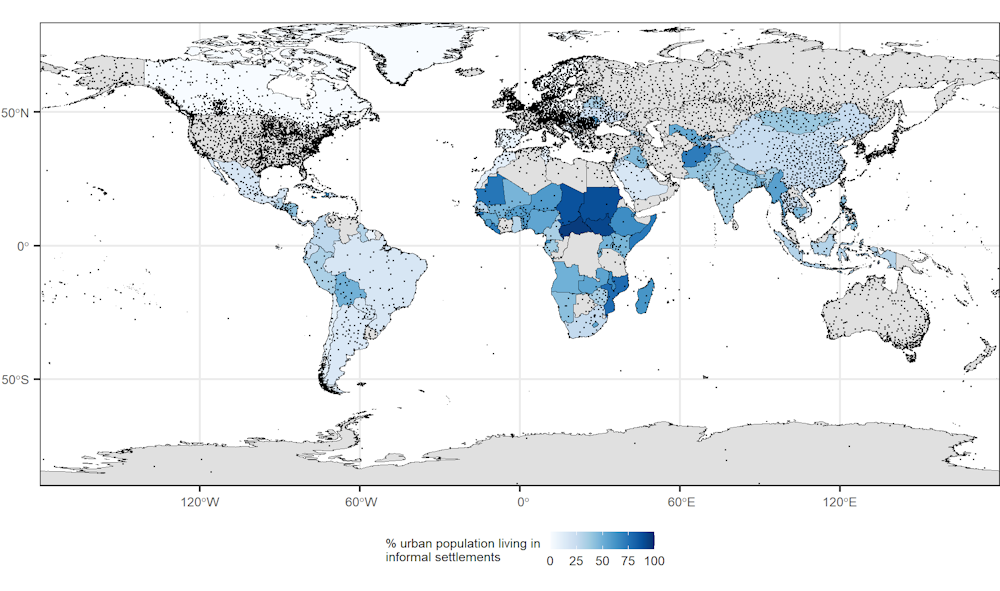
Concentrated across tropical Asia and Africa, informal settlements, commonly known as “slums”, are on the front line of climate exposure. The shortfalls in climate monitoring leave these communities dangerously vulnerable to rising humid heat. With few options to adapt, millions could be forced to seek refuge away from the hottest parts of the tropics.
Read more: Global warming now pushing heat into territory humans cannot tolerate
Why is heat such a threat in these places?
Rapid urbanisation that outpaces planned, formal development is driving the growth of informal settlements. Their residents usually lack infrastructure and services, such as electricity and water supply, that many city dwellers take for granted.
More than 1 billion people live in informal settlements. The United Nations expects this number to grow to 3 billion over the next 30 years. In countries such as Kenya or Bangladesh, nearly half the urban populations lives in informal settlements.
Most informal settlements are located in the tropics. Here it is hot and humid year-round, but their residents have few options to adapt to heat stress.
Most households in these settlements are on low incomes. Many residents must work outdoors for their livelihoods, which exposes them to heat and humidity.
On top of this, because informal settlements fall outside official systems and regulations, we often lack data about the threats they face.
Read more: Urban growth, heat islands, humidity, climate change: the costs multiply in tropical cities
What’s missing from climate data?
Most of the world’s population lives more than 25km from a weather station. This means weather stations rarely capture the full range of temperature and humidity in cities, which are usually hotter than non-urban surrounds – the urban heat island effect. These gaps in monitoring are largest across the tropics where most informal settlements are located.
As individuals we experience heat on a local scale, which isn’t captured by sparse weather station networks or meteorological models. If your home is too hot, a weather report telling you otherwise offers little respite.
Our research compiled local climate monitoring data from informal settlements in seven tropical countries. We compared these data to temperature and humidity measurements at the nearest weather station.
We found weather stations severely underestimate the heat stress that people experience in their homes and local communities. This means global climate assessments and projections also likely underestimate local-scale impacts.
Although these data come from a relatively small number of studies, they highlight a major hurdle for climate adaptation. Without accurate heat stress data, how can we ensure the most vulnerable communities are not left behind?
Read more: Why 40°C is bearable in a desert but lethal in the tropics
Even if they get a heat warning, options are limited
During a heatwave in Australia we are usually told to stay inside and drink lots of water. For residents of an informal settlement, this advice might actually increase their risk of health impacts.
Heat can be even worse indoors in informal housing with poor ventilation and insulation. Very few households have air conditioning (or could afford to run it if they did). Residents might not have access to safe drinking water, adding to the health risks of heat stress.
What’s more, advice and alerts are unlikely even to reach informal settlements. A 2023 World Meteorological Organisation report found only half of the world’s countries have early-warning systems.
These systems are activated if forecast heat is above certain trigger levels. Health advice and alerts to the public can be backed by extra public health measures. Regional climate centres currently issue broad-scale alerts, but forecasts and responses need to operate at smaller scales to be effective.
And, as we have shown, forecasts are based on weather station data that underestimate heat in informal settlements. This means early-warning systems could fail to activate even though residents of these settlements will experience dangerous heat stress.
Read more: Climate explained: will the tropics eventually become uninhabitable?
What can be done to protect people?
Current climate monitoring efforts have left millions of vulnerable people at risk of heat stress. This has direct impacts on individual health and wellbeing, with broader knock-on effects for societies and national economies.
Meteorological institutes in developing countries need urgent support to strengthen climate monitoring and improve early-warning systems. The new head of the World Meteorological Organisation has promised to do just that. We need to ensure governments and agencies, such as development banks and NGOs, capitalise on this opportunity and include informal settlements in new monitoring networks.
Inequalities in resources and adaptive capacities must also be overcome. Community-based initiatives such as urban greening and improved housing show promise to reduce urban heat. Investing in these solutions must be a priority of adaptation efforts.
The alternative to adapting is to move. Climate-related migration is already happening due to sea-level rise and heat, including here in Australia.
People don’t leave their homes and uproot their lives without good reason. Finding solutions that help them adapt to climate change should be the priority.
Read more: 'Climigration': when communities must move because of climate change
Authors: Emma Ramsay, Postdoctoral Research Fellow, Nanyang Technological University, and Research Affiliate, School of Biological Sciences, Monash University


















