The idea of ‘sovereignty’ is central to the Treaty debate – why is it so hard to define?
- Written by Jack Vowles, Professor of Political Science, Te Herenga Waka — Victoria University of Wellington
The coalition government’s approach to Te Tiriti o Waitangi (Treaty of Waitangi) will inevitably set the scene for Waitangi Day next week, with the ACT Party’s Treaty Principles Bill already generating protest and ill will.
But ACT’s initiative, even if ill-conceived, could still open up a widened debate that is long overdue.
The current Treaty “principles” were devised by the Waitangi Tribunal and the courts, and are based on interpretations of both English and Māori texts. ACT’s draft bill would rewrite the principles according to the English text only – or, at best, on a shallow reading of the Māori.
On the other far side of the debate, Māori “decolonialists” would simply abandon the principles, and advocate a return to their interpretation of the Māori text of Te Tiriti.
The decolonialists are correct on two key points: the Māori text is the original text and has the standing in international law; and the principles derived from both texts are problematic.
However, the decolonialists say Māori did not cede sovereignty in Te Tiriti, only the right for the Crown to govern non-Māori. They then revert back to a poorly defined Treaty principle in calling for an “equal partnership” that would constitutionally entrench a Māori parliament deep in the political process.
I argue against such a major constitutional change. If Māori did not explicitly cede sovereignty in 1840, neither did they fully retain it. Sovereignty is already being shared.
Because te Tiriti was between the Crown and iwi and hapū, demands for their greater self-determination can and are being addressed within our current constitution.
Complete government forever
Like ACT’s bill, the decolonial interpretation of Te Tiriti is both shallow and partial. It relies on a narrow legalistic interpretation of the concept of sovereignty, albeit one that is shared by Crown Law and much of the legal establishment.
The alleged lack of cession of sovereignty has been widely recognised by historians and legal experts for many years. Yet the late Hugh Kawharu’s authoritative translation of the key text of Te Tiriti says:
The chiefs […] give absolutely to the Queen of England for ever the complete government over their land.

To a commonsense reader, “complete government for ever” might seem to mean “sovereignty”. However, as Kawhuru pointed out, at the time Māori had no experience or cultural understanding of the concept.
Nonetheless, “complete government” was not without meaning to Māori. Many had knowledge of the government of New South Wales, and some had even visited Britain. Māori accepted the Crown would govern settlers under British law.
Māori also accepted the Crown would “protect” them. In Kawhuru’s translation, that protection was for “the unqualified exercise of their chieftainship over their lands, villages, and treasures”, and over “all ordinary people of New Zealand”, who would have “the same rights and duties of citizenship as the people of England”.
Kawharu also noted that “chieftainship” was based on limited authority and is best understood as “trusteeship”. By implication, then, chieftainship did not mean sovereignty. This idea was simply not in the Māori conceptual toolbox at the time.
An Indigenous people had agreed that an immigrant people could come to their land and be governed, not by Indigenous authorities, but by an immigrant government.
The Indigenous people also agreed that the immigrant government had a duty of protection over them: not just over the authority of their chiefs, but also over the “ordinary people”.
Such protection would require action to prevent tribal warfare and end slavery. It stretches credibility to interpret these agreements as meaning Māori signatories of Te Tiriti retained “absolute sovereignty”.
Read more: Explainer: the significance of the Treaty of Waitangi
Secular sovereignty
Why is interpretation of Te Tiriti so subject to debate? One answer is that we are confused by misunderstanding of the concept of “sovereignty”.
It is a word and idea with big connotations. Traditionally it was drawn from the power of monarchies, the authority of which was said to be derived from God. The Crown was held by a single person.
In Māori terms it has been retrospectively interpreted as “mana”, another concept with big emotional resonance. In 2013, when arguing the Ngāpui claim at the Waitangi Tribunal, Crown Law defined sovereignty as meaning “absolute and undivided power to make law”.
But this legal interpretation is incomplete. Making law is but one part of sovereignty, and not necessarily the most important one.
Secular understanding of the concept of sovereignty emerged after disastrous civil wars in England and France, and devastating wars throughout Europe.
In England, a king was executed and a republic temporarily established. There was much fear, uncertainty and insecurity. Secular sovereignty is rooted in a belief in the need for a government that can preserve peace and order and thus protect its citizens.
That government must also be able to defend its borders and protect against foreign incursion. There can be little doubt Māori ceded those protective aspects of sovereignty to the Crown in 1840.
However, in Article Two of Te Tiriti, Māori retained the continuation of chiefly authority over their peoples.
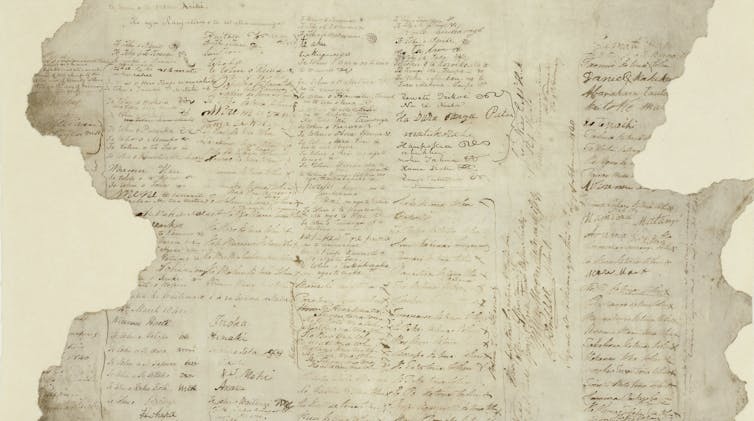
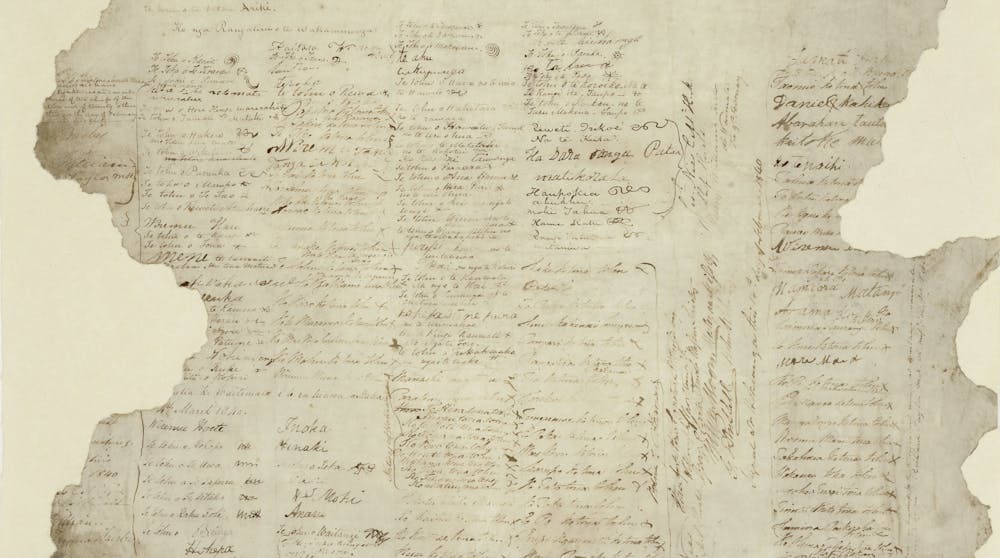 A fragment of Te Tiriti signed at Waitangi in 1840.
Wikimedia Commons
A fragment of Te Tiriti signed at Waitangi in 1840.
Wikimedia Commons
Sovereignty of the people
Some legal historians now argue that at the time of the signing of Te Tiriti in 1840, the British Colonial Office understood British sovereignty to be consistent with a pluralistic recognition of persisting Indigenous political and legal authorities. In other words, sovereignty could be shared.
But an abstract, absolute and undivided legal understanding of sovereignty was soon imposed, and Te Tiriti ignored.
Yet during the 20th century the tide turned. Changes in the meaning of sovereignty under democratic government have recovered its pluralist interpretation. Meanwhile, governments’ protective powers have also grown. They have acquired responsibilities to protect people’s health and welfare in ways few would have anticipated in 1840.
Lawyers continue to describe parliament as sovereign or “supreme” and to speak of “the Crown” as a legal entity. In political terms, the Crown is a useful fiction that sums up a much more complex set of phenomena. It is a symbol of sovereignty, not its reality.
In a democracy, sovereignty is sourced in “the people”. Like everyone else, Māori vote in elections and elect MPs and are therefore part of the Crown: the sovereign people.
The authority of “the people” is transferred to representatives who make decisions for them. Those representatives transfer authority to a cabinet and prime minister. Further authority is transferred into the public service – and beyond it.
The key to understanding sovereignty is simply this: there is no one consistent “particular place” where decisions with the force of sovereignty are always made.
Between elections, parliament may be supreme in terms of lawmaking, but parliament is subject to election every three years. In a democracy the people are the source of sovereignty but delegate its power to others. And the extent of popular sovereignty may be limited in particular ways by constitutions or treaties – like Te Tiriti o Waitangi.
Sovereignty is effective where, at any one place or time, a binding decision is made within an entire system of government. Sovereignty cannot be divided, because such division would inevitably result in conflict that would often fail to be resolved.
However, sovereignty can be passed around and shared. Sovereignty is not only found in a prime minister’s office or in cabinet. Sovereignty is found in many places, at different times: or at the same time in many places, when multiple choices are being made by different actors about various different things.
So long as those choices are recognised as decisive at that time, and on that matter, there is no paralysis or divided authority. Although, of course, they may be challenged later by other arms of government, such as in the courts.
Read more: New Zealand's indigenous reconciliation efforts show having a treaty isn't enough
Te Tiriti and the constitution
Sovereignty is found in the legislation passed by parliament, but also in the way the courts interpret that legislation. It is found in the decisions made by the police to prosecute or not prosecute, and in the ways the police choose to use their powers, because the police are not subject to direct ministerial control.
It is found in the policy and administrative decisions made throughout the machinery of government within the framework of legislation, and in non-governmental organisations that have been delegated to run government programmes.
It is found where any private individual or organisation can use powers made effective by legislation and delegations of authority, such as the ability of a private company to issue a parking fine.
Sovereignty lies behind the ways in which individuals and groups can claim ownership and control of resources, as it is “the Crown” that recognises and protects property rights.
Read more: Learning to live with the 'messy, complicated history' of how Aotearoa New Zealand was colonised
Some claim that elections based on popular sovereignty and majority rule ignore the rights of minorities. But others argue that in a representative democracy minority rule is a bigger problem than majority rule.
Majority votes in elections are modified and constrained by deliberation in parliament, including public submissions that can bring minority concerns to the table, as well as the influential lobbying of special interests.
The interpretation and application of law may be challenged in the courts, where interpretations of Te Tiriti o Waitangi may also be brought to bear.
The institutions of government in Aotearoa New Zealand have evolved since 1840 and in the process have been fundamentally transformed. Because we do not have a formal constitution, our institutions have adapted to changing needs and demands.
If we can more clearly accept, define and clarify its constraints on popular sovereignty, Te Tiriti’s promise that Māori iwi and hapū should govern themselves as much as is possible can be addressed under our existing constitution, and can be accommodated within its liberal democratic principles.
Authors: Jack Vowles, Professor of Political Science, Te Herenga Waka — Victoria University of Wellington