

Australia’s child workers are vulnerable to injury, harassment and exploitation thanks to weak and inconsistent laws
- Written by: Paula McDonald, Professor of Work and Organisation, Queensland University of Technology
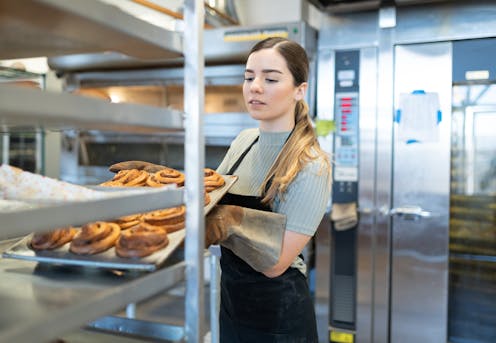
Young workers under 18 years of age occupy a unique and poorly understood position in Australia’s labour market.
They contribute to crucial industries and the economy, but are uniquely vulnerable. Compared to adults, child workers experience high rates of workplace injuries, bullying and sexual harassment, wage theft and unpredictable hours.
In Victoria alone, franchises currently face hundreds of criminal charges over alleged breaches of child employment laws, including shift lengths, break times and employing children after 9pm.
Protective regulations are insufficient and highly inconsistent across states and territories. Compounding this, few resources are directed to agencies responsible for monitoring the safety and quality of children’s work.
Different types of children’s work
In industrialised countries such as Australia, we use the term “children’s work” rather than “child labour”, which refers to work outside international legal frameworks that is harmful to physical or mental health.
Positive workplace experiences can help develop young people’s identities, career aspirations, financial skills and sense of responsibility.

The most visible child workers are employed in cafes, retail stores and fast-food outlets as apprentices or trainees.
Children also often do paid, informal jobs such as babysitting, dog walking or lawn mowing or work in family businesses such as farms and family-owned restaurants. This work is largely unmonitored, and in many states, is exempt from child employment legislation.
Another emerging form of work is content creation, where children and adolescents with large social media followings earn money by posting sponsored content, or feature on a parent-controlled platform.
The work of “kidfluencers” is not protected under Australian law, and there is no oversight of working hours or of content created, despite potential online harassment, abuse and body-shaming.
Children’s participation in elite sport can also be considered work because training can be extreme and young athletes may be subject to commercial contracts similar to professional athletes. There are currently no Australian or international legal provisions related to the duration and intensity of training regimes.
Read more: Australia's cotton farmers can help prevent exploitation in the global garment industry
Finally, children can be self-employed. A child can acquire an ABN on their own behalf from the age of 13. However, a lack of negotiating experience may make them vulnerable to coercion into unfair contracts with brands and talent agencies.
Patterns of work undertaken by children
It is unclear how many children are employed in Australia at any given time.
The Australian Bureau of Statistics (ABS) collects data on employed people aged 15 and over but only reports occupation by the aggregated category of 15-24 years. The last ABS survey on employed children aged 5-14 years was completed almost two decades ago in 2006.
Other Australian surveys estimate labour force status only for people aged 18 to 64, or place limited focus on child employment. Indeed, the International Labour Organisation has lamented the lack of data on child employment in industrialised countries.
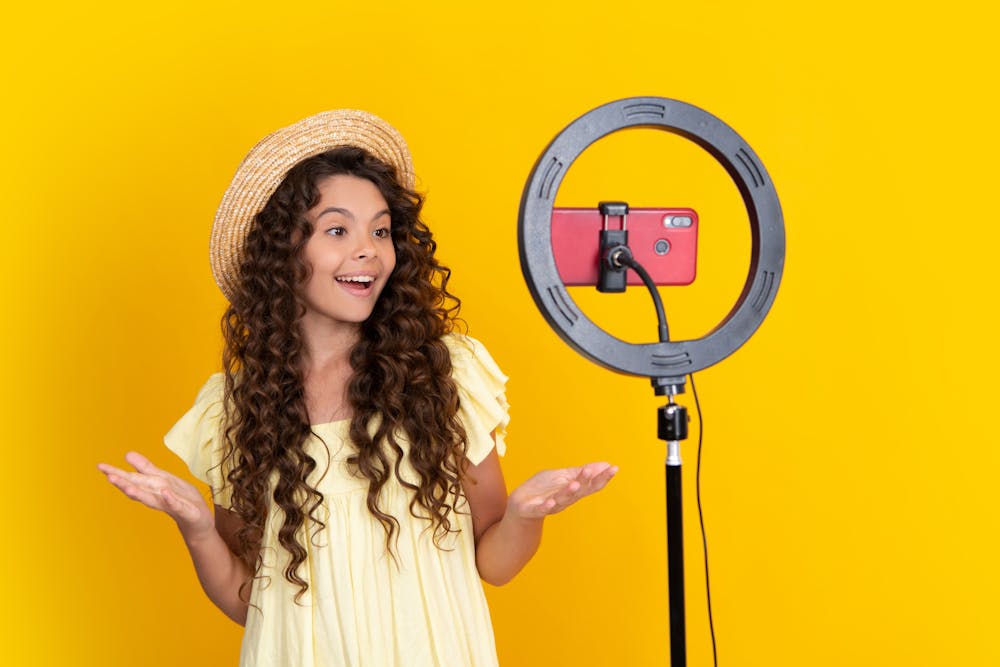 No regulation or oversight puts kidfluencers at risk of online abuse.
Red Fox Studio/Shutterstock
No regulation or oversight puts kidfluencers at risk of online abuse.
Red Fox Studio/Shutterstock
What is clear however, is most young Australians do not transition from education or training to work, but instead, combine part-time work and study, often for many years before reaching adulthood and working full-time.
Research suggests children are more likely to work if they are girls and from English-speaking backgrounds and from higher socioeconomic groups.
This may be explained by the gendered and classed preferences of the service industry which includes positions in fashion, retail and cafes where deferential, well-presented and engaging young employees are preferred.
Although there are some regulations restricting work in hazardous jobs, child workers in cafés and restaurants may still be expected to use dangerous equipment such as knives, hot ovens or deep fryers. Even when young people are aware of their health and safety rights, their capacity to redress violations may be limited.
Children want to work to gain skills and experience, enjoy social contact and earn money for discretionary spending. However, an estimated 10% work out of financial necessity, making vital contributions to low-income households.
Legislation currently protecting working children
In June 2023, Australia signed the International Labour Organization Minimum Age Convention 138, obliging all jurisdictions to protect child rights and presenting a powerful case for strategies to promote positive early work experiences.
However, while Australia’s Fair Work Act contains clauses such as ensuring minimum wages for junior employees, it has an express exemption for children under 18, allowing states and territories to self-regulate.
Other laws relevant to children’s work prevent children being employed during school hours or restrict hazardous work such as scaffolding or crane and forklift operation. There are also restrictions on very young children participating in some forms of public entertainment and measures deterring underpayments.
What changes are needed?
Currently, Australian regulation and policies governing work for minors are not fit for purpose, a problem compounded by children’s limited knowledge of relevant rights and obligations.
There is an urgent need to develop new protections and where possible, make the current patchwork of Australian laws relevant to children’s work more uniform. Particular attention should be given to minimum starting ages, participation in risky occupations, working hours relating to age or schooling, and requirements for employers such as working with children checks.
 Young athletes may be subject to commercial contracts but these are unregulated.
PeopleImages.com/Shutterstock
Young athletes may be subject to commercial contracts but these are unregulated.
PeopleImages.com/Shutterstock
Government and non-government agencies also have a role to protect young workers by setting responsive guidelines, codes and industry standards and implementing strategies to respond to problems.
There is no doubt children in some parts of the world are subjected to dangerous and exploitative practices that would rarely be seen in Australia.
Read more: Climate change contributes to violence against children – here's how
However, our current understanding of the diversity and quality of work experiences of children and adolescents in Australia and other industrialised countries is severely limited by longstanding data deficits. Addressing this problem can establish a platform from which Australia can call on all nations to end hazardous child labour.
The significance and urgency of reforming policy and practice is amplified by profound changes impacting the world of work in which young people participate including the deregulation of trading hours, growth in franchises and work that is increasingly managed via automated technologies.
Child and adolescent labour is integral to the economy, yet their work experiences are complex. Comprehensive reforms will help safeguard the current generation of young workers and ensure a future where their dignity, rights and well-being are respected and protected.
Authors: Paula McDonald, Professor of Work and Organisation, Queensland University of Technology


















