Measles is on the rise around the world – we can’t let vaccination rates falter
- Written by Jaya Dantas, Deputy Chair, Academic Board; Dean International, Faculty of Health Sciences and Professor of International Health, Curtin University
In recent weeks a series of measles alerts have been issued around Australia, including in New South Wales, Victoria and Queensland, after the identification of a small number of cases in travellers returning from overseas.
Meanwhile, places such as the United States and the United Kingdom have been contending with larger measles outbreaks.
In fact, the World Health Organization reported a 45-fold increase in measles cases in Europe last year, with 42,200 cases recorded in 2023 compared to 941 in 2022.
In South Asia, India and Pakistan have also recently reported outbreaks.
So what’s the risk of a larger outbreak in Australia? Fortunately it’s likely to be quite low – but ensuring we continue to have high rates of vaccination coverage is crucial.
Remind me – what is measles?
Measles is a highly infectious viral disease. It spreads through tiny droplets when an infected person coughs or sneezes. Measles is so contagious that if one infected person comes into contact with ten unvaccinated people, they can infect nine of them.
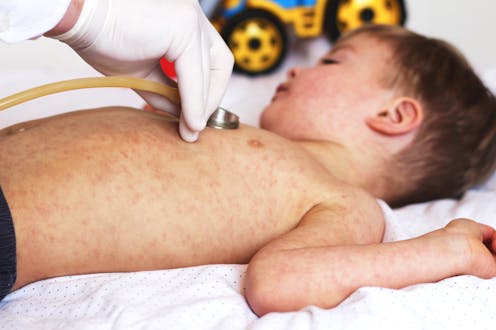
It can take around ten to 12 days for symptoms to appear after a person has been exposed to the virus. Although measles is characterised by a rash, symptoms are generally cold-like to begin with, including a fever, runny nose, fatigue, and sore or red eyes. The rash, which is not itchy, emerges two or three days later and spreads from the face down the body.
Read more: Measles in Samoa: how a small island nation found itself in the grips of an outbreak disaster
Sometimes measles can lead to secondary infections such as an ear infection, diarrhoea or pneumonia. In rare cases measles can cause encephalitis (inflammation of the brain).
In severe cases measles can lead to hospitalisation and death. We saw this in 2019 in the Pacific Island nation of Samoa. Out of 5,667 infections in a four-month period, 81 died, mostly young children.
Vaccination works
Vaccination is the most effective strategy to protect against measles. Two doses of the MMR vaccine (given to children at 12 months and 18 months in Australia) provide protection against measles, mumps and rubella.
Babies under one year have natural protection from their mums that wears off gradually. Infants six to 11 months can be vaccinated if they will be travelling internationally, but will still need to take a further two doses.
Once vaccinated, the chance of getting measles is very low and you are considered protected for life.
However, about one in 100 people who are vaccinated may still contract measles if they’re exposed to the virus. Although it’s not entirely clear why this happens, the infection in a vaccinated person is generally mild.
Vaccination rates are faltering
Globally, there has been a drop in childhood vaccinations over the course of the COVID pandemic. This is likely due to a range of factors including declining trust in vaccines, misinformation and disruptions to access.
In Europe, the proportion of children who received a first dose of the MMR vaccine dropped from 96% in 2019 to 93% in 2022, and from 93% to 91% for the second dose. This is important because about 95% vaccination coverage is needed to achieve herd immunity against measles. Under this scenario, those who are not vaccinated will be protected because the virus won’t spread.
Read more: Measles has been identified in NSW, Qld and SA. 5 things to know about the virus
In the UK, health authorities have expressed alarm at the number of children who have not been vaccinated, with reports up to almost half of children in parts of London have not received both shots.
As of September 2023, the Australian government reported immunisation rates across all childhood vaccinations of 93.26% for one-year-olds, 91.22% for two-year-olds, and 94.04% for five-year-olds. There are slight disparities between different states and territories and among some population groups.
Boosting vaccination coverage
While we appear to be quite close to the herd immunity threshold for measles and not in immediate danger of an outbreak, we still need to be vigilant.
Australia has an excellent outbreak surveillance in place in all states for infectious diseases including measles. But outbreaks are occurring globally, and are liable to take hold when people are unvaccinated or under-vaccinated. So we need to be alert in all states, increase surveillance at international transit points, and continue to increase immunisation coverage, especially among young children. Educating parents and the wider community about the importance of MMR vaccines is key.
It’s never too late to be vaccinated against measles if you missed out as a child, or are unsure if you’ve had two doses. As a single infected traveller can cause an outbreak, vaccination is particularly important if you travel frequently. If you’re unsure of your vaccination status, you can ask your GP or check your own or your children’s record through the Australian Immunisation Register.
If you suspect you or someone in your family is infected it’s important to stay isolated and contact your doctor. They will confirm the infection by referring you for a blood test and possibly a RT-PCR test.
Read more: Why people born between 1966 and 1994 are at greater risk of measles – and what to do about it
The Australian department of health in collaboration with the Australian Academy of Science has developed a set of useful resources on measles which can assist travellers, the general public and health professionals.
Authors: Jaya Dantas, Deputy Chair, Academic Board; Dean International, Faculty of Health Sciences and Professor of International Health, Curtin University