

Two past coup leaders face off in Fiji election as Australia sharpens its focus on Pacific
- Written by: Dominic O'Sullivan, Associate Professor of Political Science, Charles Sturt University
Fiji faces a general election on Wednesday, just as Australia’s main political parties devote more attention to the western Pacific, driven by worries about China’s growing influence in the region.
For most Australians, the nation is a handy holiday destination - closer than Bali or Thailand. Last month, its palm-fringed beaches were in the global spotlight when the Duke and Duchess of Sussex took a trip to the former British colony.
Anyone with a longer memory will perhaps associate Fiji with coups - two in 1987 and one in 2006. There was also a putsch - a civilian overthrow of the government - in 2000.
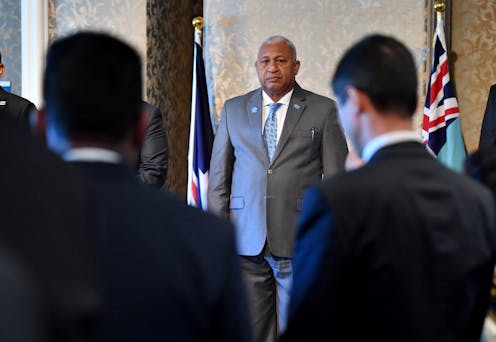
This week’s general election is only the second since Josaia Voreqe Bainimarama, who often goes by the name Frank, appointed himself prime minister after the 2006 coup. He was eventually elected in 2014 and is expected to be re-elected this week.
Read more: Fiji coup leader gets the democratic approval he wanted
For Australia, the strategic importance of the western Pacific is coming into sharp focus.
Prime Minister Scott Morrison has announced $3 billion in infrastructural spending in the region. He has committed the Australian Defence Force to military training in Pacific nations.
Australia has an abiding interest in a south-west Pacific that is secure strategically, stable economically and sovereign politically.
In a speech to the Lowy Institute last month, Bill Shorten committed a future Labor government to an independent foreign policy with a strong Pacific focus. It would support Fiji, Papua New Guinea and Tonga to develop their military capabilities.
Read more: Labor is making big promises for a Pacific development bank, but questions remain
On Fiji, he said:
We want to mend the relationship with the RFMF [Republic of Fiji Military Forces], to ensure that the ADF [Australian Defence Force] is best-placed to develop the Fiji military’s professional capabilities and to ensure Fiji’s security needs.
For Fijian voters, the military is never far from politics.
Bainimarama insists the election will be free and fair . However, the electoral system is unnecessarily complicated. Critics argue this is a deliberate strategy to disenfranchise voters.
However, as he disliked the Constitution put to him by an independent review in 2009, Bainimarama decreed his own in 2013. Section 131 (2) of that Constitution gives ultimate political authority to the military:
It shall be the overall responsibility of the Republic of Fiji Military Forces to ensure at all times the security, defence and well-being of Fiji and all Fijians.
Read more: Fiji's media still struggling to regain ‘free and fair’ space
The military has tended to be the arbiter in national affairs since the first coup in 1987.
As Bainimarama put it before the 2006 coup:
[Prime Minister Laisenia] Qarase is trying to weaken the army by trying to remove me … if he succeeds there will be no one to monitor them, and imagine how corrupt it is going to be.
The coups and the putsch were ostensibly statements of indigenous nationalism - indigenous Fijians asserting their rights over the generally wealthier and better educated descendants of Indian indentured labourers brought to Fiji by British colonial authorities between 1879 and 1916.
However, Fijian politics is vastly more complicated than an indigenous non-indigenous binary. The contentious point, according to Professor Brij V. Lal of the Australian National University’s College of Asia and the Pacific, “is not really about having a Fijian head of government,” but rather which Fijian leader would be acceptable to a particular group of Fijians at any given time".
The prime minister’s main rival clears legal hurdle
Bainimarama’s main opponent is an indigenous former prime minister and coup leader, Sitiveni Rabuka. Bainimarama is also an indigenous Fijian.
Rabuka faced electoral fraud charges that could have seen him declared him ineligible to stand at the election. Rabuka’s acquittal in the Magistrate’s Court was appealed by the Fiji Independent Commission Against Corruption, and dismissed by the High Court only on Monday afternoon. At his campaign launch in 2018, Rabuka ominously remarked:
I am here to do what I can for as long as I ever can for the good of the country.
However, indigenous nationalism and how the right to self-determination might be played out is important. It is interwoven with class, religion and an urban/rural divide to add to the fragility and complexity of Fiji’s conditional democracy.
Just as it did in 2014, Bainimarama’s Fiji First is campaigning on a range of issues including the building of a multiracial society. Practical measures to improve access to education and healthcare are also important to Fiji First.
Land ownership and rental returns are key political issues
Rabuka’s Social Democratic Liberal Party (SODELPA) argues for the restoration of distinctive indigenous voice in public life. It seeks the restoration of the Great Council of Chiefs and of chiefly influence over the distribution of rental incomes.
SODELPA will also begin extensive public consultation on the drafting of a new Constitution.
Ultimately, indigenous prosperity depends on the strength of the national economy. This, in turn, depends on political stability. Contemporary Fiji enjoys neither. While there are signs of improving economic growth, the Fijian people face two obstacles in ensuring that the outcome of Wednesday’s election reflects their collective will.
Firstly, registering to vote then casting a valid and informed vote is difficult. Secondly, as Fiji’s history since 1987 shows, and as the 2013 Constitution confirms, the election’s outcome is ultimately subject to military approval. It may not, then, be in Australia’s best interests to support a stronger Fijian military.
Democratic stability serves Australia’s interests. In Fiji, democracy can be strong only when the military is weak.
Authors: Dominic O'Sullivan, Associate Professor of Political Science, Charles Sturt University


















