how 31 top economists see 2024
- Written by Peter Martin, Visiting Fellow, Crawford School of Public Policy, Australian National University
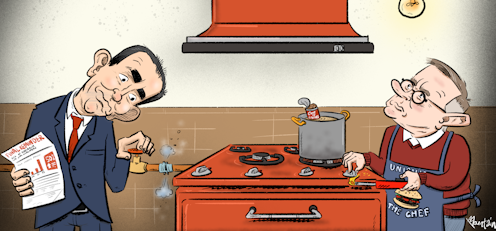
A panel of 31 leading economists assembled by The Conversation sees no cut in interest rates before the middle of this year, and only a slight cut by December, enough to trim just $55 per month off the cost of servicing a $600,000 variable-rate mortgage.
The panel draws on the expertise of leading forecasters at 28 Australian universities, think tanks and financial institutions – among them economic modellers, former Treasury, International Monetary Fund and Reserve Bank officials, and a former member of the Reserve Bank board.
Its forecasts paint a picture of weak economic growth, stagnant consumer spending, and a continuing per-capita recession.
The average forecast is for the Reserve Bank to delay cutting its cash rate, keeping it near its present 4.35% until at least the middle of the year, and then cutting it to 4.2% by December 2024, 3.6% by December 2025 and 3.4% by December 2026.
The gentle descent would deliver only three interest rate cuts by the end of next year, cutting $274 from the monthly cost of servicing a $600,000 mortgage and leaving the cost around $1,100 higher than it was before rates began climbing.
Six of the experts surveyed expect the Reserve Bank to increase rates further in the first half of the year, while 20 expect no change and three expect a cut.
Former head of the NSW treasury Percy Allan said while the Reserve Bank would push up rates in the first half of the year to make sure inflation comes down, it would be forced to relent in the second half of the year as unemployment grows and the economy heads towards recession.
Read more: The 7 new graphs that show inflation falling back to earth
Warwick McKibbin, a former member of the Reserve Bank board, said the board would push up rates once more in the first half of the year as insurance against inflation before leaving them on hold.
Former Reserve Bank of Australia chief economist Luci Ellis, who is now chief economist at Westpac, expects the first cut no sooner than September, believing the board will wait to see clear evidence of further falls in inflation and economic weakening before it moves.
Inflation to keep falling, but more gradually
Today’s Reserve Bank board meeting will consider an inflation rate that has come down faster than it expected, diving from 7.8% to 4.1% in the space of a year.
The newer more experimental monthly measure of inflation was just 3.4% in the year to December, only points away from the Reserve Bank’s target of 2–3%.
But the panel expects the descent to slow from here on, with the standard measure taking the rest of the year to fall from 4.1% to 3.5% and not getting below 3% until late 2025.
Economists Chris Richardson and Saul Eslake say while inflation will keep heading down, the decline might be slowed by supply chain pressures from the conflict in the Middle East and the boost to incomes from the tax cuts due in July.
Slower wage growth, higher unemployment
While the panel expects wages to grow faster than the consumer price index, it expects wages growth to slip from around 4% in 2023 to 3.8% in 2004 and 3.4% in 2025 as higher unemployment blunts workers’ bargaining power.
But the panel doesn’t expect much of an increase in unemployment. It expects the unemployment rate to climb from its present 3.9% (which is almost a long-term low) to 4.3% throughout 2024, and then to stay at about that level through 2025.
All but two of the panel expect the unemployment rate to remain below the range of 5–6% that was typical in the decade before COVID.
Read more: We can and should keep unemployment below 4%, say top economists
Economic modeller Janine Dixon said the “new normal” between 4% and 5% was likely to become permanent as workers embraced flexible arrangements that allow them to stay in jobs in a way they couldn’t before.
Cassandra Winzar, chief economist at the Committee for the Economic Development of Australia, said the government’s commitment to full employment was one of the things likely to keep unemployment low, along with Australia’s demographic transition as older workers leave the workforce.
Slower economic growth, per-capita recession
The panel expects very low economic growth of just 1.7% in 2024, climbing to 2.3% in 2025. Both are well below the 2.75% the treasury believes the economy is capable of.
All but one of the forecasts are for economic growth below the present population growth rate of 2.4%, suggesting that the panel expects population growth to exceed economic growth for the second year running, extending Australia’s so-called per capita recession.
The lacklustre forecasts raise the possibility of what is commonly defined as a “technical recession”, which is two consecutive quarters of negative economic somewhere within a year of mediocre growth.
Taken together, the forecasters assign a 20% probability to such a recession in the next two years, which is lower than in previous surveys.
But some of the individual estimates are high. Percy Allen and Stephen Anthony assign a 75% and 70% chance to such a recession, and Warren Hogan a 50% chance.
Hogan said when the economic growth figures for the present quarter get released, they are likely to show Australia is in such a recession at the moment.
The economy barely grew at all in the September quarter, expanding just 0.2% and was likely to have shrunk in the December quarter and to shrink further in this quarter.
The panel expects the US economy to grow by 2.1% in the year ahead in line with the International Monetary Fund forecast, and China’s economy to grow 5.4%, which is lower than the International Monetary Fund’s forecast.
Weaker spending, weak investment
The panel expects weak real household spending growth of just 1.2% in 2014, supported by an ultra-low household saving ratio of close to zero, down from a recent peak of 19% in September 2021.
Mala Raghavan of The University of Tasmania said previous gains in income, rising asset prices and accumulated savings were being overwhelmed by high inflation and rising interest rates.
Luci Ellis expected the squeeze to continue until tax and interest rate cuts in the second half of the year, accompanied by declining inflation.
The panel expects non-mining investment to grow by only 5.1% in the year ahead, down from 15%, and mining investment to grow by 10.2%, down from 22%.
Johnathan McMenamin from Barrenjoey said private and public investment had been responsible for the lion’s share of economic growth over the past year and was set to plateau and fade as a driver of growth.
Home prices to climb, but more slowly
The panel expects home price growth of 4.6% in Sydney during 2024 (down from 11.4% in 2024) and 3.1% in Melbourne, down from 3.9% in 2024.
ANZ economist Adam Boyton said decade-low building approvals and very strong population growth should keep demand for housing high, outweighing a drag on prices from high interest rates. While high interest rates have been restraining demand, they are likely to ease later in the year.
In other forecasts, the panel expects the Australian dollar to stay below US$0.70, closing the year at US$0.69, it expects the ASX 200 share market index to climb just 3% in 2024 after climbing 7.8% in 2023, and it expects a small budget surplus of A$3.8 billion in 2023-24, followed by a deficit of A$13 billion in 2024-25.
The budget surplus should be supported by a forecast iron ore price of US$114 per tonne in December 2024, down from the present US$130, but well up on the US$105 assumed in the government’s December budget update.
The Conversation’s Economic Panel
Click on economist to see full profile.
Authors: Peter Martin, Visiting Fellow, Crawford School of Public Policy, Australian National University