

There are many good ideas to tackle inequality – it's time we acted on them
- Written by Marianna Brungs, Director, Sydney Peace Foundation, University of Sydney
This is the final article in the Reclaiming the Fair Go series, a collaboration between The Conversation, the Sydney Democracy Network and the Sydney Peace Foundation to mark the awarding of the 2018 Sydney Peace Prize to Nobel laureate and economics professor Joseph Stiglitz. These articles reflect on the crisis caused by economic inequality and how we can break the cycle of power and greed to enable all peoples and the planet to flourish. The Sydney Peace Prize will be presented on November 15 (tickets here).
Forida says that if she were paid a little more money, she could one day send her son to school. She could live happily; her family could live a better life.
Forida, 22, lives in Dhaka, Bangladesh, with her infant son and husband. They live in a dark compound built mostly of tin and wood with six other families and just one toilet. It floods and leaks when it rains, and beside the compound is a polluted pond that attracts mosquitoes.
Forida makes clothes bound for Australia as part of the global fashion industry. She earns about 35 cents (AUD) an hour.
Read more: To tackle inequality, we must start in the labour market
Forida’s story is not rare.
Oxfam did a comparison earlier this year of the salaries of top CEOs of large Australian retail clothing brands and the earnings of the women, like Forida, who work in their supplier factories.
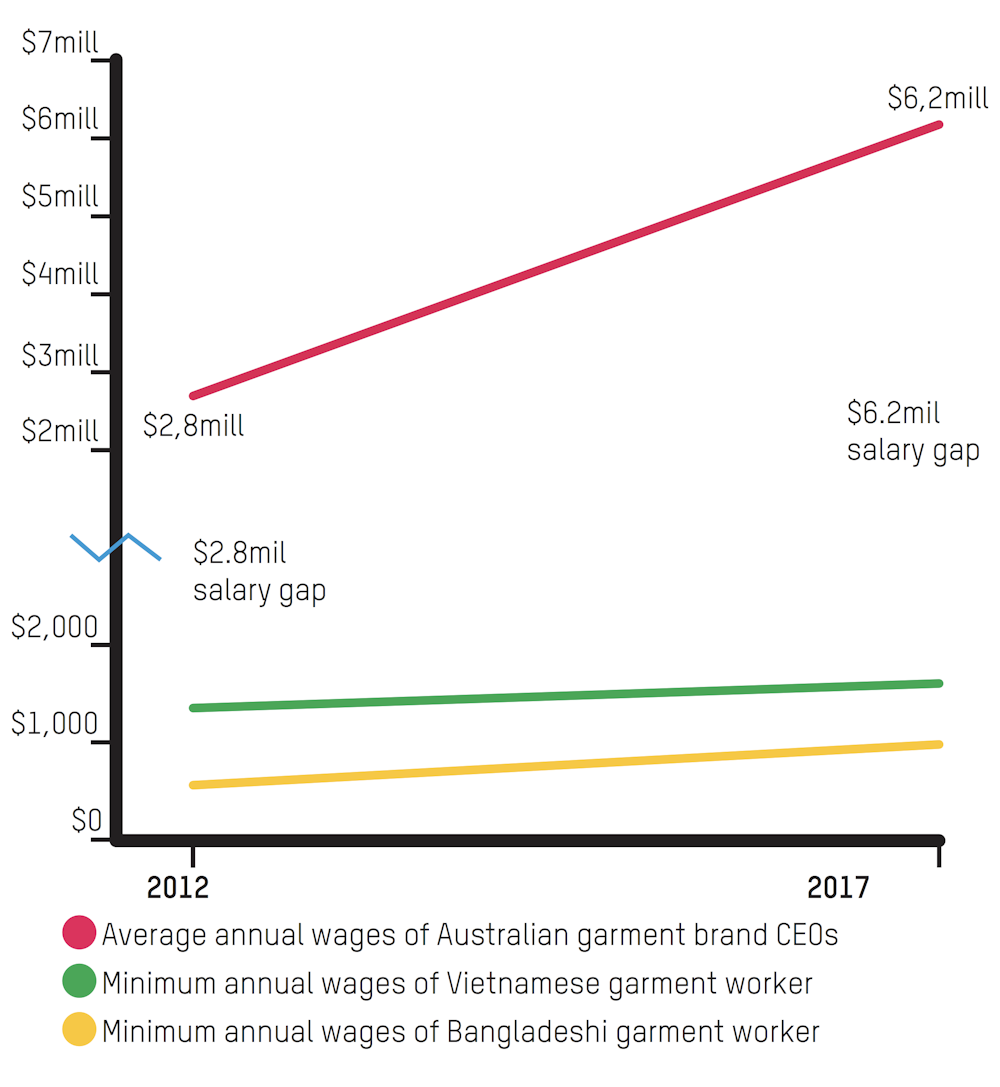 Salary gap between CEOs and garment workers (click to enlarge).
Sources: Annual reports for Wesfarmers, Premier Investments, Woolworths Holdings; Oxfam Australia (2017), What She Makes: Power and Poverty in the Fashion Industry., Author provided
Salary gap between CEOs and garment workers (click to enlarge).
Sources: Annual reports for Wesfarmers, Premier Investments, Woolworths Holdings; Oxfam Australia (2017), What She Makes: Power and Poverty in the Fashion Industry., Author provided
We found that the workers’ wages have increased at a snail’s pace, while the CEOs’ pay has shot up by millions. Annual pay for the workers who make their clothes remains appallingly low.
As a case in point, one CEO in a top fashion company in Australia earns up to $2,500 an hour, including returns from shares and bonuses. A garment worker in Bangladesh like Forida should earn at least the legal minimum wage of A$0.39 an hour. At this rate, garment workers earning the minimum wage in Bangladesh would have to work more than 10,000 years to earn what a highly paid CEO in Australia makes in a year.
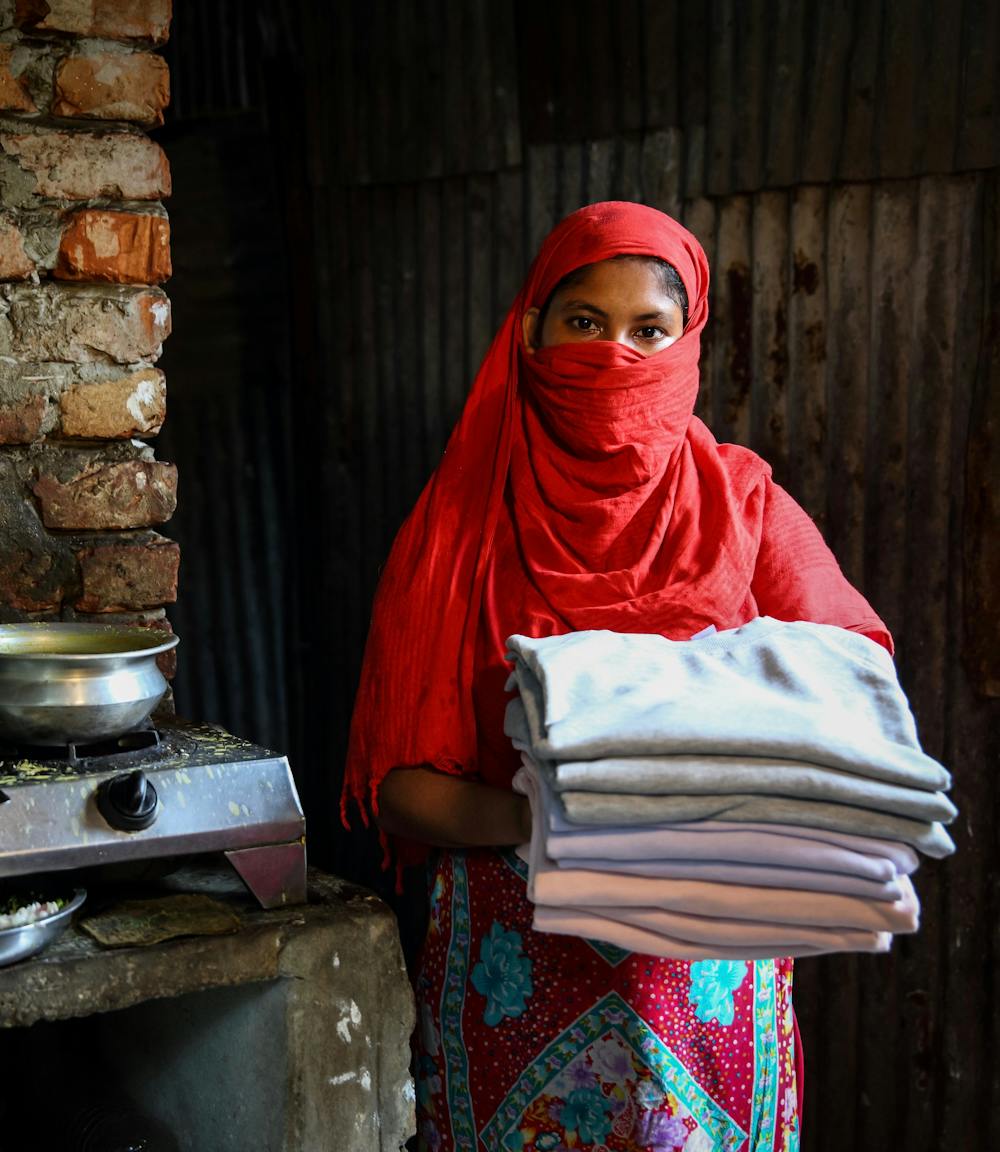 Even after her pay increases, the garments Forida makes will still earn her only about half of what’s needed to live a decent life.
GMB Akash/Panos/OxfamAUS, Author provided
Even after her pay increases, the garments Forida makes will still earn her only about half of what’s needed to live a decent life.
GMB Akash/Panos/OxfamAUS, Author provided
In December, a new minimum wage – just over 60 cents AUD an hour – will apply to garment workers in Bangladesh. But even with this improvement, the women in these factories will still only earn about half of what they need to live a decent life – enough money for adequate housing and food, health and education for their families.
There is perhaps no starker example of global inequality.
Wealthy men – for it is mostly men – are at the top of global supply chains in which a mostly female workforce toils to bring in ever more revenue. The Australian fashion industry alone was worth about A$27 billion in 2016.
So when our leaders flatly deny the notion that inequality is growing – that it is a real and serious problem that demands action – it is hard not to find this perspective jarring.
It’s certainly not the case for the many women and men at the bottom of Australian-owned global supply chains.
Inequality is on the rise in Australia, too
The evidence is strong that inequality is also on the rise in Australia. If you read some accounts of the recent Productivity Commission report on inequality, you’d be forgiven for thinking inequality isn’t a problem Australia needs to tackle.
But that media coverage hasn’t focused on some of the key trends found in the report, which offers a rather more balanced view, as Peter Whiteford has clearly pointed out.
Read more: Don't believe what they say about inequality. Some of us are worse off
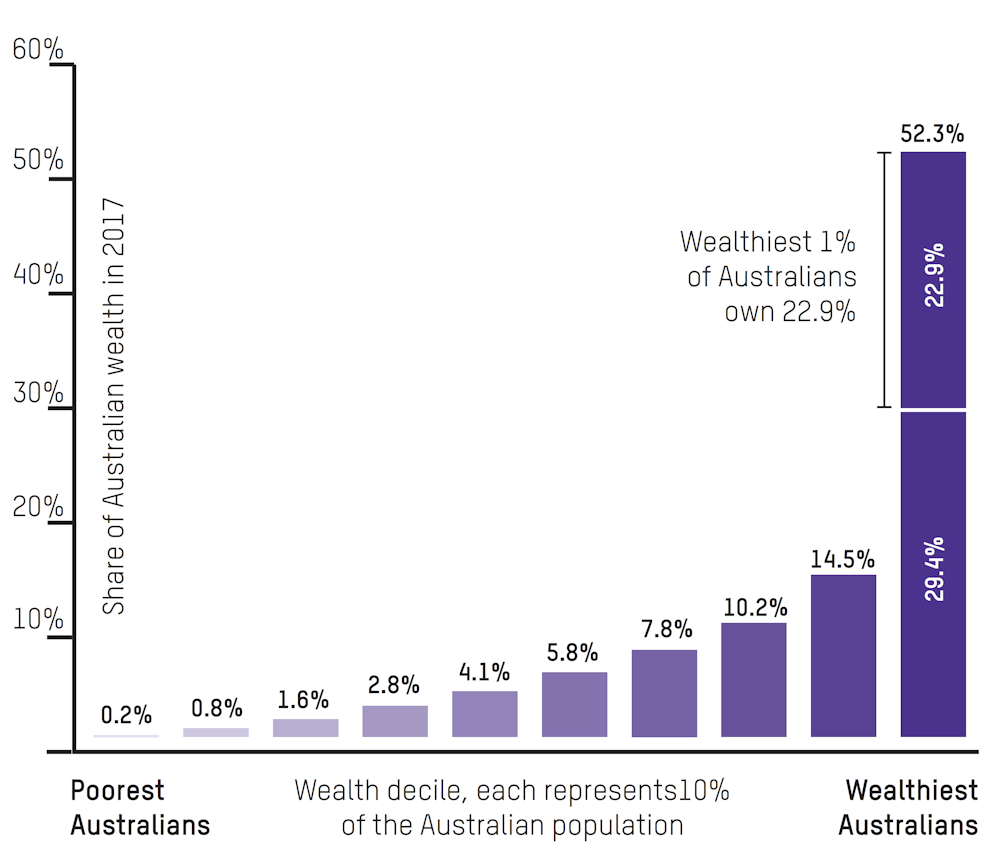 Australian wealth distribution in 2017 (click to enlarge).
Source: Credit Suisse (2017), Global Wealth Report, Author provided
Australian wealth distribution in 2017 (click to enlarge).
Source: Credit Suisse (2017), Global Wealth Report, Author provided
The commission’s report shows, for example, that inequality is a problem for people in lower-income brackets. It explores how generational inequality is entrenched in Australia – while many people move between income brackets over time, the richest and the poorest Australians don’t do this nearly as much. Poorer Australians are more likely to stay trapped in the bottom bracket while, at the top, wealth begets wealth.
And, as Gary Barrett and Stephen Whelan have shown in the first article in this series, income inequality remains a problem in Australia. So does wealth inequality. Today the wealthiest 1% of Australians own more than the poorest 70% combined.
Read more: The fair go is a fading dream, but don't write it off
The ACOSS Poverty in Australia 2018 report includes data showing that one in eight adults and more than one in six children are living in poverty today.
At the same time, at the global level, organisations like the International Monetary Fund (IMF) have been having an entirely different discussion: they know inequality is continuing to increase. Instead of arguing the reality, they’ve invested in researching and discussing solutions. And, while its own loan program still requires some change to be better aligned with fighting inequality, over the past few years, the IMF and others have been calling on governments to act.
The IMF warns that the increase in excessive inequality in most countries in the last 30 years is detrimental to growth, but it is not inevitable.Read more: How rising inequality is stalling economies by crippling demand
Inequality worsens poverty and marginalisation – especially for those who already have less power than others. What Oxfam has seen around the globe is that rising inequality disproportionately impacts women, people of colour, Indigenous people, people with disabilities and LGBTIQ communities – and others who already face challenges when it comes to access to power.
Forida is one of millions of women who are trapped in poverty. They fuel a global economy that lines others’ pockets while they are unable to escape hardship, no matter how hard or how long they work.
That Forida’s home lacks facilities like safe, internal running water and is built beside a polluted pond is linked to this global challenge of rising inequality. Governments in developing countries like Bangladesh are being starved of funds. Of course, these governments also need to make the right choices and invest in health, education and infrastructure – essential things their communities need.
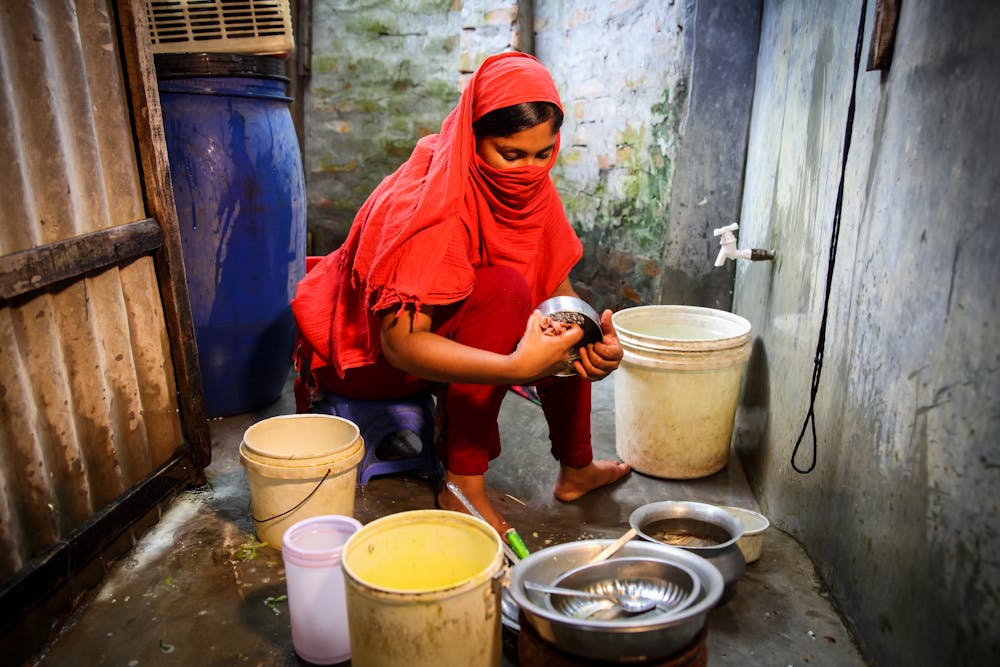 Forida’s home lacks facilities like safe, internal running water.
GMB Akash/Panos/OxfamAUS, Author provided
Forida’s home lacks facilities like safe, internal running water.
GMB Akash/Panos/OxfamAUS, Author provided
At the same time, the global estimate of the money ripped out of poor countries due to the tax-avoiding practices of wealthy firms sits at more than US$170 billion a year.
This huge amount should rightfully be used to invest in safe water and sound infrastructure for women like Forida in developing countries around the world. These women bear the burden of the lack of investment. Forida looks after her family when they are sick from water-borne diseases and only eats watery rice so her son may eat better when they run out of money at the end of each month.
We must challenge the policies and practices that are fuelling inequality, or women like Forida will continue to be left behind.
We know how to reduce inequality
Engage with the ideas to tackle inequality: there are many. And they are good. Organisations at the forefront of combating inequality, both in Australia and globally, have proposed a whole range of powerful solutions. It is time the government listens and engages.
In Australia, the campaign to raise the rate of Newstart, led by ACOSS, is gaining steam. It has the support of both former Prime Minister John Howard and the Business Council of Australia.
The Close the Gap campaign, which Oxfam helped to launch over 10 years ago, has taken stock in 2018 and produced a range of recommendations for the government to close the Indigenous health gap. And a thorough, national consultation process has culminated in the Uluru Statement from the Heart and the legitimate call for an Indigenous voice to parliament.
Unions, NGOs and Australians from all walks of life are concerned about flat-lining wages. They want to see cuts to penalty rates reversed – along with a raft of other changes to our industrial system to make it fairer. The union movement’s Change the Rules campaign makes these calls resoundingly clear.
Read more: Why are unions so unhappy? An economic explanation of the Change the Rules campaign
On a global level, Oxfam and civil society organisations have been calling on governments to act not only on rising inequality within their borders but also to help tackle it around the globe.
This means comprehensive action on business supply chains that skirt human rights – which includes paying poverty wages to women like Forida – through national action plans on business and human rights. It also means acting to ensure the tax affairs of large businesses are public – right across the globe – to help stop money being hidden in tax havens and ripped out of both Australia and the developing countries that need this revenue.
The ideas being put forward from across Australia are legitimate. They deserve greater attention. It is time for our dialogue to be about action, rather than arguing whether inequality is a problem at all.
This article was co-authored by Helen Szoke, chief executive of Oxfam Australia.
Authors: Marianna Brungs, Director, Sydney Peace Foundation, University of Sydney

















