A 380-million-year old predatory fish from Central Australia is finally named after decades of digging
- Written by Brian Choo, Postdoctoral fellow in vertebrate palaeontology, Flinders University
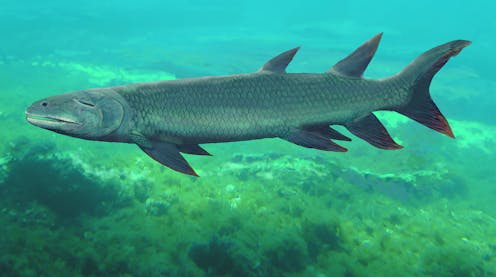
More than 380 million years ago, a sleek, air-breathing predatory fish patrolled the rivers of central Australia. Today, the sediments of those rivers are outcrops of red sandstone in the remote outback.
Our new paper, published in the Journal of Vertebrate Paleontology, describes the fossils of this fish, which we have named Harajicadectes zhumini.
Known from at least 17 fossil specimens, Harajicadectes is the first reasonably complete bony fish found from Devonian rocks in central Australia. It has also proven to be a most unusual animal.
Meet the biter
The name means “Min Zhu’s Harajica-biter”, after the location where its fossils were found, its presumed predatory habits, and in honour of eminent Chinese palaeontologist Min Zhu, who has made many contributions to early vertebrate research.
Harajicadectes was a fish in the Tetrapodomorpha group. This group had strongly built paired fins and usually only a single pair of external nostrils.
Tetrapodomorph fish from the Devonian period (359–419 million years ago) have long been of great interest to science. They include the forerunners of modern tetrapods – animals with backbones and limbs such as amphibians, reptiles, birds and mammals.
For example, recent fossil discoveries show fingers and toes arose in this group.
Read more: When fish gave us the finger: this ancient four-limbed fish reveals the origins of the human hand
Devonian fossil sites in northwestern and eastern Australia have produced many spectacular discoveries of early tetrapodomorphs.
But until our discovery, the poorly sampled interior of the continent had only offered tantalising fossil fragments.
A long road to discovery
Our species description is the culmination of 50 years of tireless exploration and research.
Palaeontologist Gavin Young from the Australian National University made the initial discoveries in 1973 while exploring the Middle-Late Devonian Harajica Sandstone on Luritja/Arrernte country, more than 150 kilometres west of Alice Springs (Mparntwe).
Packed within red sandstone blocks on a remote hilltop were hundreds of fossil fishes. The vast majority of them were small Bothriolepis – a type of widespread prehistoric fish known as a placoderm, covered in box-like armour.
Scattered among them were fragments of other fishes. These included a lungfish known as Harajicadipterus youngi, named in honour of Gavin Young and his years of work on material from Harajica.
There were also spines from acanthodians (small, vaguely shark-like fish), the plates of phyllolepids (extremely flat placoderms) and, most intriguingly, jaw fragments of a previously unknown tetrapodomorph.
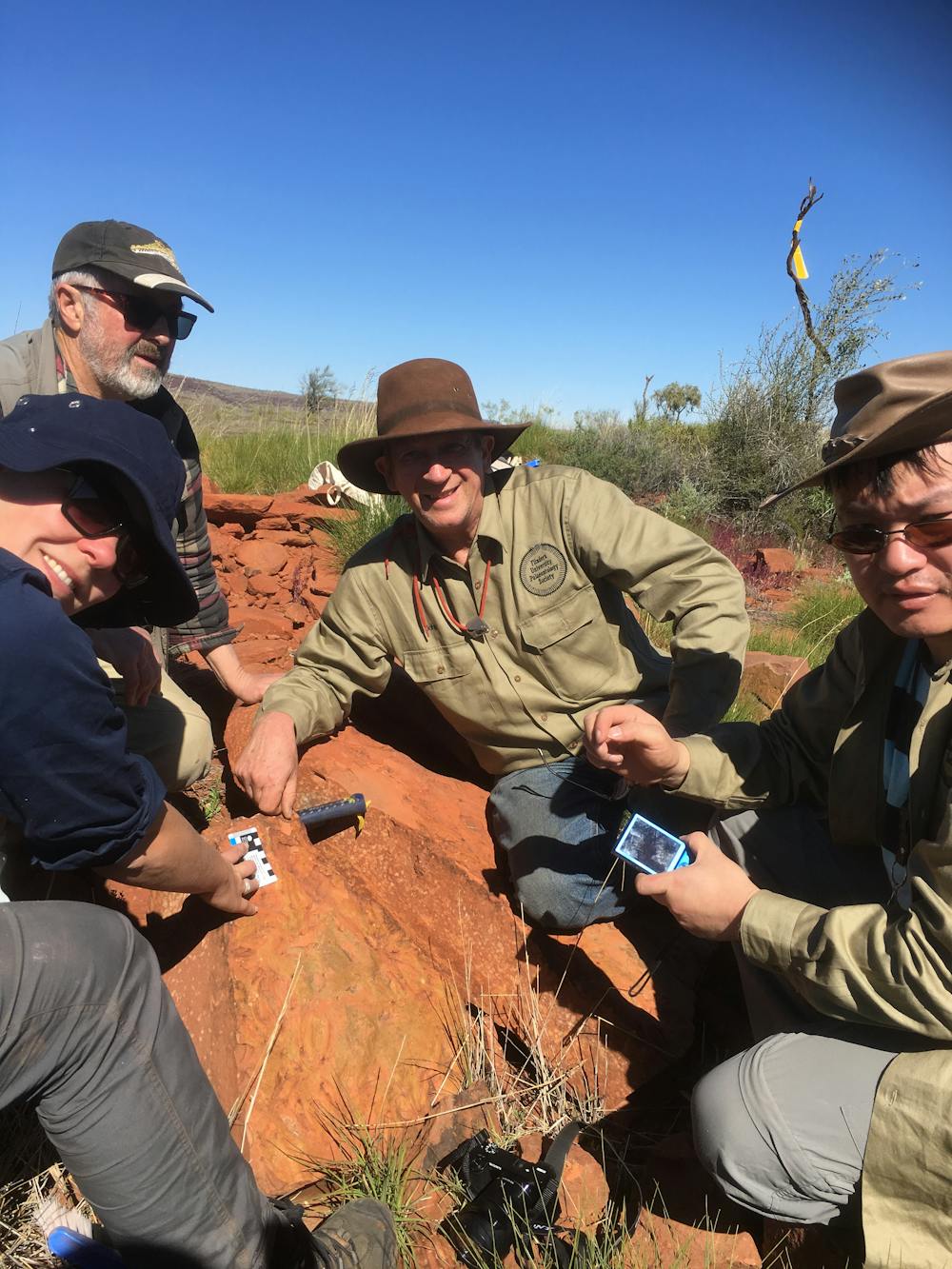
Many more partial specimens of this Harajica tetrapodomorph were collected in 1991, including some by the late palaeontologist Alex Ritchie.
There were early attempts at figuring out the species, but this proved troublesome. Then, our Flinders University expedition to the site in 2016 yielded the first almost complete fossil of this animal.
This beautiful specimen demonstrated that all the isolated bits and pieces collected over the years belonged to a single new type of fish. It is now in the collections of the Museum and Art Gallery of the Northern Territory, serving as the type specimen of Harajicadectes.
 The type specimen of Harajicadectes discovered in 2016.
Author provided
The type specimen of Harajicadectes discovered in 2016.
Author provided
A strange apex predator
Up to 40 centimetres long, Harajicadectes is the biggest fish found in the Harajica rocks. Likely the top predator of those ancient rivers, its big mouth was lined with closely-packed sharp teeth alongside larger, widely spaced triangular fangs.
It seems to have combined anatomical traits from different tetrapodomorph lineages via convergent evolution (when different creatures evolve similar features independently). An example of this are the patterns of bones in its skull and scales. Exactly where it sits among its closest relatives is difficult to resolve.
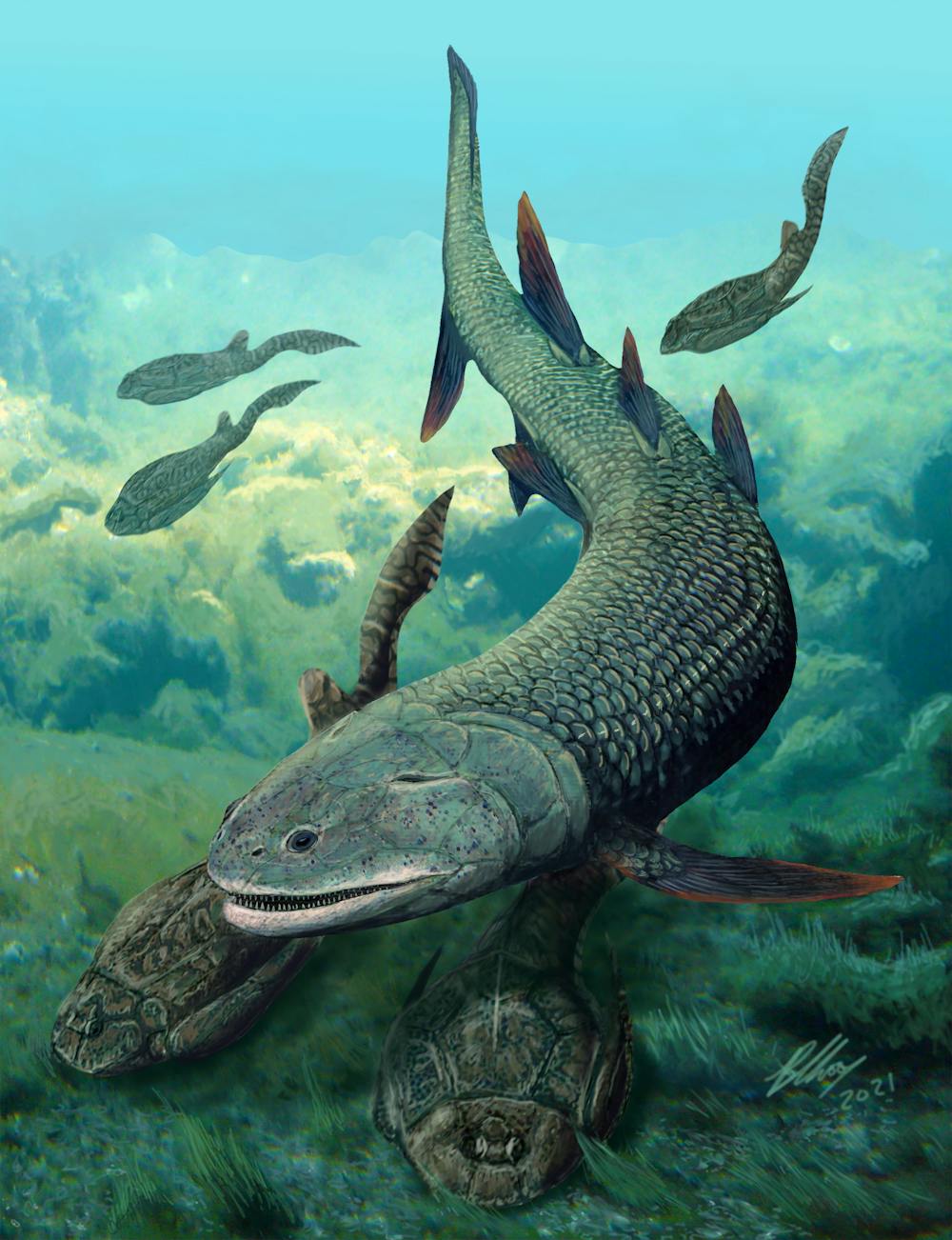 Artist’s reconstruction of Harajicadectes menacing a pair of armoured Bothriolepis.
Artist: Brian Choo
Artist’s reconstruction of Harajicadectes menacing a pair of armoured Bothriolepis.
Artist: Brian Choo
The most striking and perhaps most important features are the two huge openings on the top of the skull called spiracles. These typically only appear as minute slits in most early bony fishes.
Similar giant spiracles also appear in Gogonasus, a marine tetrapodomorph from the famous Late Devonian Gogo Formation of Western Australia. (It doesn’t appear to be an immediate relative of Harajicadectes.)
They are also seen in the unrelated Pickeringius, an early ray-finned fish that was also at Gogo.
The earliest air-breathers?
Other Devonian animals that sported such spiracles were the famous elpistostegalians – freshwater tetrapodomorphs from the Northern Hemisphere such as Elpistostege and Tiktaalik.
These animals were extremely close to the ancestry of limbed vertebrates. So, enlarged spiracles seem to have arisen independently in at least four separate lineages of Devonian fishes.
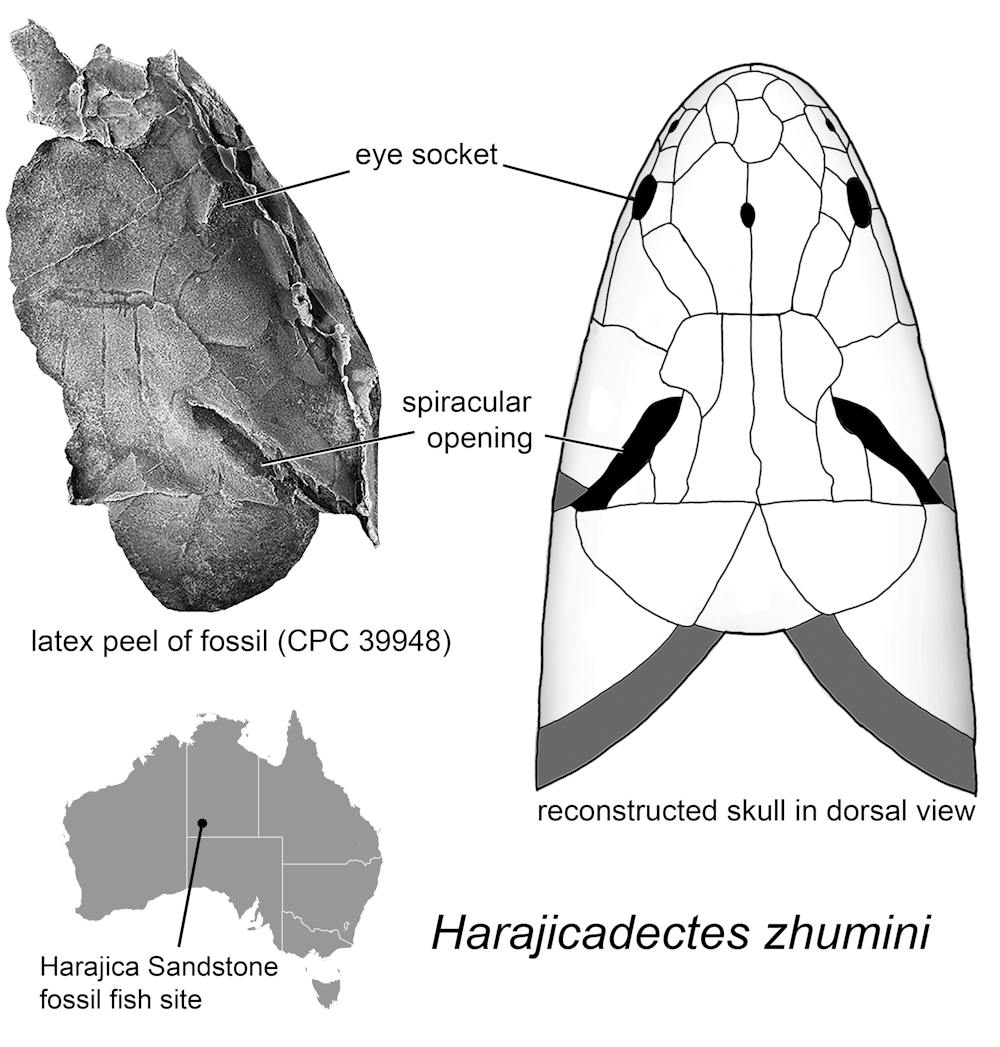 The skull of Harajicadectes seen from above, showing the enormous spiracles.
Author provided
The skull of Harajicadectes seen from above, showing the enormous spiracles.
Author provided
The only living fishes with similar structures are bichirs, African ray-finned fishes that live in shallow floodplains and estuaries. It was recently confirmed they draw surface air through their spiracles to aid survival in oxygen-poor waters.
That these structures appeared roughly simultaneously in four Devonian lineages provides a fossil “signal” for scientists attempting to reconstruct atmospheric conditions in the distant past.
It could help us uncover the evolution of air breathing in backboned animals.
Authors: Brian Choo, Postdoctoral fellow in vertebrate palaeontology, Flinders University