

Permaculture showed us how to farm the land more gently. Can we do the same as we farm the sea?
- Written by: Scott Spillias, Postdoctoral Research Fellow, CSIRO
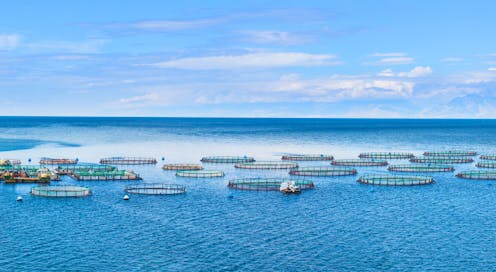
As wild fish and other marine species get scarcer from overfishing and demand for ‘blue foods’ grows around the world, farming of the ocean is growing rapidly. Fish, kelp, prawns, oysters and more are now widely farmed. The world now eats more farmed seafood than wild-caught.
These farms are springing up along coasts and in offshore waters worldwide. Australians will be familiar with Tasmania’s salmon industry, New South Wales’ oyster farms, and seaweed farms along the southern coastline. Aquaculture is already larger than fishing in Australia. Farming the sea is hailed as a vital source of food and biomass essential to reduce the damage we do to our oceans and help feed a growing population.
But the booming “blue economy” is no panacea. Fish farms can pollute the water. Mangroves are often felled to make way for prawn farms. The solutions of today could turn out to be problems of the future. We cannot simply shift from one form of environmental exploitation to another.
There is an alternative: permaculture. This approach has proven itself on land as a way to blend farming with healthy ecosystems. What if it could do the same on water?
Read more: Farming fish in fresh water is more affordable and sustainable than in the ocean
Making aquaculture better
Many of today’s most pressing problems – from climate change to biodiversity loss to pollution – are linked to the way we produce food on land. To make new farmland often involves removing habitat, destroying trees and adding synthetic fertilisers and pesticides.
Since humans began farming about 12,000 years ago, we have expanded to the point where we now actively control about 70% of Earth’s ice-free land to make food, build cities, and many other uses.
On land, we are farmers, tending domesticated species. But at sea, we’ve been hunters, seeking wild populations. Now, the seas are to be farmed. We should farm in ways which do not damage these ecosystems.
We cannot afford to use the same intensive methods of farming in the oceans as we have been on land. Given how sick many of the world’s ocean systems are already from overfishing, algal blooms from nutrient overload, and habitat loss, there’s not much room for error.

What is marine permaculture?
Permaculture as we know it was developed in the 1960s by Australians Bill Mollison and David Holmgren. The latter is a co-author of the research forming the basis of this article.
The goal was simple: create ways of farming which give back to the soil and ecosystems, using tools like no-till farming, companion planting and food forests. Over the last 50 years, it has been adopted by farmers around the world.
Permaculture is framed around three ethics – care of Earth, care of people, and a fair share – aimed at producing benefits and distributing costs equitably between different people and nature.
Read more: Let them eat carp: Fish farms are helping to fight hunger
So what would permaculture of the seas look like? While it hasn’t been fully articulated, many recent developments in ocean production and governance have strong parallels with the work permaculture practitioners have been doing for decades.
Aquaculture systems can, many now believe, not only be low-impact but work to restore lost or damaged ecosystems. Picture oyster farms slowly bringing back the natural oyster reefs which once carpeted shallow coastal waters, or prawn farms surrounded by regrowing mangroves to protect the coast from erosion.
There are strong parallels between the closed-loop approach taken by permaculture on land and an emerging sea farming approach called integrated multi-trophic aquaculture. Here, species with different ecological roles are grown together, producing more food from your farm – and strengthening natural ecosystem services.
In these systems, food waste from consumers is recycled by seaweeds and shellfish, which in turn provide food and habitat to farmed fish species. If well-designed, these benefits flow out from the farm.
Permaculture’s influence is also evident in nature-inspired design and biomimicry, using natural shapes to give nature a boost. Australian work here includes efforts to restore rocky reefs by creating structures with the nooks and crannies small sea creatures need.
 Fish farming is becoming big business. But that comes with risks.
Marius Dobilas/Shutterstock
From the grassroots
At present, a handful of corporations have disproportionately high levels of control over fisheries and aquaculture. In part, that’s because supertrawlers, motherships, and large blue-water fish farms are expensive.
If we instead took a marine permaculture approach to the blue economy, we would seek to return power back to the people who live and work at the water’s edge – a permaculture equivalent to artisanal fishing.
A localised approach to aquaculture has real benefit. Individuals and communities could develop their own versions of marine permaculture which work in their area, by adopting design solutions used elsewhere or just by tinkering and trialing.
If something isn’t working or it’s creating flow-on consequences, people can see what’s happening and respond quickly.
Small-scale sea farms are less likely to do damage, and should also boost resilience by investing in local social and environmental benefits.
How do we make this a reality?
For their part, governments can help by creating policy frameworks encouraging small-scale producers – especially those able to demonstrate positive social and ecological outcomes.
Governments have an essential role in creating comprehensive spatial plans to guide aquaculture in an area or region. This is important, as it removes uncertainty and avoids conflict between different uses.
Researchers can help by developing measures of success and testing new techniques to help guide the new communities which will form to farm the sea.
Over the past half-century, permaculture on land has grown into a diverse movement challenging conventional wisdom about how to produce food.
We’ll need that same intense creative energy to make marine permaculture a reality. It’s entirely possible to design food-producing seascapes which give back to the sea as well as take from it – while making it possible for smaller sea farmers to flourish.
Read more: A revolution disguised as organic gardening: in memory of Bill Mollison
Climate Foundation CEO Brian von Herzen and permaculture pioneer David Holmgren contributed to the research this article is based on.
Authors: Scott Spillias, Postdoctoral Research Fellow, CSIRO


















