
the dark psychological insight of Martin Amis’s Holocaust novel is lost in the film adaptation
- Written by Paul Giles, Professor of English, Institute for Humanities and Social Sciences, ACU, Australian Catholic University
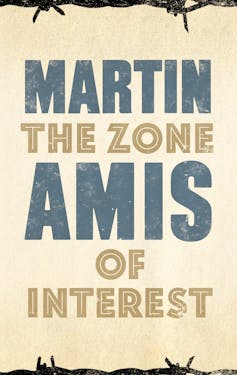
Martin Amis, who died last year, was always very concerned about his future place in the literary canon. He said that, since the “truth” about writers is only revealed 50 years after their death, they “feel the honour of being judged by something that is never wrong: time”.
Jonathan Glazer’s new film The Zone of Interest is based on Amis’s 2014 novel of the same name. It will undoubtedly revive general interest in the author’s work. But in truth Glazer’s film has very little in common with Amis’s original novel.

 Richard Baer, Josef Mengele and Rudolf Höss, Auschwitz (1944).
Public domain, via Wikimedia Commons
Amis put a lot of scholarly effort into ensuring factual accuracy for his novel, as the acknowledgments in his book amply testify. But his particular contribution was to get under the skin of history, as it were, and to recover the imaginative landscape that licensed such horrors.
In this sense, it is crucial for the novel that Paul Doll is presented as a vicious type and not just a specific Nazi commander. Though he is a caricature with recognisable affinities with other thuggish characters in Amis’s novels, he inhabits a post-human world where violence has become unsettlingly normalised.
Thomsen comments several times in the novel on the “tuxedoed appearance” of the black and white cat Maksik, who delights in tormenting and devouring mice. This overlap between human and animal is characteristic of Amis’s radically dehumanised environment. It is a world in which human beings are dissected and reduced to the “natural wastage” of their body parts, literally but also metaphorically.
This is not, of course, to suggest that Amis’s novel lacks a clear ethical perspective. He mentions in his acknowledgments the “moral solidity” of his position on the Holocaust. But he also says that his priority was to investigate closely “the moods and textures of daily life in the Third Reich”.
Rather than just an expression of horror, Amis’s novel probes how such “disgusting” practices could have entered into the realms of human consciousness.
Richard Baer, Josef Mengele and Rudolf Höss, Auschwitz (1944).
Public domain, via Wikimedia Commons
Amis put a lot of scholarly effort into ensuring factual accuracy for his novel, as the acknowledgments in his book amply testify. But his particular contribution was to get under the skin of history, as it were, and to recover the imaginative landscape that licensed such horrors.
In this sense, it is crucial for the novel that Paul Doll is presented as a vicious type and not just a specific Nazi commander. Though he is a caricature with recognisable affinities with other thuggish characters in Amis’s novels, he inhabits a post-human world where violence has become unsettlingly normalised.
Thomsen comments several times in the novel on the “tuxedoed appearance” of the black and white cat Maksik, who delights in tormenting and devouring mice. This overlap between human and animal is characteristic of Amis’s radically dehumanised environment. It is a world in which human beings are dissected and reduced to the “natural wastage” of their body parts, literally but also metaphorically.
This is not, of course, to suggest that Amis’s novel lacks a clear ethical perspective. He mentions in his acknowledgments the “moral solidity” of his position on the Holocaust. But he also says that his priority was to investigate closely “the moods and textures of daily life in the Third Reich”.
Rather than just an expression of horror, Amis’s novel probes how such “disgusting” practices could have entered into the realms of human consciousness.
 Sandra Hüller as Hedwig Höss in a scene from The Zone of Interest, directed by Jonathan Glazer.
A24, via AAP
Read more:
Moral ambiguity and the representation of genocide – is there a limit to what can be depicted?
Cloacal dreams
There are several references in The Zone of Interest (and other Amis novels) to the Irish satirist Jonathan Swift (1667-1745), a famously scatological writer. Doll’s “cloacal dreams” highlight what Time’s Arrow calls the “fiercely corpocentric” universe of Auschwitz: one that is “made of shit”.
This immersion in filth has parallels with the work of great American writers whom Amis admired inordinately. These included Saul Bellow, whose novel The Adventures of Augie March (1953) obliquely embraced the violence of Chicago gangsters, and the Russian expatriate Vladimir Nabokov, whose Lolita (1955) entered the criminal imagination of a paedophile.
Both Bellow and Nabokov preserved a strong ethical and political compass, but the power of their fiction emerged from a willingness to confront a chaotic and disturbing world. Amis’s fascination with Donald Trump during the latter part of his career showed again his interest in exploring how darker lusts for power become a compelling force, even within more mundane and supposedly civilised societies.
Amis’s memoir Experience (2000) recalls how his cousin was killed by serial murderer Frederick West. It also discusses the process through which powerful creative writing “comes from the back of your mind, where thoughts are unformulated”, rather than the front.
Amis always took issue with the more polite tradition of the liberal-humanist novel, because he suggested people often do not behave for good reasons. He described himself as working within a looser form of comedy, where “laughter in the dark”, as Nabokov put it, becomes integral to the work of art.
When The Zone of Interest was first published, Amis said it was not well received in Germany because Germans “make an absolute division between what is comic and what is serious, and no interpenetration between the two”.
Yet his earlier Nazi novel Time’s Arrow was welcomed by the Simon Wiesenthal Center in Los Angeles, which regarded the book as a serious imaginative treatment of the Holocaust. It was only English critics, Amis claimed, who accused him of trivialising the subject.
Sandra Hüller as Hedwig Höss in a scene from The Zone of Interest, directed by Jonathan Glazer.
A24, via AAP
Read more:
Moral ambiguity and the representation of genocide – is there a limit to what can be depicted?
Cloacal dreams
There are several references in The Zone of Interest (and other Amis novels) to the Irish satirist Jonathan Swift (1667-1745), a famously scatological writer. Doll’s “cloacal dreams” highlight what Time’s Arrow calls the “fiercely corpocentric” universe of Auschwitz: one that is “made of shit”.
This immersion in filth has parallels with the work of great American writers whom Amis admired inordinately. These included Saul Bellow, whose novel The Adventures of Augie March (1953) obliquely embraced the violence of Chicago gangsters, and the Russian expatriate Vladimir Nabokov, whose Lolita (1955) entered the criminal imagination of a paedophile.
Both Bellow and Nabokov preserved a strong ethical and political compass, but the power of their fiction emerged from a willingness to confront a chaotic and disturbing world. Amis’s fascination with Donald Trump during the latter part of his career showed again his interest in exploring how darker lusts for power become a compelling force, even within more mundane and supposedly civilised societies.
Amis’s memoir Experience (2000) recalls how his cousin was killed by serial murderer Frederick West. It also discusses the process through which powerful creative writing “comes from the back of your mind, where thoughts are unformulated”, rather than the front.
Amis always took issue with the more polite tradition of the liberal-humanist novel, because he suggested people often do not behave for good reasons. He described himself as working within a looser form of comedy, where “laughter in the dark”, as Nabokov put it, becomes integral to the work of art.
When The Zone of Interest was first published, Amis said it was not well received in Germany because Germans “make an absolute division between what is comic and what is serious, and no interpenetration between the two”.
Yet his earlier Nazi novel Time’s Arrow was welcomed by the Simon Wiesenthal Center in Los Angeles, which regarded the book as a serious imaginative treatment of the Holocaust. It was only English critics, Amis claimed, who accused him of trivialising the subject.
 Jonathan Glazer at a press conference for The Zone Of Interest, Cannes Film Festival, 20 May 2023.
Pascal Le Segretain/POOL, via AAP.
Read more:
Lolita: why this 'vivid, illicit' portrait of a pervert matters at a time of endless commodification of young girls
The Martian school
The Zone of Interest, like other Amis novels, is organised around voice rather than plot. In this case, there are three distinctive voices allowing access to the characters’ inner worlds. This is entirely different from the aesthetic of Glazer’s film, which minimises dialogue and works instead through visual tableaux and sound effects.
Glazer takes care to reconstruct with minute accuracy Höss’s idyllic family home just outside the Auschwitz camp. His aim is to frame the domestic routines of the Höss family household within a “Big Brother” format, capturing the smallest details of everyday life. He emphasises the Nazi capacity to keep the large-scale horrors of the concentration camp, operating just beyond these family walls, out of sight and out of mind.
Adaptation, with its combination of different sources, is always a problematic form. Glazer’s film has its distinct technical successes in its deployment of sound and vision, along with the cool objectivity of its focus.
But in verbal terms it carries nothing like the charge or challenge of the original novel. Amis represents the Nazi world as not just objectified and distant, but, in more sinister and amorphous ways, as still a living part of the human condition.
Amis’s fiction was strongly influenced by the “Martian” school of poetry pioneered by his friend Craig Raine in the 1980s, which imagines how planet Earth might appear when viewed from the perspective of an extraterrestrial visitor. In The Zone of Interest, Amis represents our familiar world from a radically unfamiliar angle.
For all of its virtues, the clinical realism of Glazer’s film never aspires to this level of unsettling insight.
Authors: Paul Giles, Professor of English, Institute for Humanities and Social Sciences, ACU, Australian Catholic University
Jonathan Glazer at a press conference for The Zone Of Interest, Cannes Film Festival, 20 May 2023.
Pascal Le Segretain/POOL, via AAP.
Read more:
Lolita: why this 'vivid, illicit' portrait of a pervert matters at a time of endless commodification of young girls
The Martian school
The Zone of Interest, like other Amis novels, is organised around voice rather than plot. In this case, there are three distinctive voices allowing access to the characters’ inner worlds. This is entirely different from the aesthetic of Glazer’s film, which minimises dialogue and works instead through visual tableaux and sound effects.
Glazer takes care to reconstruct with minute accuracy Höss’s idyllic family home just outside the Auschwitz camp. His aim is to frame the domestic routines of the Höss family household within a “Big Brother” format, capturing the smallest details of everyday life. He emphasises the Nazi capacity to keep the large-scale horrors of the concentration camp, operating just beyond these family walls, out of sight and out of mind.
Adaptation, with its combination of different sources, is always a problematic form. Glazer’s film has its distinct technical successes in its deployment of sound and vision, along with the cool objectivity of its focus.
But in verbal terms it carries nothing like the charge or challenge of the original novel. Amis represents the Nazi world as not just objectified and distant, but, in more sinister and amorphous ways, as still a living part of the human condition.
Amis’s fiction was strongly influenced by the “Martian” school of poetry pioneered by his friend Craig Raine in the 1980s, which imagines how planet Earth might appear when viewed from the perspective of an extraterrestrial visitor. In The Zone of Interest, Amis represents our familiar world from a radically unfamiliar angle.
For all of its virtues, the clinical realism of Glazer’s film never aspires to this level of unsettling insight.
Authors: Paul Giles, Professor of English, Institute for Humanities and Social Sciences, ACU, Australian Catholic University