Fire is a chemical reaction. Here’s why Australia is supremely suited to it
- Written by Jason Dutton, Professor of Chemistry, La Trobe University
Over the last 15 million years, Australia has slowly dried out. After humans arrived more than 65,000 years ago, they learned to use fire to their advantage. Today, fire weather is getting more frequent – and fires are following as the world heats up. This month, fires have flared in Victoria, destroying 46 houses, while Western Australia endures a heatwave and braces for potential fires.
We use controlled fire for food, industry and many other uses. But we fear it when it is uncontrolled. For something so common, it’s not well understood.
Fire is chemistry – a set of reactions known as combustion. Here’s what that means – and why parts of Australia are so well suited to fire.
What is fire?
For a fire to start, it needs three things: fuel, an oxidising agent and heat.
In bushfires, the fuel is plant material, the oxidising agent is oxygen in the atmosphere, and the heat could come from lightning or the fire itself once it starts.
First, the heat has to get to the fuel. Plants are mostly comprised of cellulose (a natural carbohydrate polymer we can’t digest) and lignin (a complex aromatic hydrocarbon), alongside other organic molecules.
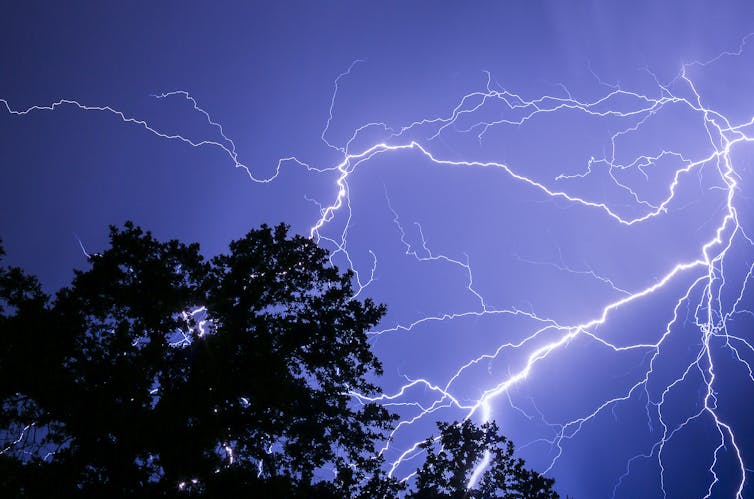
But big molecules such as cellulose and lignin don’t burn easily, unlike small molecules such as propane or ethanol. It takes an external heat source to get them to burn. This is normally in the form of lightning, the cause of most large bushfires. But humans have added other sources – a flicked cigarette, angle-grinders, or sparks from a downed powerline.

A little bit of extra heat won’t do it. But when cellulose and lignin are heated to 300°C, pyrolysis begins and the natural polymers begin to break down into small organic molecules, which promptly evaporate and form a gas.
At these temperatures, this gas rapidly reacts with oxygen in the air to produce carbon dioxide, water vapour – and heat. This is combustion.
As it burns, the gas becomes hot enough to glow, as do any solid particles within it. When we gaze at a campfire, that’s what we’re seeing – burning gas, glowing particles.
Many believe it’s the breaking of chemical bonds in the fuel that produces heat. But it’s actually the opposite. When we break any chemical bond, heat is absorbed. It’s making new chemical bonds that releases heat – the creation of water vapour and carbon dioxide.
These newly formed bonds are stronger than the bonds in the hydrocarbon fuel, meaning heat is released overall. So much heat that pyrolysis is sustained, consuming more fuel and spreading the fire.
What about the water in plants?
Plant material contains water as well as organic compounds.
There’s a unique bit of chemistry which takes place here. When heat first hits plant material, the water within begins to warm. But water has an extraordinarily high ability to store heat.
As water heats up, it begins to evaporate. Evaporation is endothermic, meaning it absorbs heat. That’s why we use it to stop ourselves overheating – we rely on sweat evaporating off our skin and taking heat with it.
This means you need still more energy to increase the temperature and overcome water’s heat absorbing properties. For pyrolysis to occur at all, the water in the plant matter has to evaporate. If there’s still water in the leaves or bark, it won’t burn.
Read more: How does the stuff in a fire extinguisher stop a fire?
Fire weather and gum trees
Australia’s forests and bushlands are mostly on the east coast, avoiding the arid interior. But they can’t avoid the extremely hot and dry air the deserts produce, especially over summer.
Hot air can hold a remarkable amount of water. Its ability to soak up water roughly doubles every 10°C. So hot, dry air acts like a sponge. It scours the water from plant matter and soaks it up.
Plant material largely comes from gum trees. Our hundreds of species are famously messy, dropping bark, leaves and limbs on the forest floor.
Eucalyptus leaves often contain large amounts of volatile organic oils. In dry conditions, these leaves act as like natural lighter fluid, or “pre-pyrolysed material”.
 Gum trees drop plenty of flammable leaves and bark, creating fuel for the next fire.
Janelle Lugge/Shutterstock
Gum trees drop plenty of flammable leaves and bark, creating fuel for the next fire.
Janelle Lugge/Shutterstock
This is because eucalypts like fire. Fire wipes out competitor species and can trigger gumnut germination.
When a bushfire begins and starts to spread, it’s usually burning the dead, dry litter and grasses, not large living trees with plenty of water.
Dry fuel is one thing. But a bushfire needs wind to spread.
Hot days in Australia are often windy, due to the temperature difference between hot deserts and cold oceans. If a lightning triggers pyrolysis and starts a fire, wind is what makes it spread.
Wind provides fresh oxygen to the fire front, making it more intense. It also blows hot dry air over fresh fuel ahead of the fire front, drying it out. If there’s no wind, fire spreads much more slowly.
What does it take to end a bushfire? A large fire will naturally burn itself out if there’s no more fuel for it. Heavy rain can douse a fire, though coals can keep smouldering and restart fires if dry, hot air arrives again.
Firefighters make firebreaks to try to starve the fire of its fuel, spray water to wet and cool the fuel or apply chemical agents such as fire-fighting foam to prevent oxygen getting in.
If we add more and more carbon dioxide to the atmosphere it traps more heat, leading to hotter days. More heat means fire weather – hot, dry and windy conditions – is more likely. And that means combustion will be more likely in some places. Under climate change, there’s more fire in our future.
Read more: Before fusion: a human history of fire
Authors: Jason Dutton, Professor of Chemistry, La Trobe University