

By boat or by plane? If you’re seeking asylum in Australia, the outcome is similarly bleak
- Written by: Savitri Taylor, Associate Professor, Law School, La Trobe University
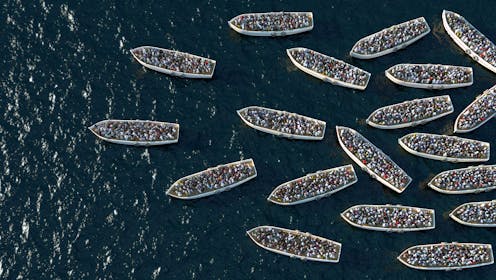
Last week, 39 foreign nationals arrived in a remote part of Western Australia by boat. This revived dormant debates about border security.
People without visas come to Australia by air and sea, though we only ever seem to hear about the latter. Unlike unauthorised air arrivals, unauthorised maritime arrivals (people without visas that arrive by boat without permission) are given high media visibility. This feeds a narrative that the country has lost control of its borders, which in turn creates a political problem for the government of the day.
But behind the headlines, what actually happens when people arrive in Australia without permission, whether by boat or by plane?
Read more: Boat arrivals sent to Nauru, and Sovereign Borders commander warns against politicising the issue
What is Australia obligated to do?
Anyone who’s not an Australian citizen is required to have authorisation in the form of a visa to enter and remain in the country.
What Australia can do to deal with unauthorised arrivals is limited by its international treaty obligations. The United Nations Refugee Convention and Protocol oblige Australia to refrain from sending “refugees” (as defined in those treaties) to places where they will face a real chance of persecution.
Under other treaties to which it is a party, Australia is also obliged to refrain from sending anyone, not just refugees, to places where they will face a real risk of certain serious human rights violations.
These treaty obligations are referred to as “non-refoulement” or protection obligations. People who claim the benefit of such protection obligations are called asylum seekers.
What happens to asylum seekers when they arrive?
The processes for people arriving by boat or plane have similarities, but are slightly different.
Australian policy is for unauthorised air arrivals to be given a screening interview to ascertain whether they could be entitled to Australia’s protection under international law. If not, they are returned to their most recent country of departure. Those who are found to have a possible case are given access to the protection visa application process.
The protection visa is Australia’s main domestic mechanism for implementing its international protection obligations. People who initially entered Australia on a valid visa can also apply for a protection visa. Most applicants fall into this group.
Read more: Who counts as a refugee? Four questions to understand current migration debates
Australia imposes penalties on airlines that bring non-citizens without valid visas here. It also posts its officials at overseas airports to help airlines identify people without visas so they can be refused boarding. As a result, there are very few unauthorised air arrivals to Australia.
Like people who come by plane, unauthorised maritime arrivals go through a screening process.
Those who are deemed not to be asylum seekers are returned to their most recent country of departure. This is usually, but not always, Indonesia.
Unless the responsible minister grants an exemption, unauthorised maritime arrivals who are found to have a possible asylum claim must be transferred to a regional processing country to have their asylum claims determined there.
How has regional processing worked?
Regional processing has a complicated history.
In late 2001, the Coalition government under John Howard entered arrangements with Nauru and Papua New Guinea (PNG) to take unauthorised maritime arrivals to those countries to process their asylum claims. Those arrangements were ended by Labor shortly after it won government in November 2007.
However, a resurgence of unauthorised maritime arrivals led the Gillard Labor government to enter a new set of arrangements with Nauru and PNG in late 2012. These allowed Australia to transfer unauthorised maritime arrivals to processing centres in those countries to have their asylum claims considered by their governments.
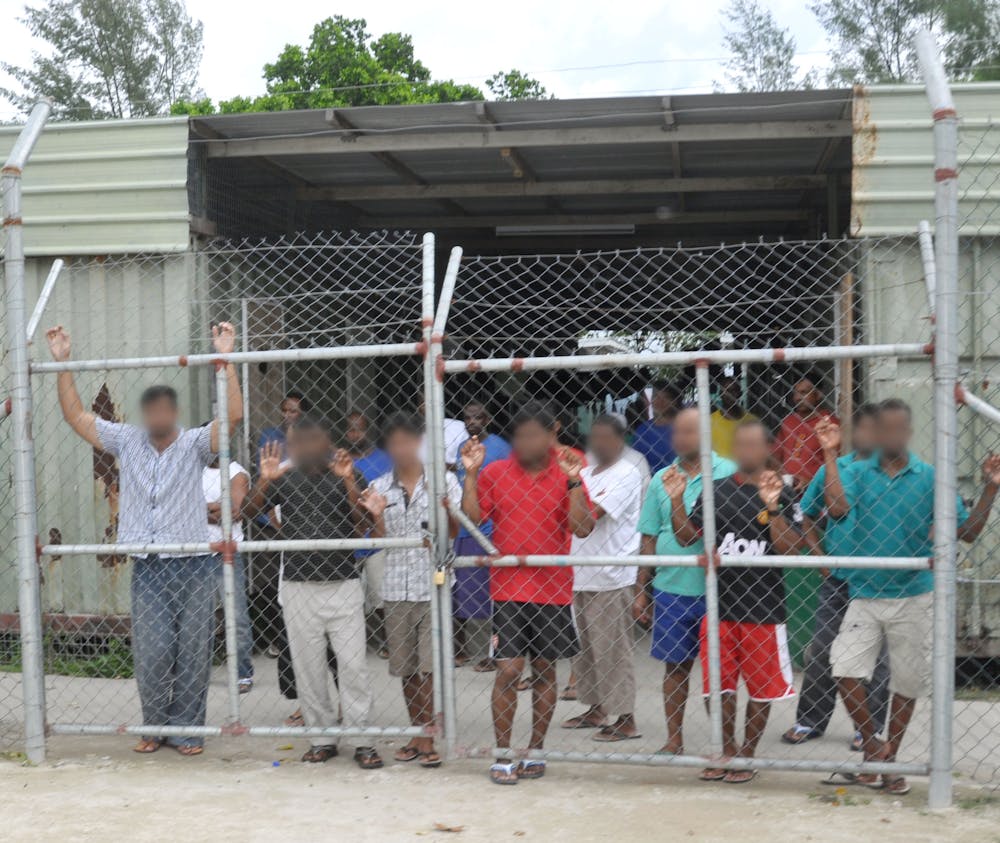
The 2012 arrangements left open the possibility that transferees who were found to be refugees might be resettled in Australia. However, when boats kept arriving, the Rudd Labor government decided to get even tougher. In 2013, it announced future unauthorised maritime arrivals would never be resettled in Australia.
After its election in September 2013, the Coalition government implemented Operation Sovereign Borders, which has been continued by the current Labor government. Many activities come under the Operation Sovereign Borders banner, including the interception of unauthorised maritime arrivals at sea by the Australian navy. Regional processing is now also characterised as being part of the program.
The regional processing arrangement with PNG ceased at the end of 2021. As of November 16 2023, there were still 64 transferees remaining in PNG. However, the Australian government’s position is that responsibility for these people lies entirely with PNG and not with Australia.
Nauru is still a regional processing country but under a new agreement. At the time it was signed in late 2021, there hadn’t been any transfers for years. However, it was considered important to maintain an “enduring regional processing capacity” on Nauru as a deterrent to people smugglers.
As previously, the Nauruan government is responsible for processing the asylum claims of transferees and managing them until they depart Nauru or are permanently settled there. However, Australia has contracted and is paying the processing centre’s service providers.
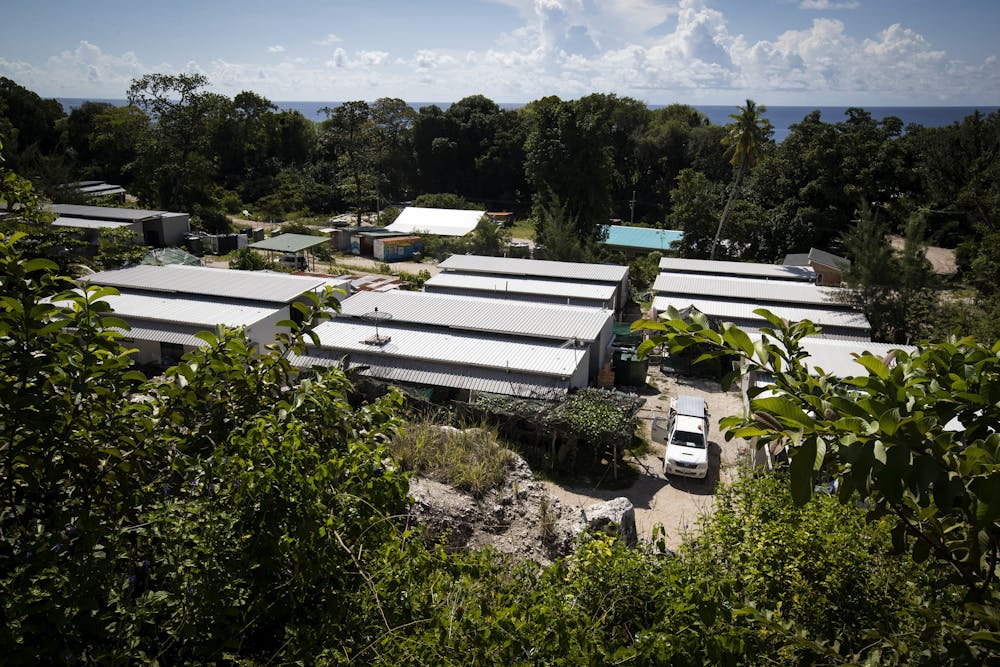 Nauru remains a regional processing country for unauthorised maritime arrivals in Australia.
Jason Oxenham/AP
Nauru remains a regional processing country for unauthorised maritime arrivals in Australia.
Jason Oxenham/AP
On June 25 2023, it was reported there were no transferees remaining in Nauru. This did not mean that a durable solution had been found for everyone who had been transferred to Nauru up until that time. While some people had been resettled in third countries, others had simply been brought to Australia with the legal status of “transitory persons”. This status prevents them from applying for a visa to remain in Australia unless granted ministerial permission to do so.
Australia’s options for resettling this cohort are limited. It has at its disposal the remainder of 1,250 refugee places promised by the United States in November 2016 and 450 refugee places over three years promised by New Zealand in 2022. Even if all these places are used, hundreds of people will remain in limbo.
What happens to last week’s arrivals?
Since Operation Sovereign Borders began, boats have either been intercepted at sea or have managed to make landfall in Australia every year except 2021.
However, between the start of Operation Sovereign Borders and the end of August 2023, only two out of the 1,123 boat passengers involved to that point had ever been accepted for regional processing. Both cases were in 2014.
This statistic raised serious concerns about the reliability of the screening process as the people screened included many from known refugee producing countries.
Given this history, it was a little surprising when the Australian government transferred 11 unauthorised maritime arrivals to Nauru in September 2023. A further 12 were transferred to Nauru in November 2023. The 39 people found in Western Australia have just been transferred there too.
Read more: Aus-NZ refugee deal is a bandage on a failed policy. It's time to end offshore processing
It seems the screening process has been abandoned or has been vastly improved. While the most reliable way for Australia to meet its international protection obligations would be to give all unauthorised maritime arrivals access to its protection visa application process, giving them all access to regional processing is certainly better than sending them back to their country of departure.
However, resettlement in Nauru of those found to be refugees is not realistic. The country, which has a population of approximately 13,000 people, is only 2,200 hectares in land area. To put this in context, Melbourne airport is larger than Nauru.
There is no reason to believe it will be any easier to find third country resettlement for transferees in the future than it has been up to now. For most, the only way out of limbo will be to return home, as eight of those transferred to Nauru in September have already done. Regional processing continues to be a policy failure for which vulnerable people will pay the price.
Authors: Savitri Taylor, Associate Professor, Law School, La Trobe University


















