Working from home is producing economic benefits return-to-office rules would quash
- Written by: Leonora Risse, Associate Professor in Economics, University of Canberra

More of us have been in paid work this past year than ever before. A big part of that is because more of us have been able to work from home than ever before.
The proportion of Australians in paid work climbed above 64% in May last year, and has stayed there since. At the same time, unemployment has hovered around a half-century low of 4%.
In April last year, female unemployment fell to what is almost certainly an all-time low of 3.3%.
It’s working from home – actually, working from anywhere – that has been the game-changer, as the most enduring change to the way we work to have come out of the pandemic.
The jump in working from home
Before the pandemic, in 2019, the share of the workforce who usually work at least partly from home was 25%. Three years on in 2022, it was 36%.
These numbers from the latest Household, Income and Labour Dynamics in Australia (HILDA) Survey show there’s also been a shift in who’s working from home.
Before the pandemic, a greater share of men than women worked from home. Now it’s a greater share of women.
Among both women and men, the biggest jump has been among parents with young children.
The proportion of mothers with children under five working at least partly from home has leapt from 31% to 43%.
The working-from-home rate for fathers with children under five has jumped from 29% to 39%.
Read more: Fancy an e-change? How people are escaping city congestion and living costs by working remotely
Which workers, which jobs?
Before the pandemic, managers and professionals were the workers most likely to work from home. They still are, with up to 60% dialling in from the home office for at least part of their work week.
But it’s clerical and administrative workers – occupations that are about three-quarters female – who had the biggest jump in working from home. Their pre-pandemic rate of 18% has soared to 42%.
In terms of industries, finance and insurance led the pack before the pandemic and still do, with rates doubling to 85%.
Working from home is now also the norm in information media and telecommunications (74%) and public administration and safety (72%).
In the traditionally male industry of construction, women’s working-from-home rates have soared from 34% to 45%.
It’s well above the men’s rate of 24%, which is largely unchanged.
While this reflects the different types of jobs that men and women do in construction, it also suggests working from home is a way to boost women’s involvement, even in this industry.
More workers, better-matched
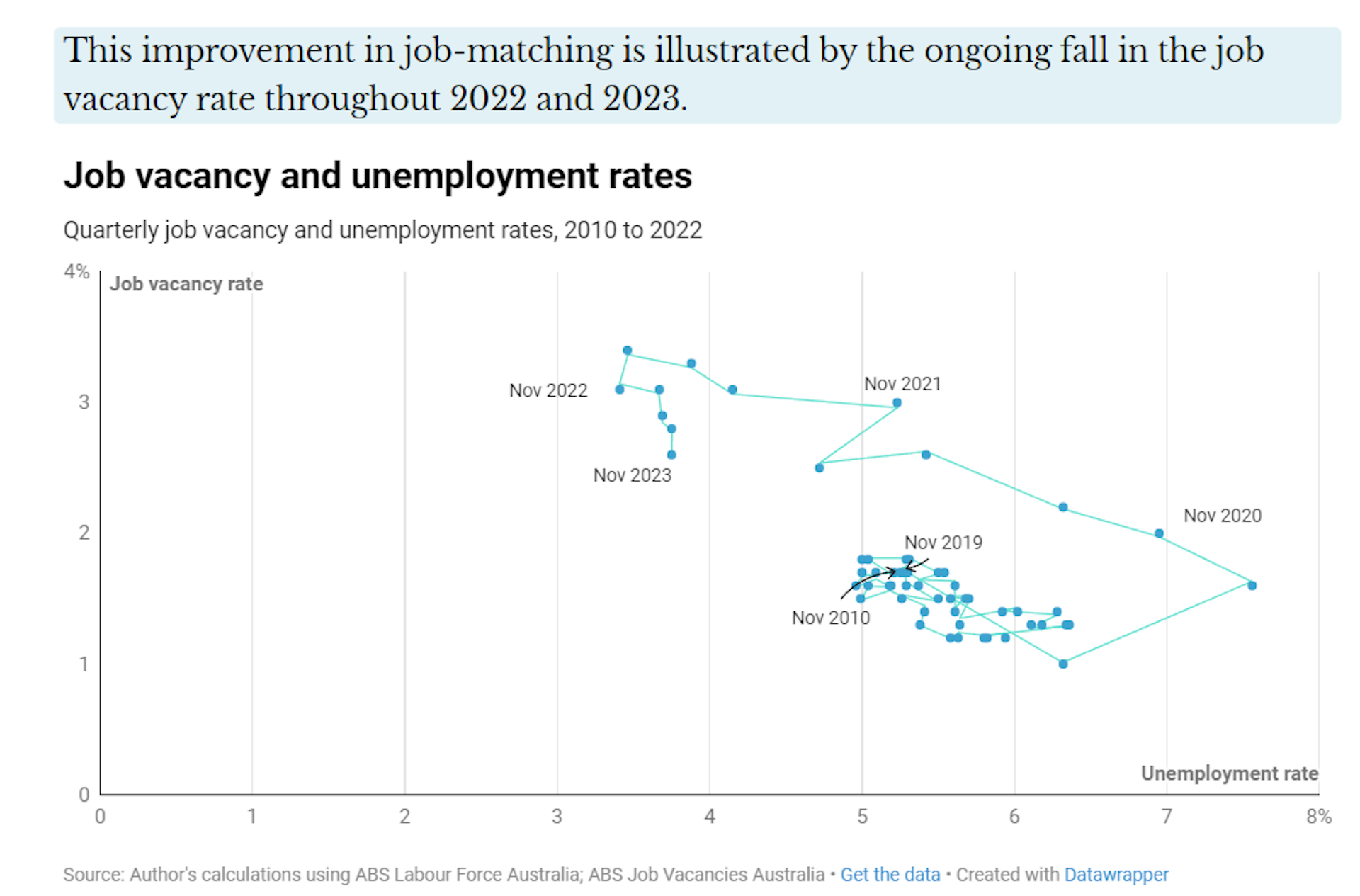
The benefit of working from home for the economy has been fewer obstacles getting in the way of matching jobseekers to employers. Distance and location are no longer the deal-breakers they were.
Better job-matching means less unemployment, and the heightened prospect of finding a good job match encourages jobseekers who in earlier times might have given up.
In finance and insurance – the industry with the biggest and fastest-growing rate of working from home – the proportion of jobs that were vacant fell from 2.5% before the pandemic to just 1.7% by the end of 2023.
Return-to-office mandates would set us back
Making workers return to the office for jobs that can be effectively done from home would unravel the economic benefits that have been achieved.
Fewer people, especially women and parents with young children, would put themselves forward for work. The pool of skills that employers are looking for would shrink. And job-matching in the labour market becomes less efficient.
The result would be more Australians unemployed, and more Australians dropping out of the paid workforce, than if we had continued to embrace working from home.
Read more: Can employers stop you working from home? Here's what the law says
Working from home still comes with challenges. Workers who are less visible in the office are more likely to be overlooked.
But it has a wider economic benefit we have a chance to hold on to.
The extraordinary transformation of our labour market means it shouldn’t be seen as a “favour” to workers, but as a favour to us all.
Authors: Leonora Risse, Associate Professor in Economics, University of Canberra