King tides and rising seas are predictable, and we're not doing enough about it
- Written by: Mark Gibbs, Director, Knowledge to Innovation; Chair, Green Cross Australia, Queensland University of Technology
Recent king tides have again caused significant damage to coastal assets in Australia and New Zealand. This time the combination of large tides and coastal storms damaged properties on Torres Strait islands and in Nelson and other coastal areas of New Zealand. It is increasingly recognised worldwide that, despite many coastal adaptation plans being developed, the implementation of these plans is lagging.
King tides occur several times a year when the Moon is slightly closer to the Earth (so they’re sometimes called perigean spring tides). This means king tides are predictable, as are rising sea levels. The combination, along with sporadic storm events, will lead to increasing flooding of our coastal cities.
Read more: Hurt by sea: how storm surges and sea-level rise make coastal life risky
Higher sea levels, whether creeping (associated with anthropogenic climate change) or transient (episodic storm events), have impacts on both private and public property and assets. What is now mostly nuisance flooding will become more problematic, and the ever-increasing global damage bill from disaster will continue to mount.
According to the global re-insurer Munich Re, losses from natural disasters in 2017 totalled US$330 billion, the second highest on record. Almost half of these losses (41%) were uninsured.
Who’s responsible for adaptation plans?
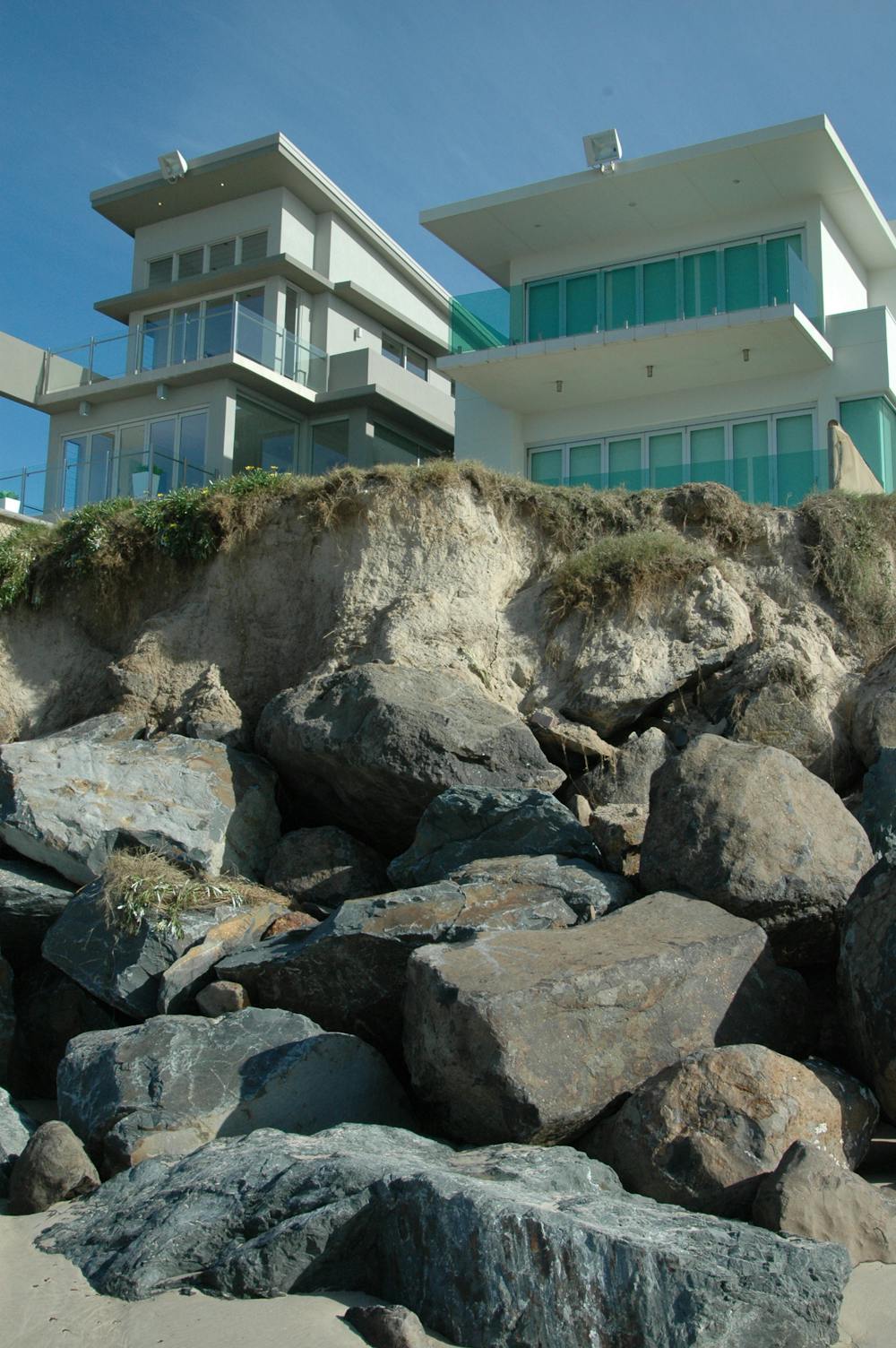 Traditional coastal protection can’t hold out forever against rising seas.
Tony Bartlett/AAP
Traditional coastal protection can’t hold out forever against rising seas.
Tony Bartlett/AAP
In keeping with the theory that risk is best managed by those closest to the risk, local government in Australia is the level of government best suited to managing such local risks. In response to the increasing threat from rising sea levels, many local government councils around Australia have developed coastal climate adaptation plans.
Federal and state governments clearly also have roles to play in managing coastal inundation. The federal government is often the insurer of last resort, especially for public infrastructure.
Read more: Coastal communities, including 24 federal seats at risk, demand action on climate threats
Read more: Coastal law shift from property rights to climate adaptation is a landmark reform
In Queensland, the state government has implemented the successful QCoast2100 program. This is helping local governments to develop adaptation plans all along the state’s coastline.
It is increasingly recognised that many of the plans developed in the past contain overcomplicated analyses of oversimplified adaptation options. Instead, we need less complicated ways of determining the most suitable adaptation option and assessments that consider more tailored and considered options, which will then be more readily implementable.
What are the options?
Coastal climate adaptation options tend to fall into one of three categories:
- retreat – relocate assets and structures inland or to higher ground
- protect – mostly by building engineered seawalls, although green infrastructure can also be implemented
- accommodate – live with the hazard but reduce the vulnerability of structures and assets.
Retreat makes intuitive sense: relocating assets out of harm’s way reduces their vulnerability. However, this approach has proved politically problematic, especially for private buildings.
Most communities are familiar with seawalls and other forms of coastal protection. Others fundamentally disagree with the principle of hard coastal protection measures.
Read more: Contested spaces: conflict behind the sand dunes takes a new turn
The third adaptation option, accommodating sea-level rise, is becoming the most popular approach in many nations, including the low-lying Netherlands. However, this approach is probably the least understood in Australia and rarely appears as the preferred option in Australian coastal adaptation plans.
This option includes making existing structures less vulnerable. This might involve relocating electrical and air-conditioning services and switchboards higher in existing buildings. Over time, vulnerable sites can be repurposed with less vulnerable land uses and structures.
This is different from pre-emptively evicting and relocating entire communities from vulnerable locations – the retreat option. The retreat option is most easily implemented immediately after major flooding that has led to significant damage.
Plans must consider the politics
Early coastal adaptation plans commonly advocated mass pre-emptive coastal retreat, but local government often ended up shelving or rejecting such recommendations. Instead, councils simply commissioned the construction of small local seawalls in areas at risk of erosion.
More developed and recent coastal adaptation plans consider finer spatial scales. What they still often don’t do is consider more sophisticated and politically informed adaptation options and approaches.
Hence adaptation planning is still often best characterised as the “plan and forget” approach. These plans typically lack monitoring and evaluation and a realistic implementation strategy.
Increased flooding of our coastline is inevitable and happening. Therefore, adaptation planning needs to consider more nuanced options that are likely to be more politically palatable and implementable.
Authors: Mark Gibbs, Director, Knowledge to Innovation; Chair, Green Cross Australia, Queensland University of Technology