a 6,700-year history of asbestos
- Written by: Sonja Klebe, Associare Professor, College of Medicine and Public Health, Flinders University
Asbestos is making national news once again after being found in contaminated mulch used in hundreds of locations, including schools and hospitals, across Sydney and regional New South Wales.
With headlines featuring terms such as “crisis”, “nightmare” and “deadly”, it’s hard to believe the toxic mineral was once hailed for its supposedly “magical” properties.
In fact, the history of asbestos goes back at least 6,700 years. Its prevalence in our built environment means it’s (unfortunately) here to stay for a long time.

Before it became a ‘killer dust’
Asbestos is a naturally occurring mineral found in rock formations across the globe, including in some national parks in Australia.
It gets its name from the Greek word for inextinguishable (ásvestos), alluding to its resistance to fire and corrosion. It was these characteristics, along with its insulating properties, that made asbestos seem like a “magic mineral” in centuries prior.
Researchers have found ancient clay pottery from East Finland, dated to 2500 BC, with asbestos fibres mixed into it – likely added for extra strength and resilience. Some of the earliest asbestos pottery, also found in Finland, has been dated to 4700 BC. Asbestos use has also been recorded at other neolithic sites, including in Central Russia and Norway.
In (Western) literature, the first known reference to what might have been asbestos comes from Theophrastus (circa 372-287 BC), a student of Greek philosopher Aristotle and his successor at the Lyceum. In his book On Stones, Theophrastus writes:
In the mines at Scapte Hyle a stone was once found which was like rotten wood in appearance. Whenever oil was poured on it, it burnt, but when the oil had been used up, the stone stopped burning, as if it were itself unaffected.
In the 10th century, Christian pilgrims travelling to Jerusalem were sold pieces of asbestos as fragments of the True Cross – their divinity supposedly evidenced by their incombustibility. By the medieval ages, trading asbestos-containing items had become common. This fascination continued for millennia.
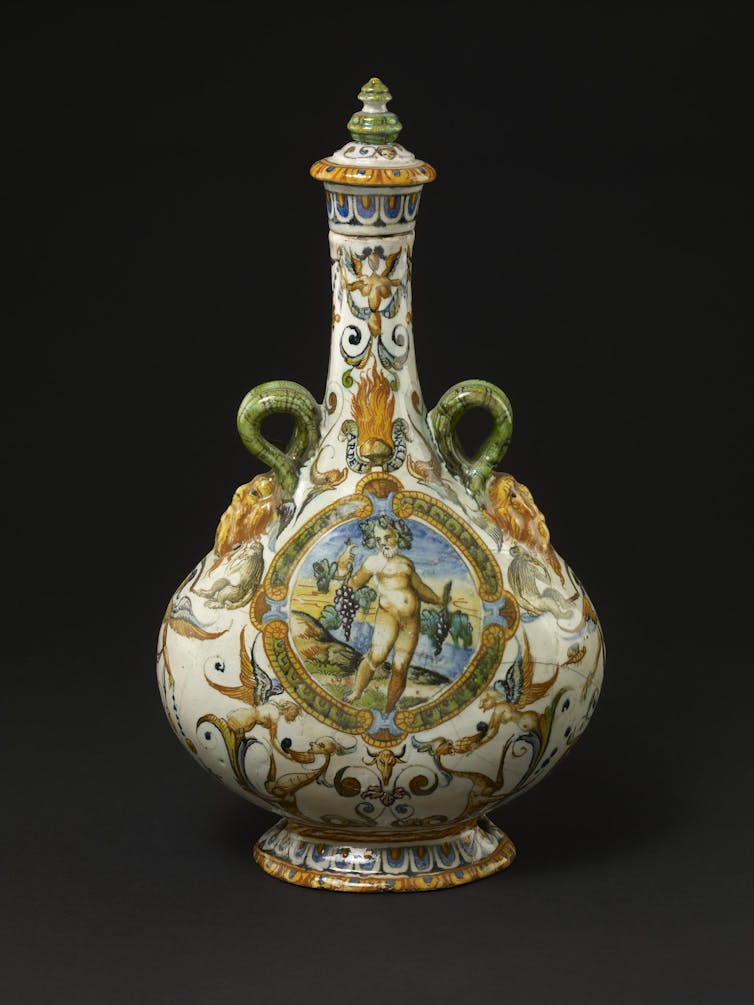
 This earthenware pilgrim flask (circa 1585-1600) has an impresa with burning asbestos and the words ‘ardet aeternum’, meaning ‘burn forever’. It’s painted with a medallion showing a nude male (Bacchus) holding two bunches of grapes.
British Museum, CC BY-NC
This earthenware pilgrim flask (circa 1585-1600) has an impresa with burning asbestos and the words ‘ardet aeternum’, meaning ‘burn forever’. It’s painted with a medallion showing a nude male (Bacchus) holding two bunches of grapes.
British Museum, CC BY-NC
In 1725, a young Benjamin Franklin found himself broke and living in London. In need of cash to pay his bills, he sold a purse made of fibrous mineral asbestos that he’d brought from North America. The recipient was Hans Sloane, whose collections would later be used to establish the British Museum.
A class I carcinogen
The carcinogenic effect of asbestos – even at brief, transient and “low” doses (such as bystander exposure) – has been recognised since at least 1965. Today, it is classified as a class I carcinogen and considered a deadly threat to humans.
Asbestos is the main cause of mesothelioma, a cancer of the surface of the lung. It can also cause lung cancer and is implicated in other cancers, including throat and stomach cancers.
In Australia, there are more than 700 cases of mesothelioma each year. We don’t know how many of the roughly 6,000 yearly cases of lung cancer are caused, wholly or partially, by asbestos.
Although asbestos use has been banned in Australia since 2003, people the world over continue to deal with its harmful effects.
The spread of ‘fibro houses’
Australia started using asbestos goods from around the 1880s, largely for steam-driven machines that benefited from its insulating properties. Only small local mines operated at the time.
Eventually, the world wars increased demand and active exploration led to larger-scale mining, especially at Wittenoom in Western Australia. Even then, local production wasn’t meeting demand.
It was initially miners who presented with the disease, followed by workers in industries manufacturing asbestos-containing products, as well as builders, plumbers and fitters. The Wittenoom miners and their families are still being followed by researchers to determine the effects of exposure.
The economic boom that followed WWII further drove demand for asbestos. In addition to local production, more than 50,000 tons of asbestos were imported to Australia each year throughout the 1950s and into the late 1970s.
 A photo of the Baryulgil Asbestos mill in northern NSW during the 1960s.
AAP
A photo of the Baryulgil Asbestos mill in northern NSW during the 1960s.
AAP
Asbestos afforded many Australians a home. Timber-framed houses clad in flat asbestos cement sheeting (called “fibro houses”) were favoured by people who built or legally supervised the building of their own home.
In the mid-1960s, nearly 20% of Australia’s housing stock was made up of fibro houses – with the highest uptake (more than 50%) in the Northern Territory. It’s impossible to say exactly what percentage of existing buildings contain asbestos.
When cyclone Tracy swept through Darwin in 1974, the death and disease that resulted from the uncoordinated cleanup served as a warning of the possible dangers of asbestos removal.
Read more: Asbestos still haunts those exposed as kids in mining towns
Asbestos is here to stay
Asbestos-related cancers have a long lag time between exposure and detectable disease. Although this lag is typically about 30 years, it can range anywhere between 10 and 70 years. As such, it can be difficult to trace exposure retrospectively.
Many buildings constructed before the mid-1980s contain asbestos. It’s often inseparably bound to other materials, such as tiles, vinyl and cement.
Regulations demand specialist removal for asbestos-affected areas of more than 10 square metres. In reality, whether this happens comes down to how effectively it can be detected, and whether the people affected can afford removals. Without specialised assessment and analysis, asbestos can be difficult to recognise.
Since there is no recognised “safe” dose – a dose below which there’s no risk of developing asbestos-related cancer – workplace standards can only minimise risk, not eliminate it.
Only time will tell what the long-term outcomes are from the latest exposure in NSW. The risk from asbestos depends on several factors, including the overall amount inhaled, the type of asbestos and the number of years since exposure.
Among the most heavily exposed Wittenoom miners, about 20% have developed mesothelioma so far.
 This photo taken around 1962, shows David Jones and his sister at their Wittenoom home after playing in asbestos tailings. David died from mesothelioma at age 48.
AAP/Jones family and Robert Vojakovic
This photo taken around 1962, shows David Jones and his sister at their Wittenoom home after playing in asbestos tailings. David died from mesothelioma at age 48.
AAP/Jones family and Robert Vojakovic
Documenting cases
Since July 2010, the Australian Mesothelioma Registry has collected information on new mesothelioma cases diagnosed in Australia. The national Asbestos Exposure Register also allows any person to register a documented or suspected case of exposure.
If you’re worried about your neighbourhood, the Asbestos and Silica Eradication Agency has produced a national heat map showing the probability of asbestos presence in buildings by geographic area.
Authors: Sonja Klebe, Associare Professor, College of Medicine and Public Health, Flinders University