

The US just returned to the Moon after more than 50 years. How big a deal is it, really?
- Written by: David Flannery, Planetary Scientist, Queensland University of Technology
In the few short years since the COVID pandemic changed our world, China, Japan and India have all successfully landed on the Moon.
Many more robotic missions have flown past the Moon, entered lunar orbit, or crashed into it in the past five years. This includes spacecraft developed by South Korea, the United Arab Emirates, and an Israeli not-for-profit organisation.
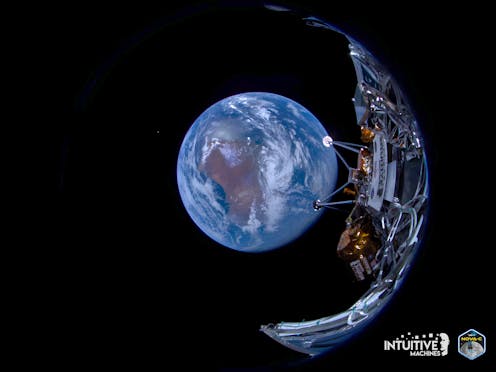
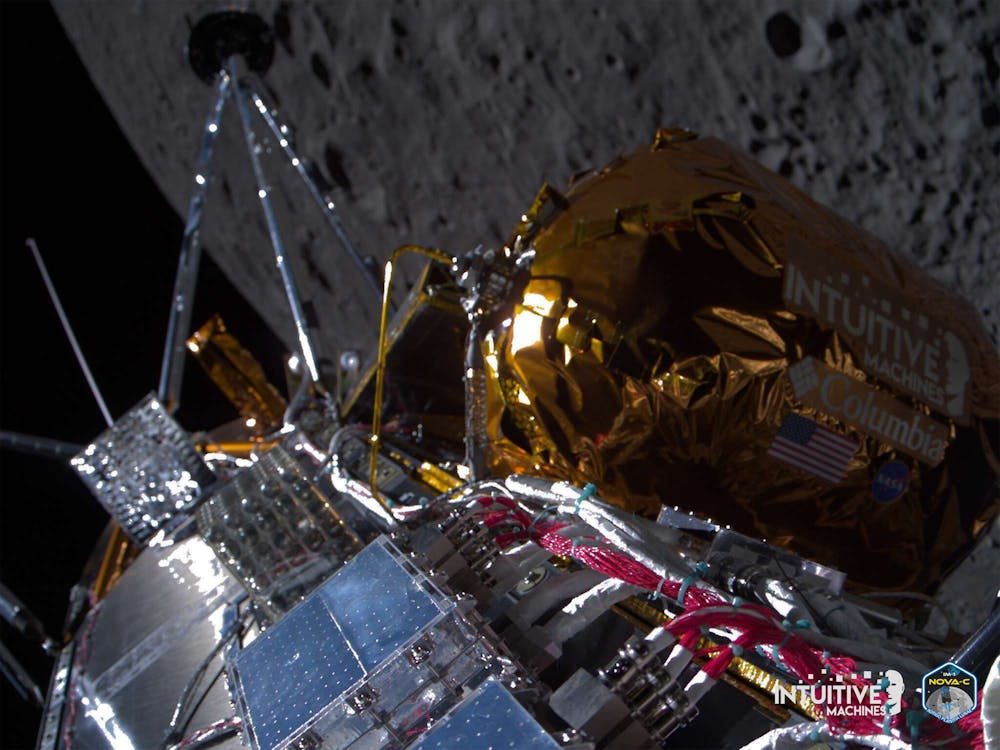
Late last week, the American company Intuitive Machines, in collaboration with NASA, celebrated “America’s return to the Moon” with a successful landing of its Odysseus spacecraft.
Recent Chinese-built sample return missions are far more complex than this project. And didn’t NASA ferry a dozen humans to the Moon back when microwaves were cutting-edge technology? So what is different about this mission developed by a US company?
Back to the Moon
The recent Odysseus landing stands out for two reasons. For starters, this is the first time a US-built spacecraft has landed – not crashed – on the Moon for over 50 years.
Secondly, and far more significantly, this is the first time a private company has pulled off a successful delivery of cargo to the Moon’s surface.
NASA has lately focused on destinations beyond the Earth–Moon system, including Mars. But with its Commercial Lunar Payload Services (CLPS) program, it has also funded US private industry to develop Moon landing concepts, hoping to reduce the delivery costs of lunar payloads and allow NASA engineers to focus on other challenges.
Working with NASA, Intuitive Machines selected a landing site about 300 kilometres from the lunar south pole. Among other challenges, landing here requires entering a polar orbit around the Moon, which consumes additional fuel.
At this latitude, the land is heavily cratered and dotted with long shadows. This makes it challenging for autonomous landing systems to find a safe spot for a touchdown.
NASA spent about US$118 million (A$180 million) to land six scientific payloads on Odysseus. This is relatively cheap. Using low-cost lunar landers, NASA will have an efficient way to test new space hardware that may then be flown on other Moon missions or farther afield.
Ten minutes of silence
One of the technology tests on the Odysseus lander, NASA’s Navigation Doppler Lidar experiment or NDL, appears to have proved crucial to the lander’s success.
As the lander neared the surface, the company realised its navigation systems had a problem. NASA’s NDL experiment is serendipitously designed to test precision landing techniques for future missions. It seems that at the last second, engineers bodged together a solution that involved feeding necessary data from NDL to the lander.
Ten minutes of silence followed before a weak signal was detected from Odysseus. Applause thundered through the mission control room. NASA’s administrator released a video congratulating everyone for returning America to the Moon.
It has since become clear the lander is not oriented perfectly upright. The solar panels are generating sufficient power and the team is slowly receiving the first images from the surface.
However, it’s likely Odysseus partially toppled over upon landing. Fortunately, at the time of writing, it seems most of the science payload may yet be deployed as it’s on the side of the lander facing upwards. The unlucky payload element facing downwards is a privately contributed artwork connected to NFTs.
The lander is now likely to survive for at least a week before the Sun sets on the landing site and a dark, frigid lunar night turns it into another museum piece of human technology frozen in the lunar regolith.
Read more: Scientists and space agencies are shooting for the Moon – 5 essential reads on modern lunar missions
Win some, lose some
NASA’s commercial approach to stimulating low-cost payload services all but guarantees some failures. But eventually NASA hopes that several commercial launch and landing providers will emerge from the program, along with a few learning experiences.
The know-how accumulated at organisations operating hardware in space is at least as important as the development of the hardware itself.
The market for commercial lunar payloads remains unclear. Possibly, once the novelty wears off and brands are no longer able to generate buzz by, for example, sending a piece of outdoor clothing to the Moon, this source of funding may dwindle.
However, just as today, civil space agencies and taxpayers will continue to fund space exploration to address shared science goals.
Ideally, commercial providers will offer NASA an efficient method for testing key technologies needed for its schedule of upcoming scientific robotic missions, as well as human spaceflight in the Artemis program. Australia would also have the opportunity to test hardware at a reduced price.
It’s worth noting that US budgetary issues, funding cuts and subsequent lay-offs do threaten these ambitions.
Meanwhile, in Australia, we may have nothing to launch anyway. We continue to spend less than the OECD average on scientific research, and only a few Australian universities – who traditionally lead such efforts – have received funding provided by the Australian Space Agency.
If we do support planetary science and space exploration in the future, Australians will need to decide if we want to allocate our limited resources, competing with NASA and US private industry, to supply launch, landing and robotic services to the global space industry.
Alternatively, we could leverage these lower-cost payload providers to develop our own scientific space program, and locally developed space technologies associated with benefits to the knowledge economy, education and national security.
Read more: Australia wants a space industry. So why won't we pay for the basic research to drive it?
Authors: David Flannery, Planetary Scientist, Queensland University of Technology


















