

does Victoria have Australia's lowest rate of public school funding?
- Written by Jennifer Buckingham, Senior Research Fellow, The Centre for Independent Studies; Associate Investigator, ARC Centre of Excellence in Cognition and its Disorders, Macquarie University
Victoria has the lowest funding rate for public schools of any state in Australia. – Victorian Greens state election pamphlet, circulated in the seat of Melbourne, November 2018
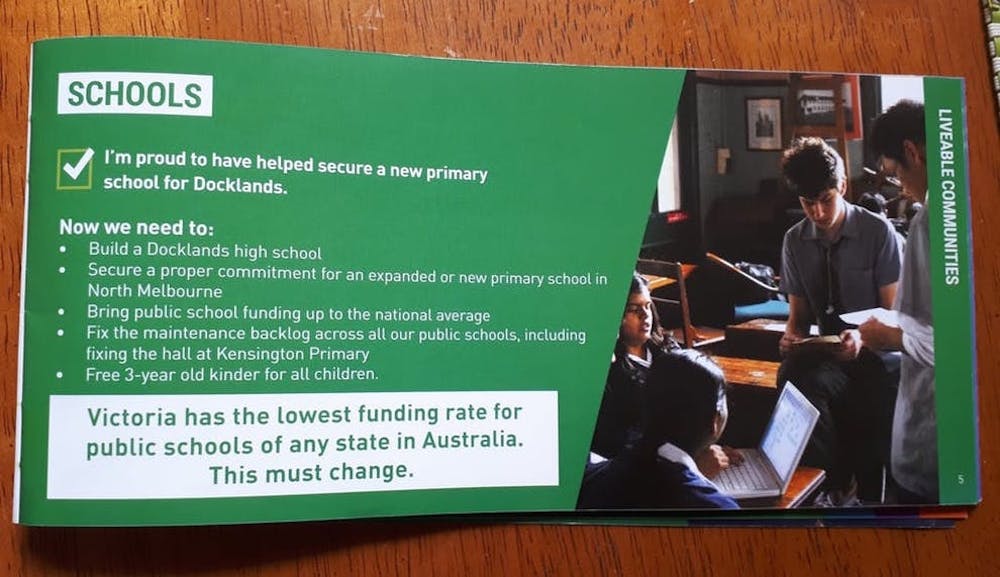 Victorian Greens state election pamphlet, November 2018.
The Australian Greens party this week outlined its federal public education policy, saying it would spend an extra A$20.5 billion on public schools over the next 10 years, legislate to remove the cap on Commonwealth contributions to the sector, and cancel what it described as special deals for private schools, among other proposals.
In the lead-up to Saturday’s Victorian election, the Victorian Greens shared campaign pamphlets arguing the state’s education funding needed to be brought up to the national average, stating that “Victoria has the lowest funding rate for public schools of any state in Australia”.
We asked the experts to check the numbers.
Checking the source
In response to The Conversation’s request for sources and comment, a spokesperson for the Victorian Greens provided the following:
According to the most recent publicly available information from the Productivity Commission’s Report on Government Services 2018, recurrent funding per student in Victoria in 2015-16 was the lowest in the country at A$13,301 per student, which is A$1,589 lower than the national average of A$14,890.
The next lowest spending state is Tasmania, spending A$14,372 per student, and the highest spending state is Western Australia at A$17,306.
The relevant figures can be found in the attached table at tab 4A.14.
Verdict
The statement made by the Victorian Greens is correct: Victoria does have the lowest funding rate for public schools of any state or territory in Australia. Total government funding for Victorian government schools in 2015-16 was A$15,656 per student.
Victoria has had the lowest per student government funding for public schools in Australia for at least a decade, due to relatively low levels of state government funding compared with other states and territories.
Nonetheless, Victorian students’ performance on national and international assessments is generally above average.
Response to the sources provided by the Victorian Greens
The figures provided by the Greens spokesperson are not the total government funding for Victorian public schools; they are state government funding only.
All schools in Australia - both government (public) and non-government (Catholic and independent) — receive public funding from both the federal government and their respective state or territory government.
Under the Commonwealth Constitution, school education is the responsibility of state governments. As such, most government funding for schools comes from state governments.
In 2015-16 (the most recent year of finalised accounts provided by the Productivity Commission), total government funding for schools was A$55.7 billion. This comprised 28% from the federal government and 72% from state and territory governments.
(The funding figures for government schools include a non-cash accounting element called user cost of capital that is not included in non-government school funding figures. This complicates comparisons between the government and non-government sectors, but does not substantially affect state-by-state comparisons of government schools).
However, the balance of funding sources in the government and non-government school sectors is very different.
Non-government schools receive most of their funding from the federal government, whereas government schools receive most of their funding from state and territory governments.
Funding for government schools
In 2015-16, 86% of funding for government schools came from state and territory governments, and 14% from the federal government. The latter was an increase over the past decade from the 9% of federal funding for government schools in 2006-07.
In Victorian government schools, the federal government’s share of funding increased from 9% to 15% in the decade to 2015-16.
This increase in the federal government contribution is largely the result of the various iterations of the school funding model that arose from the Gonski review of school funding in 2011.
The current funding model under the Australian Education Act 2013 has two components: a base level of funding, and additional loadings for disadvantage. All government schools are allocated 100% of the base level, while non-government schools have their base level adjusted according to the socioeconomic status of the school population.
The loadings — which are allocated for socioeconomic disadvantage, indigenous students, students with limited English language proficiency, students with disabilities, and small/remote schools — are not subject to any means-test adjustments.
The funding model sets each school a theoretical or aspirational Schooling Resource Standard (SRS) that combined federal and state/territory funding should meet. As the SRS represents a large increase in funding for some school sectors, it is being phased in over several years.
What’s Victoria’s share?
While both levels of government produce budget forward estimates projected over four years, it’s not possible to predict funding levels or enrolments with sufficient precision to know whether Victorian government schools will continue to have lower per student funding than other states in the future.
In 2015-16, total government funding for Victorian government schools was A$15,656 per student – the lowest rate in Australia.
Does lower funding mean poorer outcomes?
No, lower average funding does not necessarily mean lower average performance.
Victorian government and non-government school students have been at least above average and often among the highest achieving states in the National Assessment Program for Literacy and Numeracy (NAPLAN), frequently outperforming the higher funded schools in the Australian Capital Territory.
In the Program for International Student Assessment 2015 (PISA), Victoria’s average performance in reading, mathematical and scientific literacy was among the top three states and territories (but Victoria had relatively low proportions of high-achieving students).
In the Trends in International Maths and Science Study 2015 (TIMSS), the average performance of Victorian students in maths and science in Years 4 and 8 was either equal first or second among Australian states and territories. – Jennifer Buckingham
Blind review
The verdict is correct: Victorian government schools have the lowest level of government funding of any state. This is true when all government funding is counted (as the fact-checker correctly argues it should be, given the original statement) or just state government funding (the figures provided by The Greens.)
Comparing funding as a percentage of Schooling Resource Standard (SRS) gives a more nuanced comparison of relative funding, by taking into account the individual needs of each school. But it doesn’t change the answer: in 2016, Victorian government schools got just 82% of their SRS target, 6 percentage points lower than the next lowest funded state.
It’s even harder to make a clear link between funding levels and student outcomes. The data provided on average achievement levels in NAPLAN, PISA and TIMSS cover all school sectors, not just government schools. State-wide averages do not account for the fact that Victoria has fewer disadvantaged students than many states. And while it is formally true that Victoria is in the top three in PISA and top two in TIMSS, Victoria’s performance was not statistically higher than the national average in any of these international tests in 2015. Determining the impact on outcomes of Victoria’s low funding levels is a subject for another discussion. – Peter Goss
 The Conversation FactCheck is accredited by the International Fact-Checking Network.
The Conversation’s FactCheck unit was the first fact-checking team in Australia and one of the first worldwide to be accredited by the International Fact-Checking Network, an alliance of fact-checkers hosted at the Poynter Institute in the US. Read more here.
Have you seen a “fact” worth checking? The Conversation’s FactCheck asks academic experts to test claims and see how true they are. We then ask a second academic to review an anonymous copy of the article. You can request a check at checkit@theconversation.edu.au. Please include the statement you would like us to check, the date it was made, and a link if possible.
Authors: Jennifer Buckingham, Senior Research Fellow, The Centre for Independent Studies; Associate Investigator, ARC Centre of Excellence in Cognition and its Disorders, Macquarie University

















