

‘Inequality serves no-one’: Australia finally has a strategy to achieve gender equality
- Written by: Susan Harris Rimmer, Professor and Director of the Policy Innovation Hub, Griffith Business School, Griffith University
As International Women’s Day comes around once more, the latest gender pay gap figures for Australia have made for disappointing reading, including naming those companies where the gap is widest.
Looking at full-time equivalent total remuneration, the gender pay gap in Australia is at 21.7%. Yikes.
As she launched the government’s latest gender equality strategy at the Press Club on Thursday, Finance Minister and Minister for Women Katy Gallagher called this “an eye-watering disparity”.
So what are the key points in the strategy and what actual difference is it likely to make?
As a guiding principle, one of Gallagher’s strongest quotes from the launch was that “inequality serves no-one”.
The strategy sets out that gender inequality and stereotypes also constrain men, limiting their choices, supports and opportunities. One way to redress this would be to normalise equal parenting and caring roles in Australian society.
Where the strategy is weakest is on how to preserve women’s hard-fought gains during crises and shocks such as the climate transition.
So what is the big picture for Australian gender equality?
In this context, Gallagher said she is determined to get Australia back up the international rankings on gender equality.
I know what you’re thinking: Australia didn’t have a gender equality strategy before now? The surprising answer is no.
There is a 2022–32 strategy on violence against women and girls, for example, but until now, there has been never been a plan for the broader goal of gender equality, and no plan to address human rights since 2013.
And even now, the ten-year strategy won’t start until 2025. Can you imagine defence or infrastructure going years or decades without a strategy? AUKUS has a $368 billion plan between now and the mid-2050s. But key areas of social policy such mental health, gender equality or climate adaptation lapse for years, or are built and unbuilt by electoral change.
Nonetheless, the government is at least to be given some credit for finally giving us one on gender equality.
So what’s in it?
Working for Women: A Strategy for Gender Equality has a vision of “an Australia where people are safe, treated with respect, have choices and have access to resources and equal outcomes no matter their gender”. It includes a great section on harmful gender attitudes and stereotypes, complete with narratives.
There are also five priority areas for action: gender-based violence; unpaid and paid care; economic equality and security; health; and leadership, representation and decision-making.
Some of the key points are:
- New federal procurement rules will be developed by the Workplace Gender Equality Agency (WGEA) so Australian businesses with 500 employees or more will be required to meet new gender equality targets if they want to win government contracts (noting federal public procurement is worth $70 billion).
These targets will focus on the gender makeup of companies’ boards and the workforce; equal pay; flexible working arrangements; workplace consultation on gender equality; and efforts to prevent and address sexual harassment.
This has been proven overseas to be an excellent lever for gender quality outcomes. My research for UK think tank Chatham House showed public procurement accounts for around one-fifth of global gross domestic product. It is estimated women-owned businesses and women entrepreneurs supplied just 1% of this market.
The federal government will pay superannuation on paid parental leave (PPL) from July 1 2025.
The government will work towards the goal that paid and unpaid care work must be better valued. Women currently account for 75% of disability carers, 87% of residential aged carers, and more than 90% of early childhood educators.
The strategy will also tackle structural medical biases that lead to poorer health outcomes for women and girls, especially in relation to endometriosis and pelvic pain, and menopause.
Read more: Government to pay super on paid parental leave, benefitting 180,000 families a year
But climate impacts could undo it all…
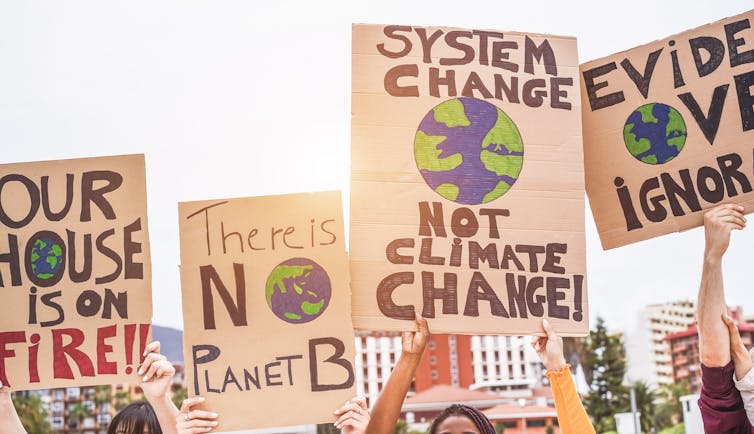
Where the strategy falls down badly is in the consideration of climate impacts and related disasters on Australia’s progress towards gender equality.
Literally the last page of the report notes that given the unequal impact of crises such as climate change and natural disasters on women, diverse leadership and representation are important. But the strategy doesn’t see climate adaptation as the game-changer that it is, with most current climate adaptation measures in energy, transport, disaster management, finance, climate services and technology fuelling gender inequality outcomes.
Nevertheless, as the minister said in her speech, the strategy points us to a better future for the next generation of girls and women:
To a little girl who is born today. That by the time you go to school, you won’t have preconceived ideas about “girl” jobs and “boy” jobs. That by the time you choose the subjects you study you don’t self-select out of maths or science and technology if that’s what you’re interested in. That as you grow up, you and your male peers learn about respectful relationships and enthusiastic consent rather than how women should protect themselves and their friends from the threat of violence.
That if you experience the pain of endometriosis or polycystic ovarian syndrome your diagnosis doesn’t take a decade, or that you’re told the pain is in your head and then sent away from the ED with only Nurofen as pain relief.
That you won’t be catcalled when you go for a run or look over your shoulder when you walk alone.
Authors: Susan Harris Rimmer, Professor and Director of the Policy Innovation Hub, Griffith Business School, Griffith University


















