

The magic tricks and the deep souls of theatre, dance and music at the 2024 Perth Festival
- Written by: Jonathan W. Marshall, Associate Professor & Postgraduate Research Coordinator, Western Australian Academy of Performing Arts, Edith Cowan University
During last October’s launch event for the 2024 Perth Festival of the arts, the presentation offered by artistic director Iain Grandage implied that the festival would touch on various timely global political issues.
Across the program, which wrapped up on Sunday, I was struck by how it was often more in the act of putting on and performing the work, rather than their spoken content, that expressed political responses to our times – a few good trick-style shows aside.
The magic of performance
Belgian theatre collective Ontroerend Goed and performance artist Geoff Sobelle both focused on theatrical illusion.
Ontroerend Goed’s Are we not drawn onward to new erA was promoted as an “inventive palindromic eco-drama”, while one critic reflected on how Sobelle’s Food alluded to “the consequences for the environment” of global human food consumption, but “without drawing any clear conclusions”.
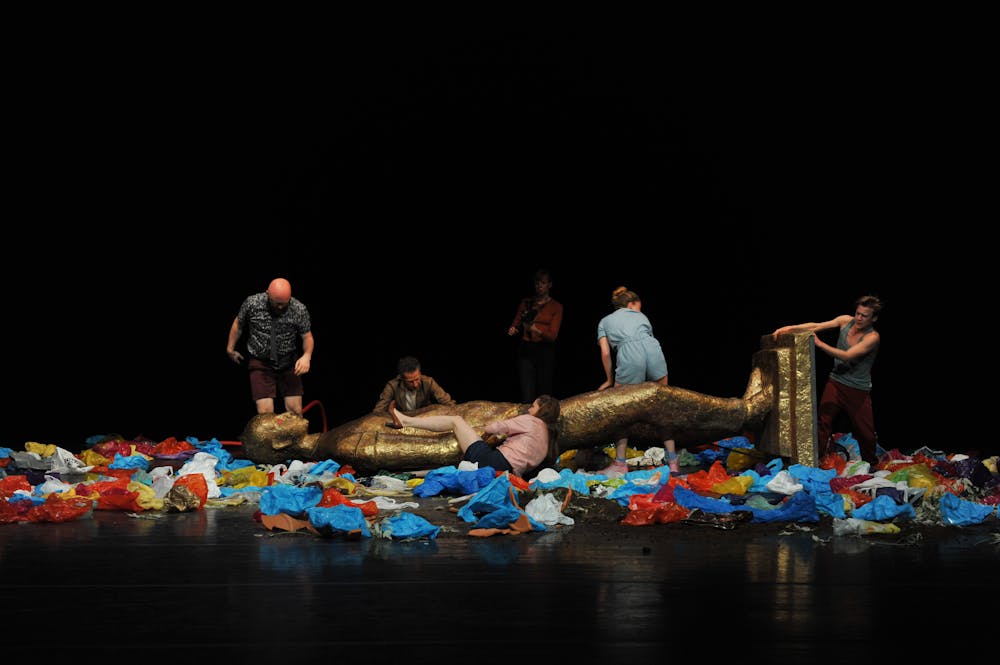
Act one of Are we not drawn reworked the idea that underpins Christopher Nolan’s Tenet (2020) to run a scene backwards before a filmed recording was then projected in reverse – in the “right” order.
Sobelle spent much of his show producing food out of nowhere, or disappearing remnants of a gargantuan meal down his throat, before offering a familiar narrative of colonial development. He dug toy bison out of a massive sand box, before burying them again as he unearthed farms, stations and skyscrapers.
Are we not drawn and Food were entrancing magic tricks, but beyond witnessing Ontroerend Goed’s performers make a mess and topple a statue, not much was learned. (The improvised removal of Edward Colston’s statue was more dynamic.)
Read more: Edward Colston museum display: what happens next for the fallen statue
A wonderfully weird opera
The opera Wundig wer Wilura presented a different approach. Composed, conducted and sung in Noongar by 30 First Nations artists, the staging itself was a statement.
The piece charted tensions between Noongar groups from what is now York, Western Australia, and two lovers – one from each group – were forbidden to marry but eloped, starting a war. A clever man, or sorcerer, intervened, turning combatants into grass trees and the lovers into hills.
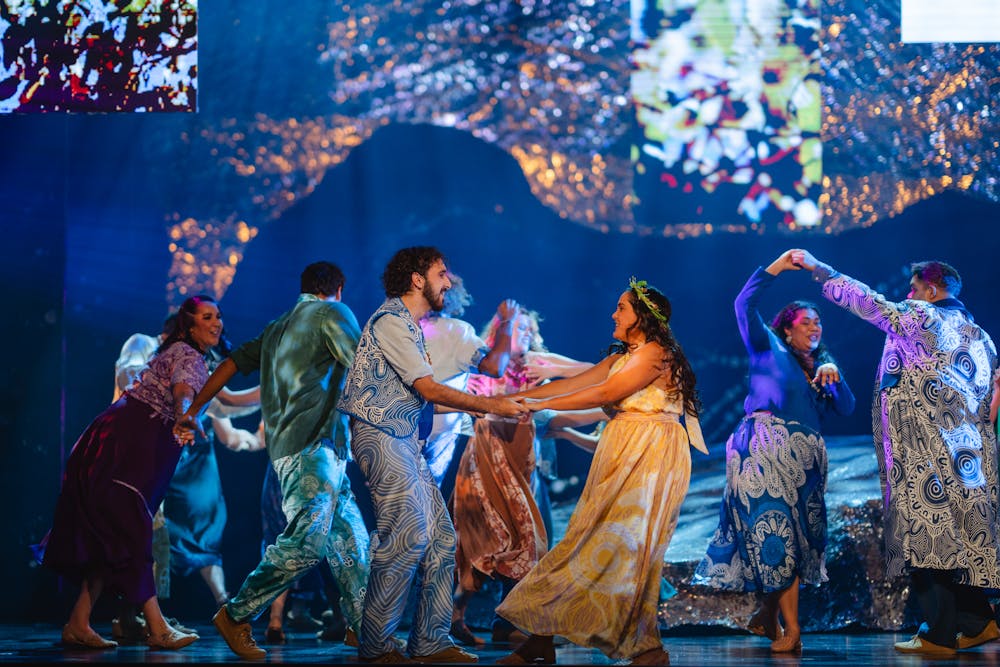 Wundig wer Wilura shares characteristics with Wagner’s famous ring cycle.
West Beach Studio/Perth Festival
Wundig wer Wilura shares characteristics with Wagner’s famous ring cycle.
West Beach Studio/Perth Festival
Wundig wer Wilura shares characteristics with Wagner’s famous ring cycle: epic figures from a mythic era express passion and violence in the face of otherworldly forces.
Composed in a sweeping yet low-key orchestral mode by Gina Williams and Guy Ghouse, passages reminded me of fragments from popular sources such as The Divinyls’ Pleasure and Pain, the lightly musicalised speech patterns of 10CC’s Dreadlock Holiday, and Kate Bush’s dramatic pop-meets-classical style.
Ian Wilkes’ choreography had the cast in near constant motion, but none seemed overwrought. Where Wagner’s characters scream or plummet earthwards, Wundig wer Wilura’s were melancholy rather than epic.
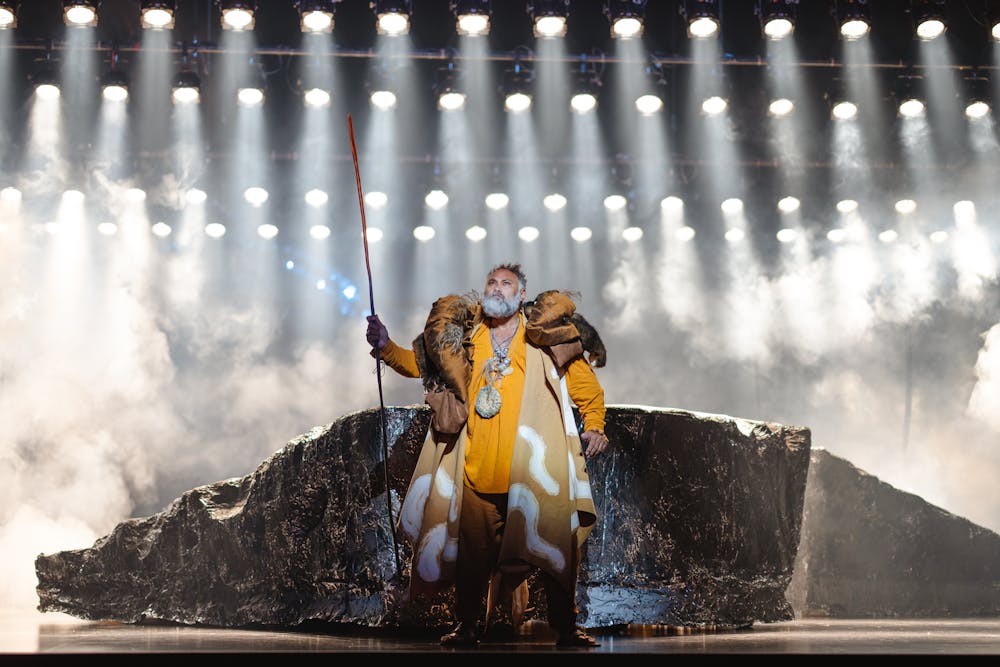 David Leha was a compellingly otherworldly presence in an otherwise sympathetically human drama.
West Beach Studio/Perth Festival
David Leha was a compellingly otherworldly presence in an otherwise sympathetically human drama.
West Beach Studio/Perth Festival
As a settler-descent critic with a liking for Wagner and the avant garde, I found the production best at its weirdest. David Leha as the clever man was strikingly attired in a puffy costume swelling his shoulders, pointing a staff as he sang in staggered bursts. He was a compellingly otherworldly presence in an otherwise sympathetically human drama.
Lyricism and commentary
Entrancing for different reasons was the formal exactness of Joan Jonas’ performance Mirror Piece I and II (1969-70/2024). Originally documented through still images, the choreography performed between tableaux for the Perth Festival production was essentially new.
Jonas’ video art often explored issues of voyeurism, surveillance and narcissism. In Mirror Piece, the audience is positioned partly as narcissistic voyeurs, invited to gaze at themselves and their peers in the mirrors while also watching staggered, linear configurations of these rectangles of glass manipulated by focused, fashionable performers.
 Mirror Piece is partly a study in voyeurism, surveillance and narcissism.
Perth Institute of Contemporary Art/Perth Festival
Mirror Piece is partly a study in voyeurism, surveillance and narcissism.
Perth Institute of Contemporary Art/Perth Festival
The unadorned precision of the movements and variety of arrangements had its own lyricism, quite apart from any social commentary.
Wilder in structure was the politicised jazz-fusion ensemble Irreversible Entanglements. The quintet recalled Sun Ra’s free jazz fantasies, the Africanist stylings of Idris Ackamoor and the verbal potency of Gil Scott Heron.
Five artists performed independent jazzy scribbles and meandering blurts, before coming together for sometimes funky sections (think Herbie Hancock) or harmonious stepped chords. The performers supplemented vocals, drums, bass, saxophone and trumpet with electronics and other instruments, drifting into Jah Wobble territory.
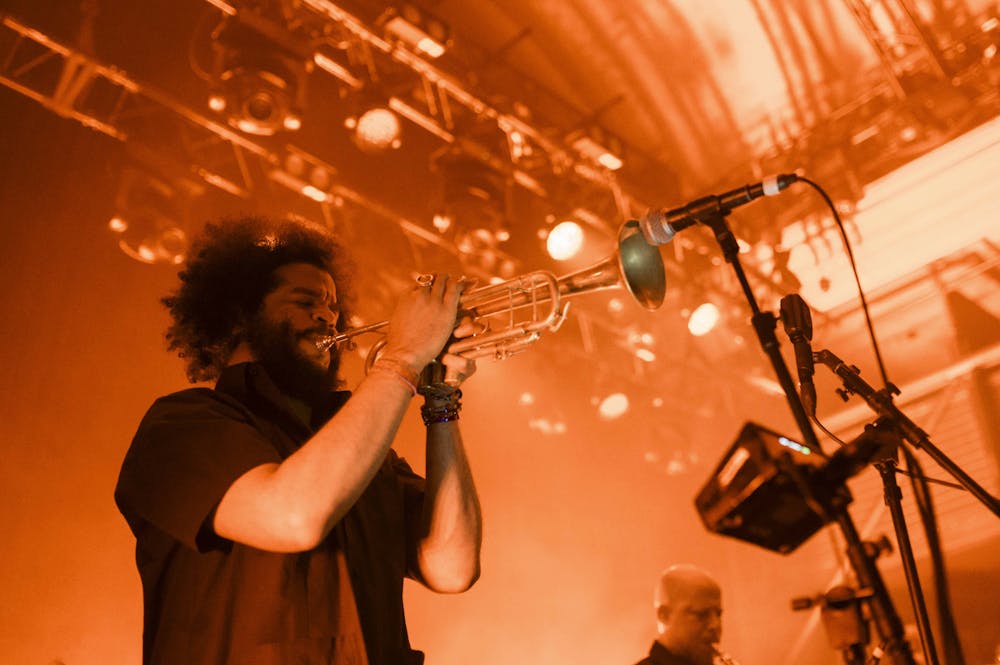 The politicised jazz-fusion ensemble Irreversible Entanglements performed independent jazzy scribbles and meandering blurts.
Mark Francesca/Perth Festival
The politicised jazz-fusion ensemble Irreversible Entanglements performed independent jazzy scribbles and meandering blurts.
Mark Francesca/Perth Festival
Vocalist Moor Mother urgently repeated her concise phrases, the use of voice musical and percussive more than poetic.
The din offered by the group was at once tense and flowing, epitomising how people of different backgrounds can produce a unified collective without surrendering their identities: anarcho-syndicalism as musical performance.
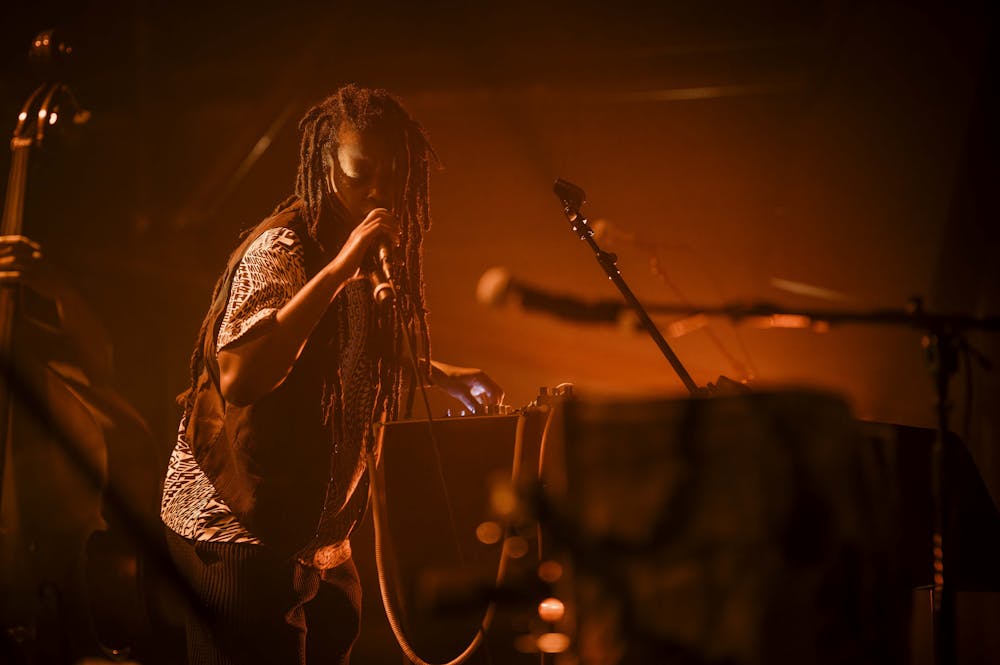 Vocalist Moor Mother was musical and percussive.
Mark Francesca/Perth Festival
Vocalist Moor Mother was musical and percussive.
Mark Francesca/Perth Festival
Soul legends Cymande were another standout, with complex funky song structures, often featuring different arrangements in the same piece.
They powered through their best-known song Bra two-thirds in, but later brought the crowd to an exultant conclusion. A well-oiled soul machine of a three-piece brass section, drums, congas, keyboards, bass and guitar, it was fantastic performance by what is now an exemplar for orchestrated creolised soul.
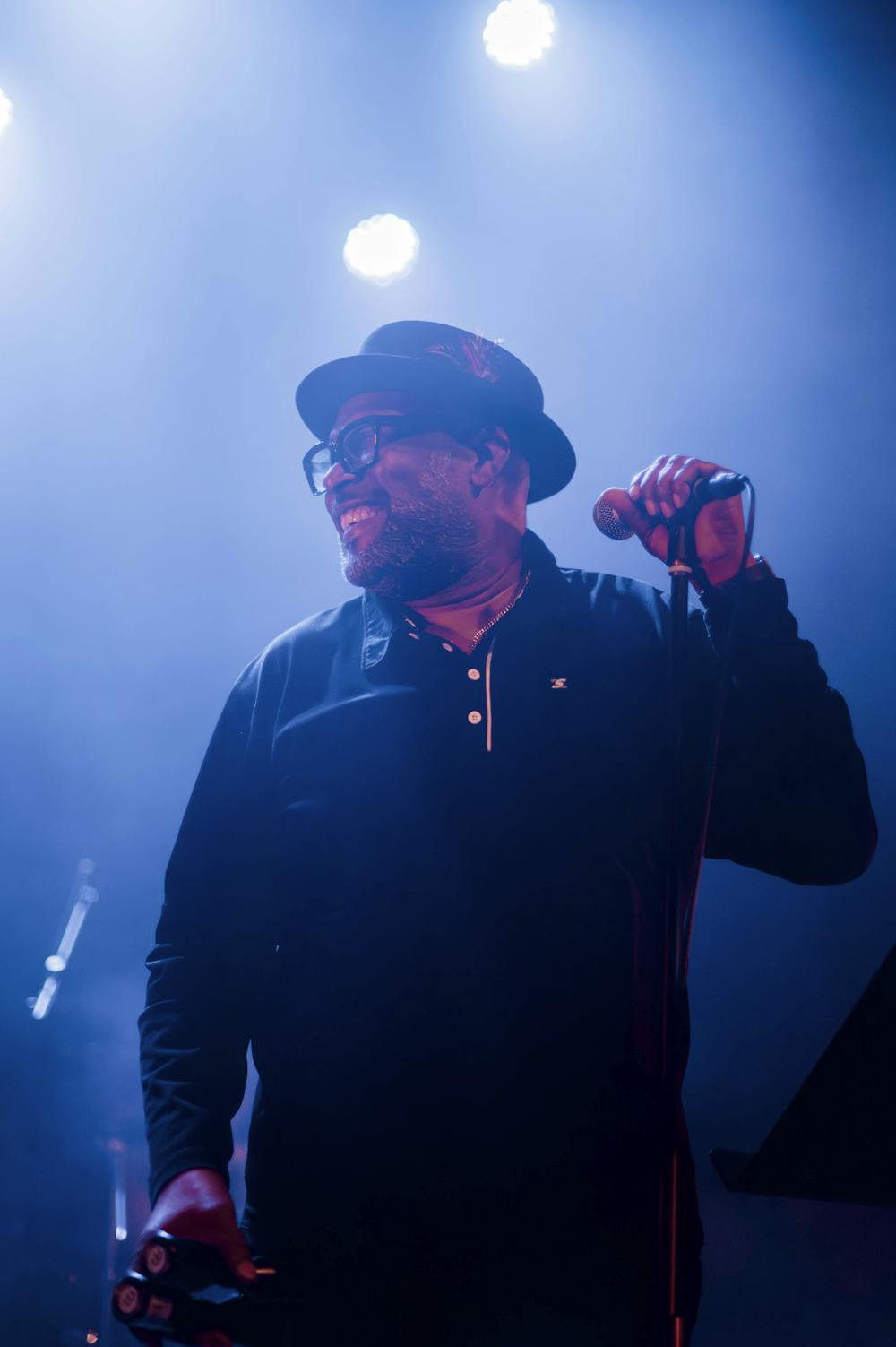 Soul legends Cymande were a standout.
Mark Francesca/Perth Festival
Soul legends Cymande were a standout.
Mark Francesca/Perth Festival
Politics and art
Marrugeku’s Mutiara was the supreme example of politics melding with artistic form.
Marrugeku excels at taking cultural memories of oppression and turning them into conflicted yet energised choreography.
Mutiara is framed around the experience of First Nations, Malay and creole workers in the Australian pearling industry of the early 20th century. The dancers fight impulses from within, generating empowered choreographic expressions.
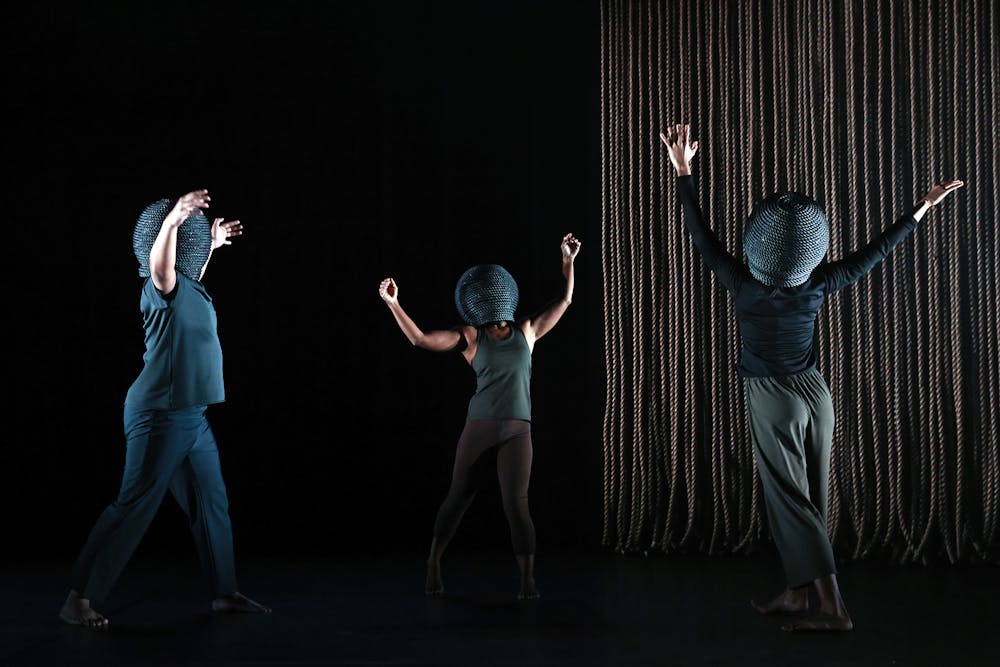 Marrugeku extol at taking cultural memories of oppression and turning them into choreography.
Prudence Upton/Perth Festival
Marrugeku extol at taking cultural memories of oppression and turning them into choreography.
Prudence Upton/Perth Festival
The choreography is co-devised by performers Soultari Amin Farid, Dalisa Pigram and Zee Zunnur, together with Ahmat Bin Fadal. It draws on Malay martial arts (silat), First Nations and Malay dance and European dance theatre. Sequences are often marked by abrupt redirections of velocity. Although weaving and flowing, the movement often pauses or pops, before finding new ways out of each temporary arrest. The dancers break through barriers with almost every gesture.
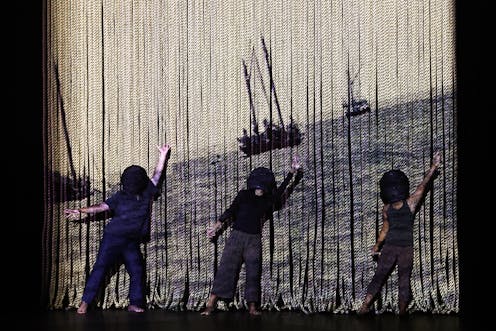
In one eerie sequence, the dancers enter not quite staggering, with black wicker baskets over their heads, hands flailing in slow motion or pointing in awkward poses. Only later did I realise this sequence represented the dancers dreaming of being dressed in diving helmets while finding their way on the bottom of the ocean.
For many festival shows, just the act of putting on the show could be political, but Marrugeku focused on that most complex tool of political expression: the body.
Read more: A theatre production ... in the pool? This new play in Perth leaves the audience buoyed
Authors: Jonathan W. Marshall, Associate Professor & Postgraduate Research Coordinator, Western Australian Academy of Performing Arts, Edith Cowan University


















