

how Australia’s environment fared in the world’s hottest year
- Written by: Albert Van Dijk, Professor, Water and Landscape Dynamics, Fenner School of Environment & Society, Australian National University
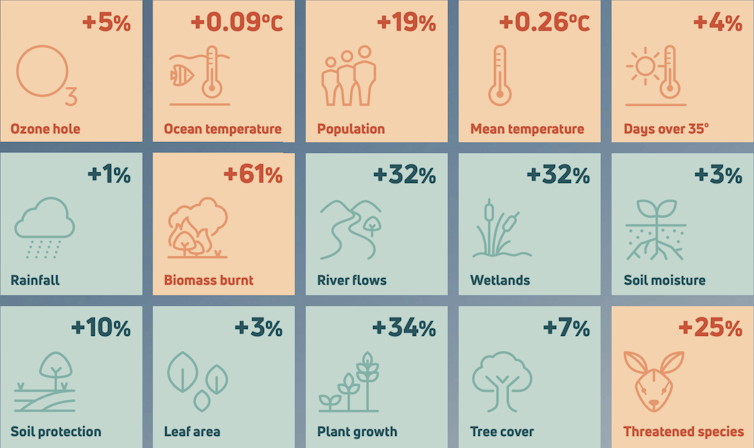
Global climate records were shattered in 2023, from air and sea temperatures to sea-level rise and sea-ice extent. Scores of countries recorded their hottest year and numerous weather disasters occurred as climate change reared its head.
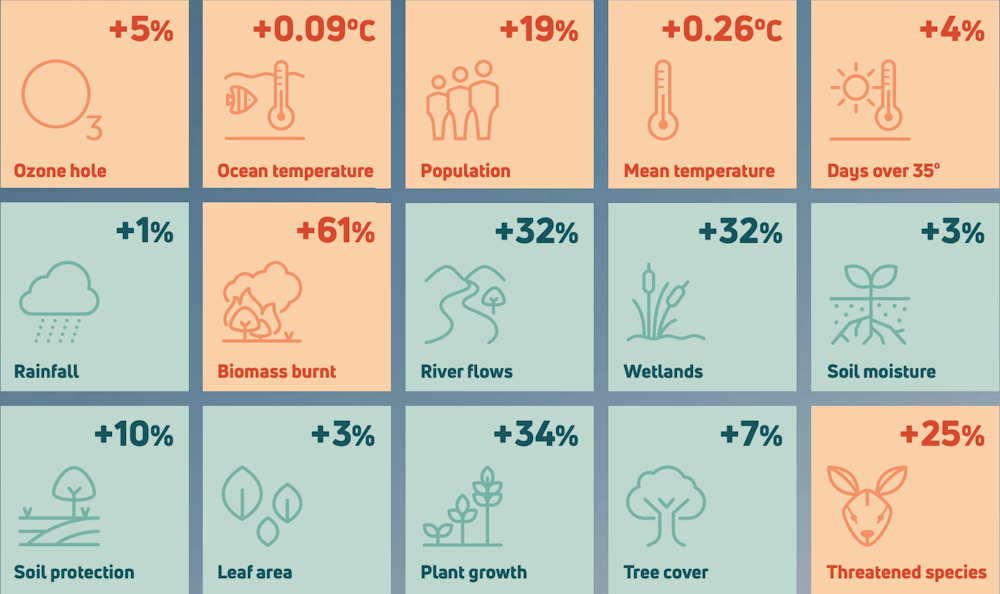
How did Australia’s environment fare against this onslaught? In short, 2023 was a year of opposites.
For the past nine years, we have trawled through huge volumes of data collected by satellites, measurement stations and surveys by individuals and agencies. We include data on global change, oceans, people, weather, water, soils, vegetation, fire and biodiversity.
Each year, we analyse those data, summarising them in an annual report that includes an overall Environmental Condition Score and regional scorecards. These scores provide a relative measure of conditions for agriculture and ecosystems. Scores declined across the country, except in the Northern Territory, but were still relatively good.
However, the updated Threatened Species Index shows the abundance of listed bird, mammal and plant species has continued to decline at a rate of about 3% a year since the turn of the century.
Read more: How 2023's record heat worsened droughts, floods and bushfires around the world
Riding a climate rollercoaster in 2023
Worldwide, 77 countries broke temperature records. Australia was not one of them. Our annual average temperature was 0.53°C below the horror year 2019. Temperatures in the seas around us were below the records of 2022.
Even so, 2023 was among Australia’s eight warmest years in both cases. All eight came after 2005.
However, those numbers are averaged over the year. Dig a bit deeper and it becomes clear 2023 was a climate rollercoaster.
The year started as wet as the previous year ended, but dry and unseasonably warm weather set in from May to October. Soils and wetlands across much of the country started drying rapidly. In the eastern states, the fire season started as early as August.
Nonetheless, there was generally still enough water to support good vegetation growth throughout the unusually warm and sunny winter months.
Fears of a severe fire season were not realised as El Niño’s influence waned in November and rainfall returned, in part due to the warm oceans. Combined with relatively high temperatures, it made for a hot and humid summer. A tropical cyclone and several severe storms caused flooding in Queensland and Victoria in December.
As always, there were regional differences. Northern Australia experienced the best rainfall and growth conditions in several years. This contributed to more grass fires than average during the dry season. On the other hand, the rain did not return to Western Australia and Tasmania, which ended the year dry.
So how did scores change?
Every year we calculate an Environmental Condition Score that combines weather, water and vegetation data.
The national score was 7.5 (out of 10). That was 1.2 points lower than for 2022, but still the second-highest score since 2011.
Scores declined across the country except for the Northern Territory, which chalked up a score of 8.8 thanks to a strong monsoon season. With signs of drought developing in parts of Western Australia, it had the lowest score of 5.5.
 Environmental Condition Score by state and territory and change from the previous year.
Australia's Environment 2023 Report
Environmental Condition Score by state and territory and change from the previous year.
Australia's Environment 2023 Report
The Environmental Condition Score reflects environmental conditions, but does not measure the long-term health of natural ecosystems and biodiversity.
Firstly, it relates only to the land and not our oceans. Marine heatwaves damaged ecosystems along the eastern coast. Surveys in the first half of 2023 suggested the recovery of the Great Barrier Reef plateaued.
However, a cyclone and rising ocean temperatures occurred later in the year. In early 2024, another mass coral bleaching event developed.
Secondly, the score does not capture important processes affecting our many threatened species. Among the greatest dangers are invasive pests and diseases, habitat destruction and damage from severe weather events such as heatwaves and megafires.
Read more: New ecosystems, unprecedented climates: more Australian species than ever are struggling to survive
Threatened species’ declines continued
The Threatened Species Index captures data from long-term threatened species monitoring. The index is updated annually with a three-year lag, largely due to delays in data processing and sharing. This means the 2023 index includes data up to 2020.
The index showed an unrelenting decline of about 3% in the abundance of Australia’s threatened bird, mammal and plant species each year. This amounts to an overall decline of 61% from 2000 to 2020.
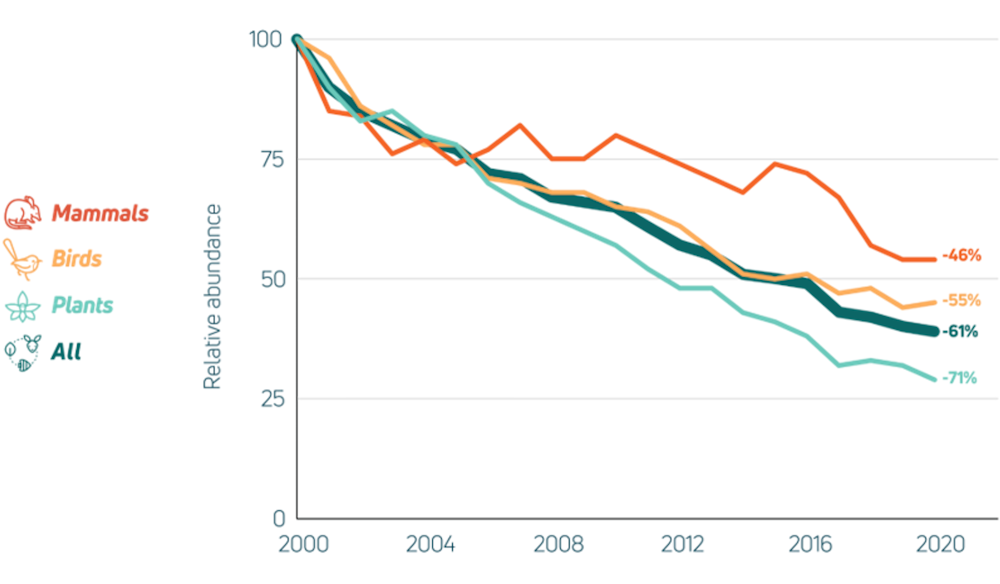 Threatened Species Index showing the abundance of different categories of species listed under the EPBC Act relative to 2000.
Australia's Environment 2023 Report
Threatened Species Index showing the abundance of different categories of species listed under the EPBC Act relative to 2000.
Australia's Environment 2023 Report
The index for birds in 2023 revealed declines were most severe for terrestrial birds (62%), followed by migratory shorebirds (47%) and marine birds (24%).
A record 130 species were added to Australia’s threatened species lists in 2023. That’s many more than the annual average of 29 species over previous years. The 2019–2020 Black Summer bushfires had direct impacts on half the newly listed species.
Population boom adds to pressures
Australia’s population passed 27 million in 2023, a stunning increase of 8 million, or 41%, since 2000. Those extra people all needed living space, food, electricity and transport.
Australia’s greenhouse gas emissions have risen by 18% since 2000. Despite small declines in the previous four years, emissions increased again in 2023, mostly due to air travel rebounding after COVID-19.
Our emissions per person are the tenth-highest in the world and more than three times those of the average global citizen. The main reasons are our coal-fired power stations, inefficient road vehicles and large cattle herd.
Nonetheless, there are reasons to be optimistic. Many other countries have dramatically reduced emissions without compromising economic growth or quality of life. All we have to do is to finally follow their lead.
Our governments have an obvious role to play, but we can do a lot as individuals. We can even save money, by switching to renewable energy and electric vehicles and by eating less beef.
Changing our behaviour will not stop climate change in its tracks, but will slow it down over the next decades and ultimately reverse it. We cannot reverse or even stop all damage to our environment, but we can certainly do much better.
Authors: Albert Van Dijk, Professor, Water and Landscape Dynamics, Fenner School of Environment & Society, Australian National University


















