

‘I wanted to stop … but I also wanted to pull’. 1 in 50 people have trichotillomania – a new memoir unpacks compulsive hair-pulling
- Written by: Jane Turner Goldsmith, PhD candidate, Creative Writing, University of Adelaide
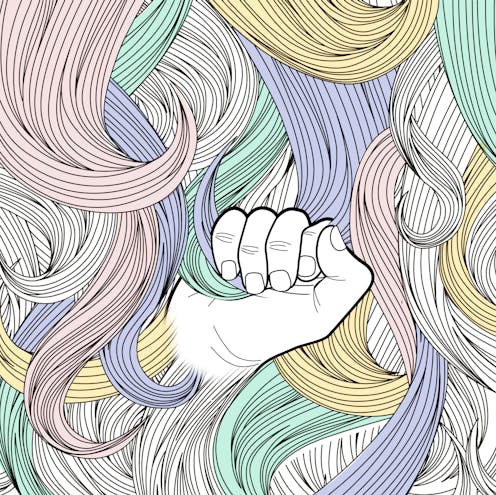
Towards the end of Adele Dumont’s affecting memoir The Pulling, she thanks the reader, her “stranger”, for the opportunity to unburden herself of her compulsion of 17 years (and since the age of 17): to pull out strands of her hair, regularly and frequently. As a result, a large section of her scalp would eventually lay bare, yet cleverly concealed from others.
Hair-pulling, or trichotillomania, does not come up much in public conversation. While terms such as ADHD, OCD or PTSD have almost passed into common parlance, hair-pulling is not well known, despite, as the author claims, affecting 2% of the population – an incidence greater than that of schizophrenia (0.32%) or bipolar disorder (around 1% over a lifetime).
Read more: Pulling out your hair in frustration? What you need to know about trichotillomania
But the secrecy and shame that surrounds trichotilllomania mean it is very much a hidden disorder, poorly understood by the general population. Pull your hair out – why don’t you just stop?
Review: The Pulling – Adele Dumont (Scribe)
Dumont’s memoir is structured around themes (“inside an episode”, “shame”, “other people”) and starts with an account of her childhood and family upbringing. The quality of the writing and the tender voice quickly drew me into the mystery of this baffling disorder.
Reading it, I was alert for evidence of trauma or abuse, anything that might explain Dumont’s “eventual unravelling”. There are very few clues from childhood.

Sensing something amiss
Her parents met while fruit-picking in far-north Queensland; her father was a backpacker from France. Together they spent 15 years moving between orchards and later, with their two daughters, from farm to farm across rural Australia. The family lived in tents and later a caravan, and the young Adele remembers a solitary childhood: lived in nature, but never far from her parents.
The family moved to the outskirts of Sydney for the girls to attend school. In the holidays or on weekends, the young Adele remembers her father lifting her gently from sleep to her bed in the Kombi, waking up in orchards.
Her parents stayed together, despite some “unease in the marriage”. She adored her self-taught French bookworm father, his devotion to her and younger sister (“E”), his capacity to accept others “as they were”. Dumont presents her mother as a psychologically complex character, a little scary. “Mama” was at pains to provide materially for her daughters, but not present in a way that enabled them to relax in their own home.
Mama was devoted to her daughters and they led a frugal (“elemental”) life where nothing was ever wasted. Dumont uses the example of her mother’s tendency to hoard, and her own tendency to hoard secrets, to explain her eventual writing of “this silence and all this story” — lest it be wasted.
Dumont writes of her mother’s “laughter without any happiness in it”. She can’t remember her mother “ever being calm”. Perhaps her mother’s family history might account for this: she had an alcoholic brother who died young and a father diagnosed with PTSD – Dumont recalls him as “emotionally detached and damaged”.
The watchful young Adele falls into a pattern of reasoning that is common to hyperaware and highly empathic children who sense something amiss in the people they love. She feels responsible for, in this case, her mother’s suffering.
Read more: Can reading help heal us and process our emotions – or is that just a story we tell ourselves?
Compensating by being ‘exceptional’
One possible clue to the origins of the hair-pulling habit is that the young Adele resented comparison with her mother (her thick hair or full cheeks, for example) but loved being noticed for being “just like Papa” for her habit of playing with her hair while reading. This innocuous-seeming gesture was, in Dumont’s words “a convenient cover for what I was really doing”.
Another clue is Dumont’s tendency towards perfectionism and savage self-criticism. Like so many young women who, sadly, are not comfortable about their appearance, Dumont developed “good girl” behaviours and excelled at school, writing and languages. (“To compensate for this ugliness I needed to be exceptional – exceptionally good, exceptionally polite, exceptionally kind.”) She became a teacher of English and taught asylum-seekers in detention, the subject of her first book.
Dumont claims her secret was too “nebulous” to even attempt putting into words. But she manages to powerfully and elegantly deconstruct the experience of a hair-pulling episode, at the same time cautioning her reader (“you”) that this might be painful to bear.
She describes the urge to go to the place “where only [she] could go”, the desire to pull, the trance-like state it engendered. In her transportation, she finds something “unknowable”, a kind of clarity and “grace”:
Rather than different thoughts all jostling for attention, I am able to discern one strand of thought, which reveals itself as cleanly as a fishbone lifted from its surrounding flesh. This strand of thought distinguishes itself not only in its purity but in its fluidity; roaming and cartwheeling and leaping like a creature released.
Dumont manages very effectively to evoke the full, sensory, “surreal” experience of hair-pulling for her. As a reader, I felt I could enter her world and (almost) comprehend the payoffs of the behaviour. I understood these as something to do with being in flow and claiming an intimate, secret space of oneness with self. There is some enlightenment, yet enough mystery to keep reading.
Read more: Pulling out your hair in frustration? What you need to know about trichotillomania
Defining compulsions
There are no simple answers to the problem of trichotillomania: “I wanted to stop pulling, but I also wanted to pull. And one of these desires was always stronger than the other.”
The ambivalence Dumont reveals about her hair-pulling is also reflected in the “irreconcilable” chasm she feels between herself and others, and between her known self and the self revealed to others. It also explains her resistance to therapy.
 It took Dumont 11 years to seek professional help for a disorder that started as a harmless habit and morphed into a significant compulsion that threatened relationships, work, quality of life and her future. Such resistance might resonate with anyone trying to dispense of an unwelcome habit.
There is the sense of not wanting to let go of something that is in some way defining, as Dumont puts it: “Nobody – no professor or psychiatrist – has the power to eradicate my compulsions. They are mine to keep.”
There is also, fortunately for the reader empathising strongly with Dumont’s conflict and pain, a healthy dose of self-dignity at stake (no doubt also familiar to hesitant help-seekers). “Asking someone for help was a form of cheating.”
But the biggest reason for resisting help or even disclosing the habit to those close to her – not even her parents or sister knew – was shame. Shame and being “ashamed at [her] own shame” drew her into a defensive cycle of approaching/resisting help and disclosure. The tension and effort of having to keep the habit secret for fear of being discovered took a toll Dumont admits is “so high it can shape one’s destiny”.
Dumont’s silent plea for the psychologist to whom she would eventually confide could also be “you” – her reader, her stranger. She writes:
I need her to be tender and patient and sensitive but not to pity me. Professional but not clinical. I need her to understand the gravity of my situation, but not to try to amend it.
It is a plea for acceptance and a strong aversion to glib solutions.
There is a sharply intellectual quality to this memoir, written by a deeply reflective young woman. By the last page of the memoir, I felt I was indeed Dumont’s intended reader, her stranger, her “you”. I returned her appreciation, grateful for the opportunity to walk a little in her shoes, painful though it was at times – and for her honesty, courage and intimacy.
Dumont’s testimony is written with perceptive insight, both into herself and those around her. She is a gifted and compassionate linguist and writer.
Despite the very specific nature of the subject, the memoir speaks to a broad readership: to anyone who has felt the isolation of difference, whether “being” different or simply feeling it. Hers is at once a brave appeal to readers for understanding and acceptance, and a brave read.
Authors: Jane Turner Goldsmith, PhD candidate, Creative Writing, University of Adelaide
It took Dumont 11 years to seek professional help for a disorder that started as a harmless habit and morphed into a significant compulsion that threatened relationships, work, quality of life and her future. Such resistance might resonate with anyone trying to dispense of an unwelcome habit.
There is the sense of not wanting to let go of something that is in some way defining, as Dumont puts it: “Nobody – no professor or psychiatrist – has the power to eradicate my compulsions. They are mine to keep.”
There is also, fortunately for the reader empathising strongly with Dumont’s conflict and pain, a healthy dose of self-dignity at stake (no doubt also familiar to hesitant help-seekers). “Asking someone for help was a form of cheating.”
But the biggest reason for resisting help or even disclosing the habit to those close to her – not even her parents or sister knew – was shame. Shame and being “ashamed at [her] own shame” drew her into a defensive cycle of approaching/resisting help and disclosure. The tension and effort of having to keep the habit secret for fear of being discovered took a toll Dumont admits is “so high it can shape one’s destiny”.
Dumont’s silent plea for the psychologist to whom she would eventually confide could also be “you” – her reader, her stranger. She writes:
I need her to be tender and patient and sensitive but not to pity me. Professional but not clinical. I need her to understand the gravity of my situation, but not to try to amend it.
It is a plea for acceptance and a strong aversion to glib solutions.
There is a sharply intellectual quality to this memoir, written by a deeply reflective young woman. By the last page of the memoir, I felt I was indeed Dumont’s intended reader, her stranger, her “you”. I returned her appreciation, grateful for the opportunity to walk a little in her shoes, painful though it was at times – and for her honesty, courage and intimacy.
Dumont’s testimony is written with perceptive insight, both into herself and those around her. She is a gifted and compassionate linguist and writer.
Despite the very specific nature of the subject, the memoir speaks to a broad readership: to anyone who has felt the isolation of difference, whether “being” different or simply feeling it. Hers is at once a brave appeal to readers for understanding and acceptance, and a brave read.
Authors: Jane Turner Goldsmith, PhD candidate, Creative Writing, University of Adelaide 

















