

Even far from the ocean, Australia’s drylands are riddled with salty groundwater. What can land managers do?
- Written by: Nik Callow, Associate Professor - Geography, The University of Western Australia
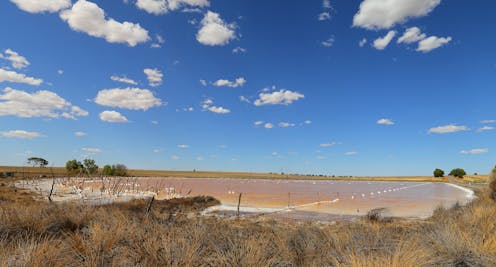
In the 1890s, railway engineers noticed river water used by steam locomotives started to become salty when surrounding land was cleared for agriculture.
Over the next decades, the problem worsened. In 1917, a Royal Commission in Western Australia dismissed the threat from salt and instead promoted more clearing of land.
Ignoring the problem didn’t solve it. Salt water began rising from below in many new agricultural regions. Crops could not use this salty water. In March 1924 – a century ago this month – the railway engineer W.E. Wood published the first scientific paper on the causes of salinity in Australia.
Wood concluded land clearing was causing groundwater levels to rise, bringing salt stored underground to the surface. He correctly proposed the salt in this region had come from the oceans, after evaporated seawater with residual salt fell as rain.
In 2002, our last comprehensive national estimate put salinity-affected land at around 1.75 to 2 million hectares – about 7.5 times the size of the Australian Capital Territory.

What is dryland salinity?
Salt is a natural part of our oceans. Some parts of the land have plenty of salt and are naturally saline. Salt lakes are part of traditional songlines. Globally, we also find salted earth where former inland seas have deposited salt and where irrigation has concentrated salt in the soil.
But other areas have become salty due to land clearing. This is dryland salinity. When deep-rooted trees and shrubs are present, they use most of the rainfall. Very little is left over to leak down into the groundwater.
When trees and shrubs are cut down to make way for farmland, more rain permeates the earth. This mixes with naturally salty groundwater and rises to the surface where it can damage plants and infrastructure.
Plants such as samphire are salt-tolerant and can live in salt lakes. Saltbush can absorb salty water and get rid of the salt by expelling it onto the outside of its leaves. But most plants can’t do this. Absorbing salt water will damage or kill them.
The cruel irony of dryland salinity is that plants can die in dry landscapes from there being too much water.
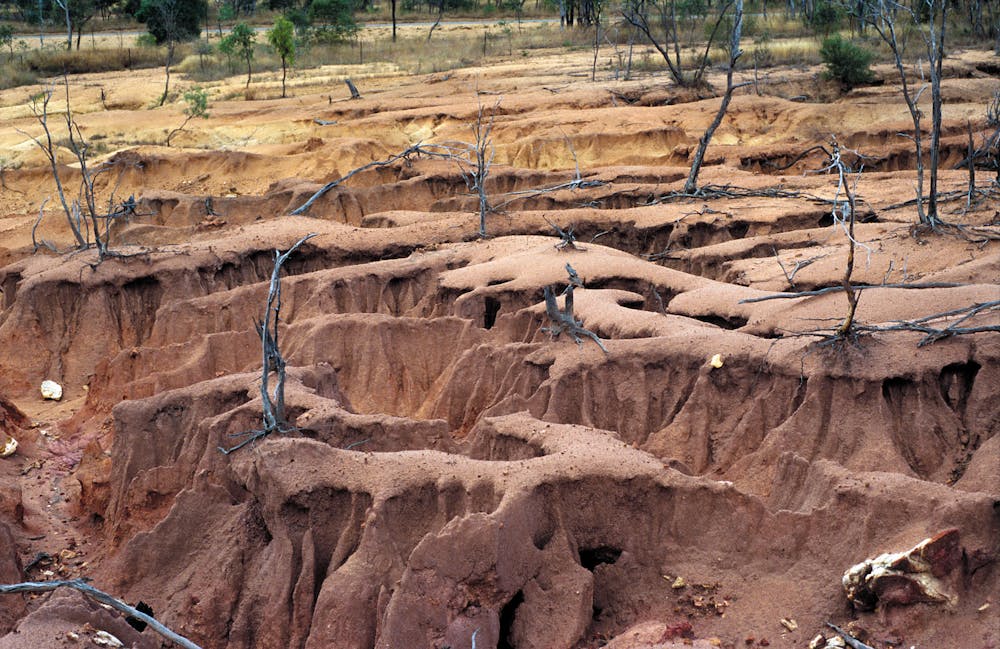 After dryland salinity killed these trees, serious erosion can begin. This image is of a mesa landscape west of Charters Towers in northern Queensland.
CSIRO/Wikimedia, CC BY
After dryland salinity killed these trees, serious erosion can begin. This image is of a mesa landscape west of Charters Towers in northern Queensland.
CSIRO/Wikimedia, CC BY
The long search for solutions
In Australia, dryland salinity is worst in southwest Western Australia, as well as the southern and western reaches of the Murray-Darling Basin.
We didn’t begin trying to fix the problem in earnest until the 1950s, when state-based Soil and Land Conservation services started tackling salinity in Australia.
The 1990s saw the first nationally coordinated efforts through the National Dryland Salinity Program. This drew together farmers, community groups, natural resource management organisations, universities and government agencies such as CSIRO. Satellites gave us a better understanding of the true extent of the problem, estimated to affect around 20,000 farms.
Unfortunately, we no longer have a coordinated national approach. Government investments have shifted to focus on equally complex challenges such as improving water quality in Great Barrier Reef catchments and trying to save threatened species from extinctions.
Read more: I have always wondered: why is the sea salty?
Saltbush, not ponds
So what works against dryland salinity? Researchers have found some practical and economic solutions.
Revegetating the landscape can work, but requires trees, shrubs and plantations to cover two-thirds of a cleared catchment to manage a problem affecting a much smaller area. This is very expensive, and doesn’t work well with existing farms or for regional communities.
The most widely adopted methods of dealing with salt are based on adaptation, such as planting species such as river and old man saltbush on saline land and areas around it. Livestock can eat the leaves, and saltbush species are excellent at living in salty soils.
Other developing options include pumping up brackish groundwater and turning it into high-quality water through micro-desalination.
Engineering solutions such as pumping out salty water and deep drainage run into problems with salt disposal, cost and challenges with clay soils, which do not drain well.
Subsurface drains in sandier soils near the surface can reduce waterlogging and salinity, and also increase crop productivity.
In areas prone to dryland salinity, reducing pooling of water reduces the salinity of water flowing into ecosystems downstream. This means landscape rehydration strategies such as natural sequence farming, which deliberately slow and pond water, can actually make salinity worse in older, weathered landscapes.
Less rain but still salinity
The scale of the salinity challenge is further demonstrated by the impact of climate change.
Since 1970, annual rainfall has fallen across Australia by about 10–15%, particularly in Victoria and southwest Western Australia. This change in climate has impacted drinking water supplies in WA, forcing an increasing reliance on desalination.
You might expect groundwater levels to also potentially drop. But for many areas such as south-western WA and the Murray Darling Basin, groundwater levels are actually still rising even as rainfall declines, due to the ongoing impact of historic land clearing.
A key lesson we have learned from the long fight against dryland salinity is it’s very hard to create profitable farms which mimic the original natural systems.
The fight against salinity continues
Salinity still affects millions of hectares of agricultural land across Australia, driven by the processes described 100 years ago. An award for excellence in salinity research named after railway engineer W.E. Wood was awarded five times in the early 2000s, and will return in 2024 to mark the centenary of his paper.
We’ve learned a lot about dryland salinity in a century, but the search continues for viable methods of combating or adapting to the salt below.
Read more: Australia's south west: a hotspot for wildlife and plants that deserves World Heritage status
Authors: Nik Callow, Associate Professor - Geography, The University of Western Australia



















