

Is Dune an example of a white saviour narrative – or a critique of it?
- Written by: Cherine Fahd, Associate Professor Visual Communication, University of Technology Sydney

Science-fiction film as a genre allows us to encounter hypothetical worlds in which to understand our own.
These films often present utopian and dystopian worlds, exploring themes of nationalism and heroism. They often include a strong, white, male lead who heroically rescues the poor and the good from the stranglehold of authoritarianism. Therefore, historically, science fiction has had mass appeal for political zealots from the far left to the alt-right.
In Denis Villeneuve’s Dune: Part Two (2024), however, science fiction becomes a genre to subvert colonial and patriarchal narratives of the white, masculine saviour.
Read more: Bagpipes in space: how Hans Zimmer created the dramatic sound world of the new Dune film
What is a ‘white saviour’?
Elements of a white saviour narrative are pervasive in Villeneuve’s first Dune film (2021), which hints at – but doesn’t commit to – subverting this narrative. But before we get into the details, it helps to understand what the “white saviour complex” is.
This is, to put it simply, the idea that a white person or people are needed to help or “save” people of colour from their circumstances.
White saviourism, also called the white “messiah complex”, is born of a legacy of colonialism, and often performed in a paternalistic or self-serving way. For decades, we’ve seen this narrative play out in science-fiction films, from the Star Wars franchise to Avatar (2009).
The setup
Signs of white saviourism in the first Dune film are recognisable in the male protagonist, Paul Atreides, played by Timothée Chalamet. Paul is destined for messianic status in both films, which have so far stayed close to the plot line of Frank Herbert’s book series of the same name.
However, Chalamet’s casting as a white saviour is complicated by his physicality. In both demeanour and appearance, Paul Atreides contradicts the traditional masculinity of science-fiction heroes, with his fine features, elfin stature and mummy’s boy status.

The first film follows the House of Atreides as it travels to the distant planet, Arrakas, to take charge of the scarce and precious spice production which their future wealth, power and survival depend on.
The Indigenous inhabitants of Arrakas, the Fremen, are portrayed as being deeply connected to the desert environment.
They find innovative ways to survive in the extreme weather conditions, yet are considered savage by the aristocratic characters in the film. They’re even referred to as “rats” by the film’s villainous, luminously white, oil-bathing leader, Baron Vladimir Harkonnen.
This reflects a common criticism of the white saviour complex: it perpetuates stereotypes about the Indigenous people being “helped”, while ignoring their strengths and agency.
Dune as a colonial critique
It’s tempting to consider Dune’s narrative, settings and costume design as an appropriation of Islamic and Arab culture. For example, there are scenes where the Fremen are dressed in Bedouin clothing, worshipping behind an Islamic architectural screen in ways that are reminiscent of Muslim prayers at a mosque.
The cinematography and light also appear to refer to 19th-century paintings by Jean-Léon Gérôme, much of which are of Islamic subjects. Such appropriations aren’t unique to Dune; the landscape of Arrakas itself is reminiscent of Tatooine, the desert planet where much of the action takes place in the original Star Wars trilogy.
While the intention may be to create otherworldly settings, the portrayal of a desert land often relies on stereotypical tropes of “exoticness” associated with the Middle East, as well as the use of Arabic-sounding names for characters and locations.
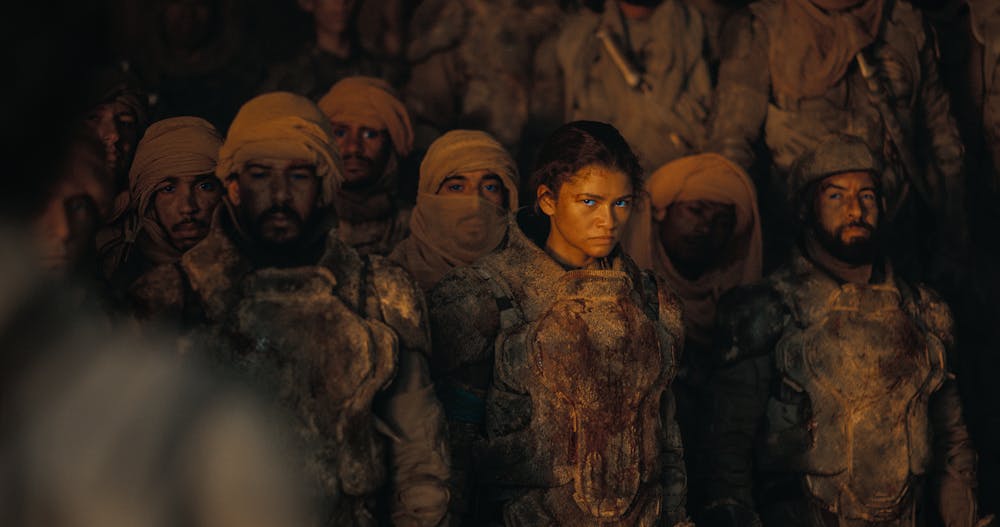 The Fremen are portrayed with clear parallels to real Arab-Bedouin peoples.
Courtesy Warner Bros
The Fremen are portrayed with clear parallels to real Arab-Bedouin peoples.
Courtesy Warner Bros
Nonetheless, there is a surprising critique of colonialist fantasy in Dune: Part Two, which primarily takes place through changes between the script and the book. These changes enable us to see the white saviour from the perspective of Chani (played by Zendaya), Paul’s Fremen love interest.
In the book, Chani is a supporting character who is merely there to encourage and promote Paul’s ascendancy. She is also a white person who is bound to Paul through having his children. In the film, Chani’s character has been adapted to provide a critical counterpoint.
This reveals Villeneuve’s directorial intention in reframing the book to account for the postcolonial and feminist perspectives of the 21st century. In many ways, Dune: Part Two can be read through the post-colonial perspective of late Palestinian-American writer Edward Said.
In his 1978 book Orientalism, a founding text of post-colonialism, Said argued against the West’s distorted image of the East or the Orient as exotic, backward, uncivilised and sometimes dangerous.
He expressed that Western scholars, artists and politicians use Orientalism as a pervasive framework to depict the East as the “Other”. This reinforces a binary opposition between the West as rational, developed and superior and the East as irrational, undeveloped and inferior.
While we see this play out in both Dune films’ visual tropes, a more nuanced message is delivered through the character of Chani.
Paul through Chani’s eyes
Chani is a woman of colour who is sceptical of Paul’s mother’s intentions for him as leader. She also refuses to believe in the prophecy of a saviour, as is held by some Fremen.
Ultimately, the film’s postcolonial and feminist leanings are made explicit in the final scenes. Through careful cinematography and editing, the audience is encouraged to see, from Chani’s perspective, the ways in which Paul is being manipulated.
 Chani (Zendaya) is sceptical of the intentions of Paul’s mother, Jessica Atreides (Rebecca Ferguson).
Courtesy Warner Bros
Chani (Zendaya) is sceptical of the intentions of Paul’s mother, Jessica Atreides (Rebecca Ferguson).
Courtesy Warner Bros
When Paul avenges the death of his father and takes control of the empire, promising to marry the empress – despite having declared his enduring love for Chani – we encounter this betrayal from Chani’s standpoint.
The scenes tend to switch back to her disappointment as the witness. As viewers, we are not encouraged to celebrate Paul’s rise to messiah. Rather, we mourn the loss of his moral conscience with Chani. And this point is affirmed when we see Chani surfing the worm alone in the final scenes.
As a woman of colour who is both independent, powerful and resistant to the white saviour narrative, Chani activates the idea of looking at cinema from a non-white vantage point. She leads us to be critical of both colonial and patriarchal narratives.
Where will this lead? We will have to find out in the next film.
Read more: Diplomacy and resistance: how Dune shows us the power of language – including sign language
Authors: Cherine Fahd, Associate Professor Visual Communication, University of Technology Sydney


















