
Australia must wean itself from monster utes – and the federal government’s weakening of vehicle emissions rules won’t help one bit
- Written by: John Quiggin, Professor, School of Economics, The University of Queensland
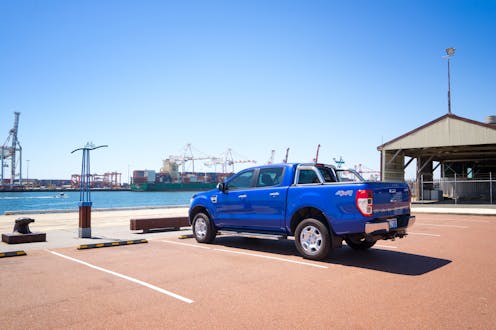
The federal government has bowed to pressure from the car industry, announcing it will relax proposed emissions rules for utes and vans and delay enforcement of the new standards by six months.
The legislation was introduced to parliament on Wednesday. The government says the new rules give Australian motorists a greater choice of electric vehicle models and insists the policy is “good for the environment”.
But on the latter point, the government is mistaken. The amended rules will slow the reduction in emissions from Australia’s polluting road transport sector. And they reflect domestic and international trends that, taken together, increase the risk Australia, and the world, will fail to achieve net-zero emissions by 2050.
What are the changes?
Vehicle emissions standards set a limit on grams of CO₂ that can be emitted for each kilometre driven, averaged across all new cars sold. Carmakers failing to meet the standards will incur financial penalties.
The federal government released its initial version of proposed vehicle emissions standards in February.
Under the changes announced this week, some 4WD wagons – such as the Toyota LandCruiser and Nissan Patrol – will be reclassified from “passenger car” to “light commercial vehicle”. The change means less stringent emissions standards will apply to those models.
In a statement, the government justified the change by saying some off-road wagons have a similar chassis and towing capacity to vehicles in the light-commercial category, and so should be subject to the same standards.
The government will also give more favourable treatment to heavier vehicles. And manufacturers will not be penalised under the scheme until July 2025 – six months later than the government originally proposed.
The global picture
The government’s decision to weaken the standards is a response to pressure from the domestic vehicle industry, and a concession to the Opposition which falsely claims the new standards are a “ute tax”.
But the watering-down also reflects a broader international trend in which the legacy vehicle industry is backing away from its earlier commitments to a rapid transition to electric vehicles.
For example, in the United States Ford and GM have both cut back production of some models, reportedly due to lower-than-expected consumer demand.
Also in the US, carmakers this month secured a relaxation of the Biden administration’s fuel efficiency targets for new vehicle sales.
US politicians are also pushing for increased tariff protection from imports, already taxed at 27.5%. This would make US producers even more competitive against big Chinese electric vehicle brands such as BYD.
Toyota, the world’s largest car maker, has gone all-in on hybrid electric vehicles, beginning with the highly successful Prius. But as the global market has shifted to fully electric cars, Toyota has fought against further tightening of standards.
Pressures in Australia
Australia no longer has a domestic car manufacturing industry. But global carmakers continue to exert powerful influence through the Federated Chamber of Automotive Industries, Australia’s peak industry body for manufacturers and importers of passenger and light-commercial vehicles. The chamber has consistently lobbied against effective climate action.
The government’s agreement to weaken standards also reflects the prevailing assumption, apparently shared by both major parties, that tradespeople comprise the majority of the “working class” voters for whom they are vying.
But it’s an out-of-date assumption. In the 1980s, the occupations fitting a broad interpretation this term (trades and technical workers, machinery operators and labourers) accounted for 40% of all employed workers, and a majority of full-time non-managerial workers.
But today, only 28% of workers fit this description. Workers with professional qualifications, such as teachers and nurses, outnumber trades and technical workers two to one. But their concerns are frequently dismissed by some politicians as those of a woke, inner-city minority.
Utes are changing
The shift from substance to symbol in regards to the working class is mirrored in the transformation of utes themselves.
Until relatively recently – and as the name implies – utes were utilitarian vehicles designed for the practical tasks of carrying a farming couple “to church on Sundays and the pigs to market on Mondays”. But over time, this has been replaced by various forms of cosplay.
Utes have been tricked out with sports bars and fancy wheels, metallic paint and so on. More recently, the traditional ute has been replaced by US-style pickups, typically sold in dual-cab configurations.
Most models of the market-leading Ford Ranger don’t even offer a single-cab version, though such versions are sold overseas.
These vehicles are massive, but many have far less carrying capacity than a traditional ute. For example, the Ram 1500 has a tub length of 1.7 metres, compared to about 2.4 metres for the tray of a standard single-cab ute.
Unless the growth in the size of passenger vehicles is stopped and reversed, Australia’s task of meeting our net-zero target will be even more difficult.
It’s unlikely the two big parties will act on this issue any time soon. But as climate change worsens, the need to wean ourselves from monster cars and internal-combustion engines will demand the attention of our political leaders.
Authors: John Quiggin, Professor, School of Economics, The University of Queensland


















