

Ten essential reads to catch up on Australian Space Agency news
- Written by: Sarah Keenihan, Section Editor: Science + Technology, The Conversation
The Australian government announced today South Australia is home to the Australian Space Agency.
Minister for Industry, Science and Technology Karen Andrews said Adelaide was selected to host the agency after putting forward the strongest case. She explained:
South Australia is already home to more than 60 organisations and 800 employees in the space sector and this decision builds on the very strong technology and defence presence in the state.
The news comes 15 months after the coalition government’s Simon Birmingham first declared Australia would finally have a space agency.
So how did we get here? Here are ten essential reads to fill you in.
1. Australia’s place in space seemed unclear
As the world’s space experts and agencies gathered in Adelaide ready for the International Astronautical Congress in September 2017, space historian Kerrie Dougherty mapped out Australia’s path from being a major space player in the late 1950s to being one of only two OECD nations without a space agency.
2. Then came the space agency announcement
Once the International Aeronautical Congress began, and in front of an expectant audience of more than 4,000 international delegates, Senator Simon Birmingham – representing then Minister for Industry, Innovation and Science, Arthur Sinodinos – announced Australia’s federal government is committed to a space agency.
We gathered analysis from three Australian experts in response to the announcement.
3. Existing capability began to be mapped
Megan Clark (formerly CSIRO head) launched a review of Australia’s existing space capabilities.
As explained by space policy expert Anthony Wicht, the Australian government released three reports examining Australia’s existing space capabilities, setting them in the light of international developments, and identifying growth areas and models for Australia to pursue.
4. But what does the Agency actually need?
Yes we’ve got capability, but space policy expert Anthony Wicht also analysed what the Australian space sector actually needed from its space agency.
His five key steps focused on including both “new” and “old” space, giving the agency actual power, making the most of the space “brain drain” and working cooperatively with the Department of Defence.
5. And there were more questions
As the process of gathering space capability continued, we asked two academics working the space sector – archeologist Alice Gorman and engineer Andrew Dempster – to give us their perspectives on key questions in the field. Things like: what will a space agency need in terms of people, resources and infrastructure? How strongly should the agency be linked with defence programs? Where should the space agency be located? Which Australian states have relevant space capabilities right now?
6. Federal budget 2018 allocated money
Space policy expert Anthony Wicht provided a breakdown on budget night, after the federal government announced A$41 million of funding to kickstart the Australian space sector over four years.
The funding was allocated across establishing the national space agency and international space investment.
7. Details on the agency became clearer
Megan Clark was announced as interim head of the space agency.
Space engineer Andrew Dempster fleshed out how the A$41 million of funding could be put to good use (and work together with other funding allocated in the sector more broadly).
To the ongoing question of where the agency should be located, Andrew wrote:
A national approach, with nodes in each state and territory, will be the most productive solution.
8. Don’t forget: Australia’s position is unique
Politics and funding notwithstanding, astrophysicist Simon Driver reminded us Australia sits in a vital position for international space observation – explaining we’re vital for the success of global space operations, and we can and should leverage this to Australia’s advantage.
Regarding Australia’s existing relationships with NASA and the European Space Agency, Simon wrote:
We have an opportunity to move from service provision to active partnership, and at the same time lean a little on the established leaders adept at industry engagement to kick-start our own aspirations and business start-ups.
9. But we need better space legislation
Yes we’ve got a space agency, and Megan Clark is now confirmed as head.
But space law academic Melissa de Zwart said there are gaps in our Space Activities Act that will restrict what Australia can do in space. She wrote:
[…] the Space Activities Amendment (Launches and Returns) Bill 2018 received its second reading in the House of Representatives on May 30, 2018, with little fanfare or coverage.
Despite the lengthy period of consultation and the initial statements that an entirely new Act would be drafted, this is a revision of the already existing legislation. It does little to inspire confidence in the government’s approach to an Australia commercial space industry.
10. And better policy around small satellites
Following SpaceX’s December 3 Falcon 9 rocket launch in the USA (which carried Australian small satellites among other items), military and space law expert Duncan Blake presented the case that Australia’s space agency could play a vital role in driving better policy around these shrinking devices.
The growing number of small satellites orbiting Earth present some unique challenges, such as interference with communication networks, the buildup of space junk, and the legal questions that arise if something goes wrong.
And the winner is: South Australia
Many of the issues raised over the past 15 months still remain to be addressed.
It’s clear there is a strong sense of excitement in South Australia now the head quarters of the space agency has been named as Adelaide’s old Royal Adelaide Hospital site (referred to as Lot Fourteen).
But what about the new logo? It’s based around Indigenous star constellations.
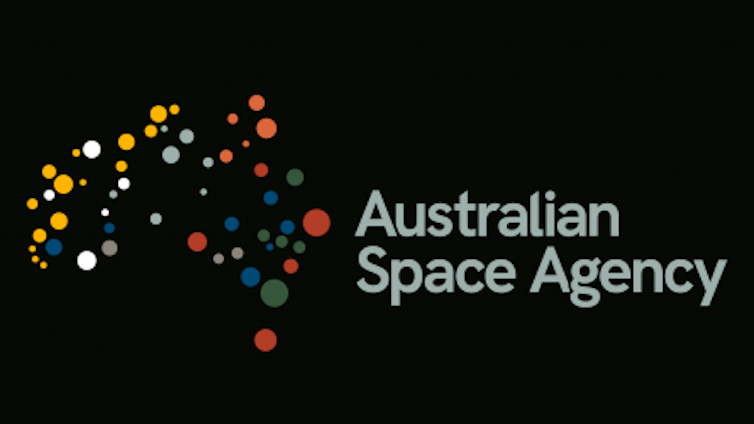 Australia’s new Space Agency logo is based around Indigenous constellations.
Australian Space Agency
Australia’s new Space Agency logo is based around Indigenous constellations.
Australian Space Agency
Indigenous elders Uncle Lewis O'Brien and Aunty Denise Smith-Ali granted the space agency approval to represent their stories of the night sky, including the emu in the sky, women in the sky and seven sisters.
Paul Curnow is an astronomy lecturer at University of South Australia and provided consultancy on star patterns seen in the agency’s branding. He said:
The emu in the sky is a dark cloud next to the Southern Cross that stretches out across the Milky Way towards Scorpius. In some cultures, the emu’s position in the sky signals the best time for emu egg collection, or when the emus are breeding, depending on the height above the horizon and time of year. These are depicted in yellow. This dark emu is seen throughout many parts of Australia by Indigenous groups.
The red/orange dots represent women in the sky, said Curnow:
The story behind the new space agency logo.The Noongar People see the Southern Cross as four women that had camped near a forest and were swept into the sky. The women were fleeing from a group of men because they had broken the law, so they flew up to the sky to become the four bright stars of the Southern Cross.
Read more: The stories behind Aboriginal star names now recognised by the world's astronomical body
Authors: Sarah Keenihan, Section Editor: Science + Technology, The Conversation
Read more http://theconversation.com/ten-essential-reads-to-catch-up-on-australian-space-agency-news-108671


















