The shocking facts revealed: how sharks and other animals evolved electroreception to find their prey
- Written by: Benedict King, PhD candidate in vertebrate palaeontology, Flinders University
Many creatures can use electric fields to communicate, sense predators or stun their prey with powerful electric shocks, but how this ability came about was a mystery.
Our new paper, published this week in the journal Palaeontology, details how this electroreception may have evolved in the earliest backboned animals.
It also reveals how completely new kinds of sensory organs were present in the ancient relatives of sharks and bony fishes, the extinct placoderm fishes.
Read more: The eyes have it: how vision may have driven fishes onto land
What is electroreception and how does it work?
Sharks are the poster child for electroreception. Some species are so sensitive to electric fields that they can detect the charge from a single flashlight battery connected to electrodes 16,000km apart. Great White Sharks are known to react to charges of one millionth of a volt in water.
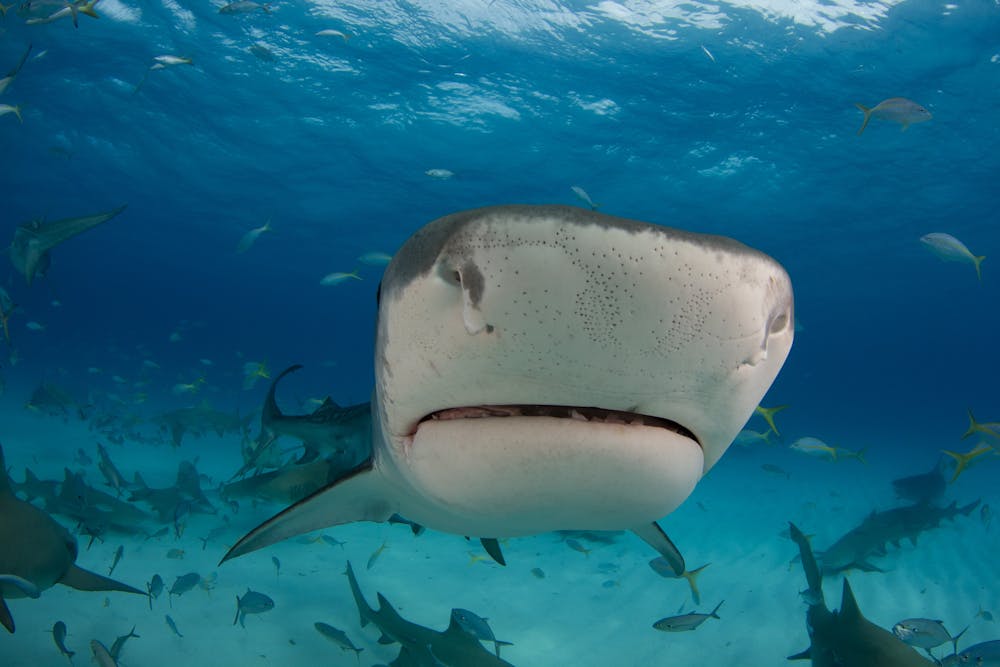 Note the many tiny pores on the snout of this Tiger Shark.These are electroreceptors called ‘ampullae of Lorenzini’.
Shutterstock/Matt
Note the many tiny pores on the snout of this Tiger Shark.These are electroreceptors called ‘ampullae of Lorenzini’.
Shutterstock/Matt
The electroreceptors (known as ampullae of Lorenzini) are jelly-filled tubes that open on the surface of sharks’ skin. Inside, each tube ends in a bulb known as the ampulla. If you remove the skin from the head of a shark, hundreds of these bulbs can be seen.
The jelly in the tube is highly conductive, which allows the electrical potential at the pore opening to be transferred to the ampulla at the base of the tube. Voltage differences across the membrane lining each ampulla then cause nerves to be activated, sending signals to the brain.
Electroreceptors are most often used to capture prey, by the detection of electrical fields generated by the prey. For example, this allows sharks to find prey hidden in the sand.
An explanation of electroreception.Some fish have also evolved complex electrocommunication, by which they communicate through the detection of electrical signals produced by other fish.
Although best known from sharks, electroreception is also known in several obscure groups of fishes, including lungfishes, coelacanths, the bizarre chimaerids, and the ancient jawless lampreys.
In fact, electroreception is surprisingly widespread in vertebrates, which led us to search for its presence in the ancestors of living fish by studying ancient fossils.
Fossil evidence for electroreception
High-resolution CT scans allowed us to “digitally dissect” well-preserved fossils and reveal sensory systems preserved inside the bones. One of the best known sensory systems in fossil fishes is the lateral line system, which detects pressure changes in water. Fishes use this system to change direction as a group without crashing into each other when swimming in a shoal.
But surrounding the lateral line system in some fossil fishes was another series of small holes. CT scans revealed that their internal structure was similar to electroreceptors in living fishes, and the position of the pores matches the distribution of electroreceptors in living lungfishes.
A complex system of branching tubes (below) appears to have supplied nerves to the electroreceptors.
Electroreceptor system revealed in the fossil lungfish Speonesydrion.These ancient electroreceptor systems appear to have been particularly elaborate in fossil lungfish. Lungfish are an ancient group, which still survive in Australia, Africa and South America. Exceptionally preserved 400 million year old fossil lungfish from Australia had snouts that were covered in a dense array of these electroreceptors.
Other fossils from the same time period show that electroreceptor systems may have been quite diverse. For example, another ancient fish, related to the ray-finned fishes called Ligulalepis, has a series of large pits that widen at the base, which may represent clusters of electroreceptors.
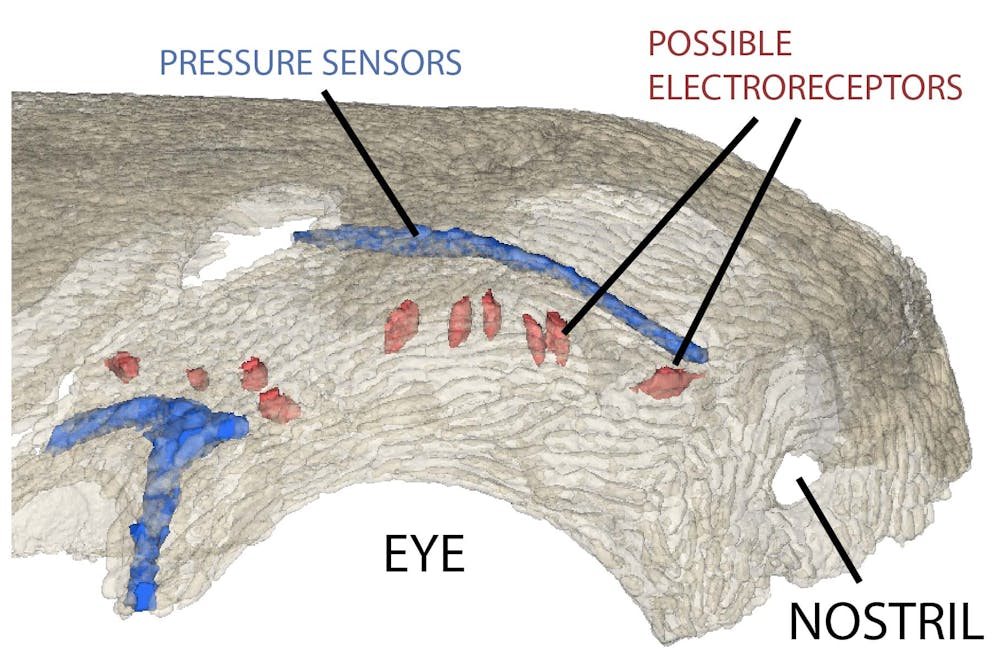 Digital model of the skull of the fossil fish Ligulalepis. The bone is rendered transparent to reveal the sensory systems inside.
Benedict King, Author provided
Digital model of the skull of the fossil fish Ligulalepis. The bone is rendered transparent to reveal the sensory systems inside.
Benedict King, Author provided
It now appears that during the early evolution of vertebrates, electroreceptor systems were diverse and went through a period of experimentation.
Some of these early experiments were successful and persist today. For example, the coelacanth (Latimeria) is a unique lobe-finned fish more closely related to land animals than most other fishes. It has a specialised electroreceptor organ called the rostral organ sunken into its braincase. This is used to detect prey hidden in small crevices when the coelacanth performs its characteristic “headstand”.
Unknown new sensory systems
Our studies also revealed previously unknown sensory systems in the placoderm fishes, an extinct group that dominated ecosystems between about 420 million and 360 million years ago. These sensory systems appear to be completely unique, although they do not resemble electroreceptors.
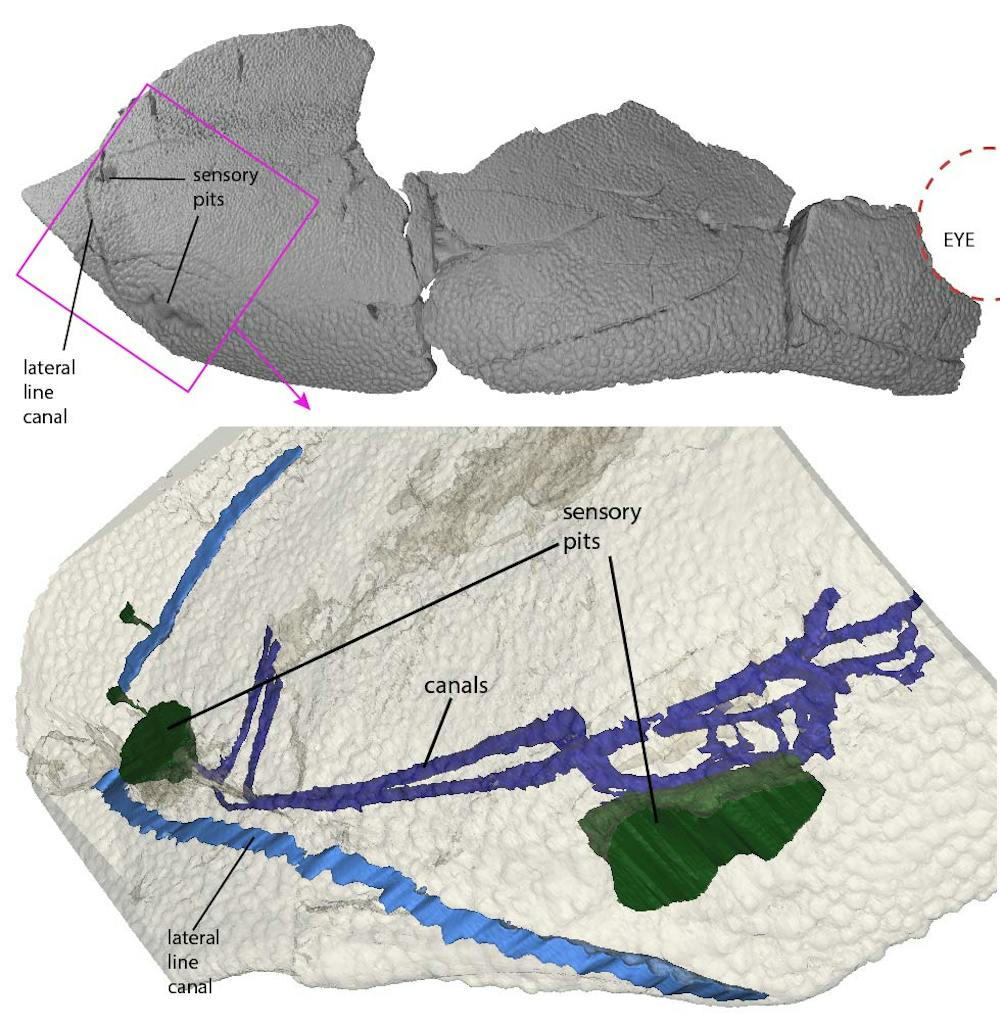 The right cheek of a placoderm fish, showing previously unknown sensory systems. Above, the bone and below, internal structure from CT scans.
Benedict King, Author provided
The right cheek of a placoderm fish, showing previously unknown sensory systems. Above, the bone and below, internal structure from CT scans.
Benedict King, Author provided
These include large pits on the underside of the cheek, which we have named “Young’s apparatus” in honour of Australian placoderm researcher Dr Gavin Young, who first illustrated them in detail from 3D fossils found near Burrinjuck Dam.
While we can’t confirm what they were used for, the fact that these pits show a nerve passage through the bone suggests that they might have housed some sort of unusual sensory system.
The more we study the ancient jawed placoderms, the more we discover about them that simply doesn’t match the predictions of the early researchers who thought them to be essentially shark-like.
Read more: Chew on this: we finally know how our jaws evolved
Recently we discovered that the oldest members of the group had jaws and cheek bones similar to early bony fishes (osteichthyans). Placoderms also revealed the origin of the vertebrate face, how sexual organs first evolved and when vertebrate copulation originated.
The unexpected discovery of new kinds of sensory systems also sends an evolutionary signal that they are not shark-like and indeed very distinct in the way they sensed their environment.
Our study of these fascinating fishes continues as more stunning 3D placoderm fossils are being found from Australian sites, and prepared using ditigal and CT tomographic methods. Work is in progress here in Australia that will soon reveal new information on the anatomy of these fishes never before imagined. Stay tuned.
Authors: Benedict King, PhD candidate in vertebrate palaeontology, Flinders University