

We saw one of the most powerful magnets in the Universe come to life – and our theories can’t quite explain it
- Written by: Marcus Lower, Postdoctoral Research Fellow, CSIRO
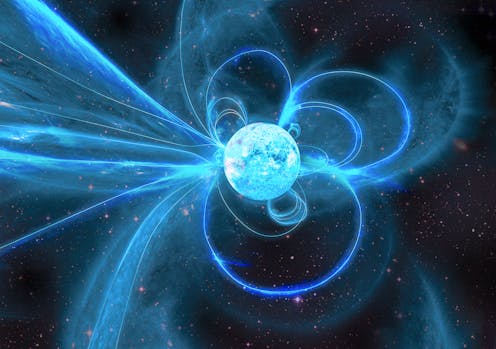
After a decade of silence, one of the most powerful magnets in the universe suddenly burst back to life in late 2018. The reawakening of this “magnetar”, a city-sized star named XTE J1810-197 born from a supernova explosion, was an incredibly violent affair.
The snapping and untwisting of the tangled magnetic field released enormous amounts of energy as gamma rays, X-rays and radio waves.
By catching magnetar outbursts like this in action, astronomers are beginning to understand what drives their erratic behaviour. We are also finding potential links to enigmatic flashes of radio light seen from distant galaxies known as fast radio bursts.
In two new pieces of research published in Nature Astronomy, we used three of the world’s largest radio telescopes to capture a host of never before seen changes in the radio waves emitted by one of these rare objects in unprecedented detail.
Magnetic monsters
Magnetars are young neutron stars, with magnetic fields billions of times stronger than our most powerful Earth-based magnets. The slow decay of their magnetic fields creates an enormous amount of stress in their hard outer crust until it eventually fractures. This twists the magnetic field and releases large amounts of energetic X-rays and gamma rays as it unwinds.
These exotic stars were initially detected back in 1979 when an intense gamma-ray burst emitted by one was picked up by spacecraft across the Solar System. Since then, we’ve found another 30 magnetars, the vast majority of which have only been detected as sources of X-rays and gamma rays. However, a rare few have since been found to also emit flashes of radio waves.
Read more: Explainer: what is a neutron star?
The first of these “radio-loud” magnetars goes by the name XTE J1810-197. Astronomers initially discovered it as a bright source of X-rays after an outburst in 2003, then found it emitted bright pulses of radio waves as it rotated every 5.54 seconds.
Unfortunately, the intensity of the radio pulses dropped rapidly, and within two years it had completely faded from view. XTE J1810-197 remained in this radio silent state for over a decade.
A wobbly start
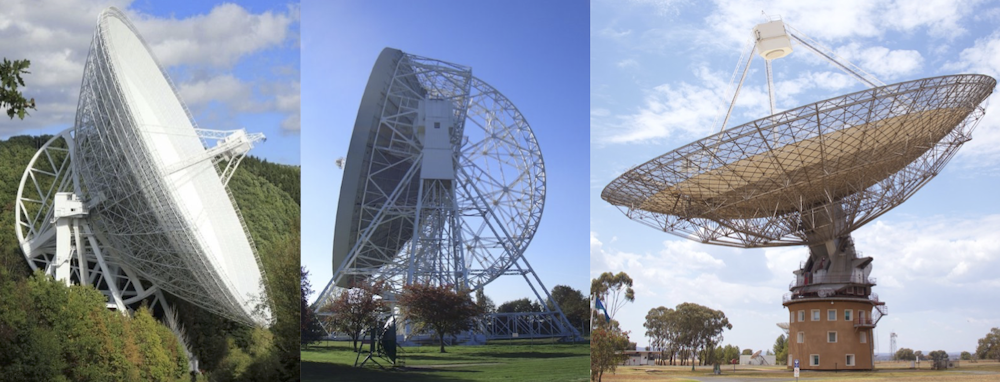
On December 11 2018, astronomers using the University of Manchester’s 76-metre Lovell telescope at the Jodrell Bank Observatory noticed that XTE J1810-197 was once again emitting bright radio pulses. This was quickly confirmed by both the Max-Planck-Institut’s 100-metre Effelsberg radio telescope in Germany and Murriyang, CSIRO’s 64-metre Parkes radio telescope in Australia.
Following confirmation, all three telescopes began an intense campaign to track how the magnetar’s radio emission then evolved over time.
The reactivated radio pulses from XTE J1810-197 were found to be highly linearly polarised, appearing to wiggle either up and down, left to right, or some combination of the two. Careful measurements of the polarisation direction allowed us to determine how the magnetar’s magnetic field and spin direction are oriented with respect to the Earth.
Our diligent tracking of the polarisation direction revealed something remarkable: the direction of the star’s spin was slowly wobbling. By comparing the measured wobble against simulations, we were able to determine the magnetar’s surface had become slightly lumpy due to the outburst.
The amount of lumpiness was tiny, only about a millimetre off from being a perfect sphere, and gradually disappeared within three months of XTE J1810-917 waking up.
Twisted light
Normally, magnetars only emit very small amounts of circularly polarised radio waves, which travel in a spiral pattern. Unusually, we detected an enormous amount of circular polarisation in XTE J1810-197 during the 2018 outburst.
Our observations with Murriyang revealed the normally linearly polarised radio waves were being converted into circularly polarised waves.
Read more: A rare magnetic star is born – with a push in the right direction
This “linear-to-circular conversion” had long been predicted to occur when radio waves travel through the super-heated soup of particles that resides in neutron star magnetic fields.
However, the theoretical predictions for how the effect should change with observing frequency did not match our observations, though we weren’t too surprised. The environment around a magnetar in outburst is a complicated place, and there are many effects that can be at play that relatively simple theories aren’t designed to account for.
Piecing it all together
The discovery of the slight wobble and the circular polarisation in the radio emission of XTE J1810-197 represents an exciting leap forwards in how we can study the outbursts of radio-loud magnetars. It also paints a more complete picture of the 2018 outburst.
We now know that cracking of the magnetar surface causes it to become distorted and wobble for a brief period of time, while the magnetic field becomes filled with super-hot particles whizzing about at almost light speed.
Read more: This newly discovered neutron star might light the way for a whole new class of stellar object
Combined with other observations, the amount of wobble could be used to test our theories of how matter should behave at densities much higher than we could ever hope to replicate in labs on Earth. The inconsistency of the linear-to-circular conversion with theory, on the other hand, motivates us to devise more complex ideas of how radio waves escape from their magnetic fields.
What’s next?
While XTE J1810-197 remains active to this day, it has since settled into a more relaxed state with no further signs of wobbling or linear-to-circular conversion. There are however hints that both phenomena may have been seen in past observations of other radio-loud magnetars, and might be a common feature of their outbursts.
Like cats, it’s impossible to predict what a magnetar will do next. But with current and future upgrades to telescopes in Australia, Germany and North America, we are now more ready than ever to pounce the next time one decides to awaken.
Authors: Marcus Lower, Postdoctoral Research Fellow, CSIRO


















