

what we know about why ocean temperatures keep smashing records
- Written by: Alex Sen Gupta, Senior Lecturer, School of Biological, Earth and Environmental Sciences, UNSW Sydney
Over the last year, our oceans have been hotter than any time ever recorded. Our instrumental record covers the last 150 years. But based on proxy observations, we can say our oceans are now hotter than well before the rise of human civilisation, very likely for at least 100,000 years.
This isn’t wholly unexpected. Ocean temperatures have been steadily rising due to human-caused global warming, which in turn means record hottest years have become increasingly common. The last time ocean temperature records were broken was 2016 and before that it was 2015. The last year we experienced a record cold year was way back at the start of the 20th century.
But what is remarkable about the past year is the huge ongoing spike in global ocean temperature which began in April last year. Last year was hotter than the previous record year by a whopping 0.25°C. In contrast the margins of other previous record years were all less than 0.1°C.
Why? Global warming is the main reason. But it doesn’t explain why the heat spike has been so large. Climate drivers such as El Niño likely play a role, as do the random alignment of certain weather events and possibly the reduction in sulfur emissions from shipping. Researchers around the world are trying to understand what’s going on.
How big is the jump in heat?
You can see the surge in heat very clearly in the near-global ocean surface temperature data.
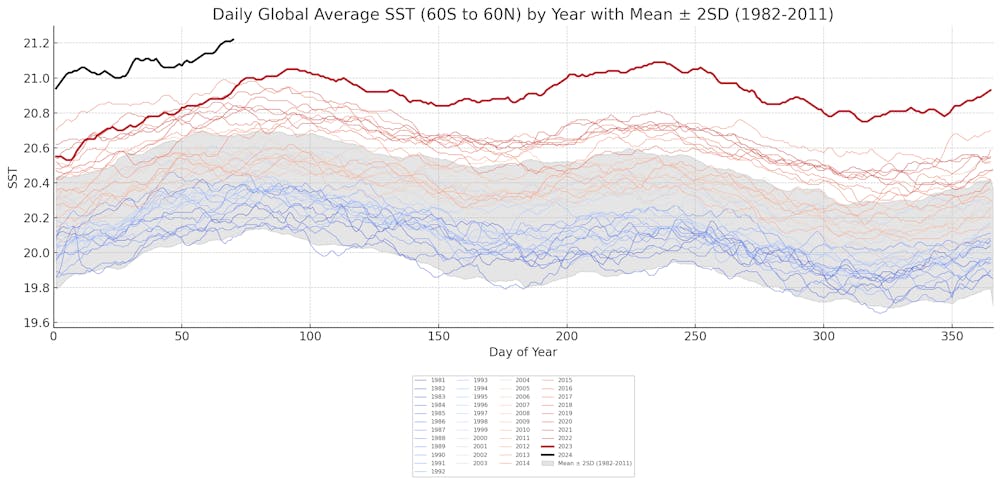
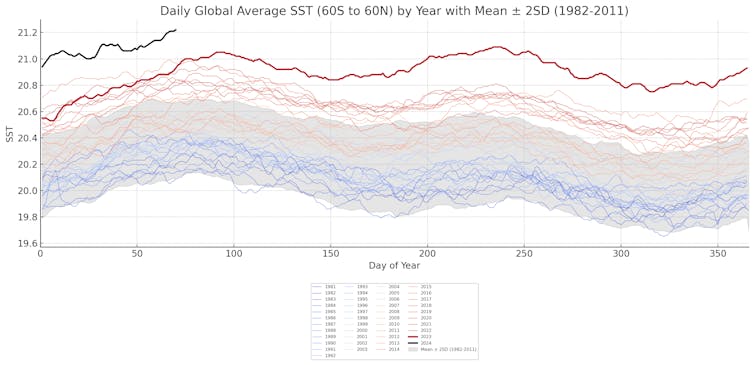
The trend is clear to see. Earlier years (in blue) are typically cooler than later years (in red), reflecting the relentless march of global warming. But even with this trend, there are outliers. In 2023 and 2024, you can see a huge jump above previous years.
These record temperatures have been widespread, with the oceans of the southern hemisphere, northern hemisphere and the tropics all reaching record temperatures.
What’s behind the surge?
We don’t yet have a complete explanation for this record burst of warming. But it’s likely several factors are involved.
First, and most obvious, is global warming. Year on year the ocean is gaining heat through the enhanced greenhouse effect – indeed over 90% of the heat associated with human-caused global warming has gone into the oceans.
The extra heat pouring into the oceans results in a gradual rise in temperature, with the trend possibly accelerating. But this alone doesn’t explain why we have experienced such a big jump in the last year.
Then there are the natural drivers. The El Niño event developing in June last year has certainly played a substantial role.
El Niño and its partner, La Niña, are opposite ends of a natural oscillation, the El Niño Southern Oscillation, which plays out in the tropical Pacific ocean. This cycle moves heat vertically between the ocean’s deeper waters and the surface. When El Niño arrives, warmer water comes up to the surface. During La Niña, the opposite occurs.
You can see the impact of an El Niño on short term temperature spikes clearly, even against a backdrop of strong long-term warming.
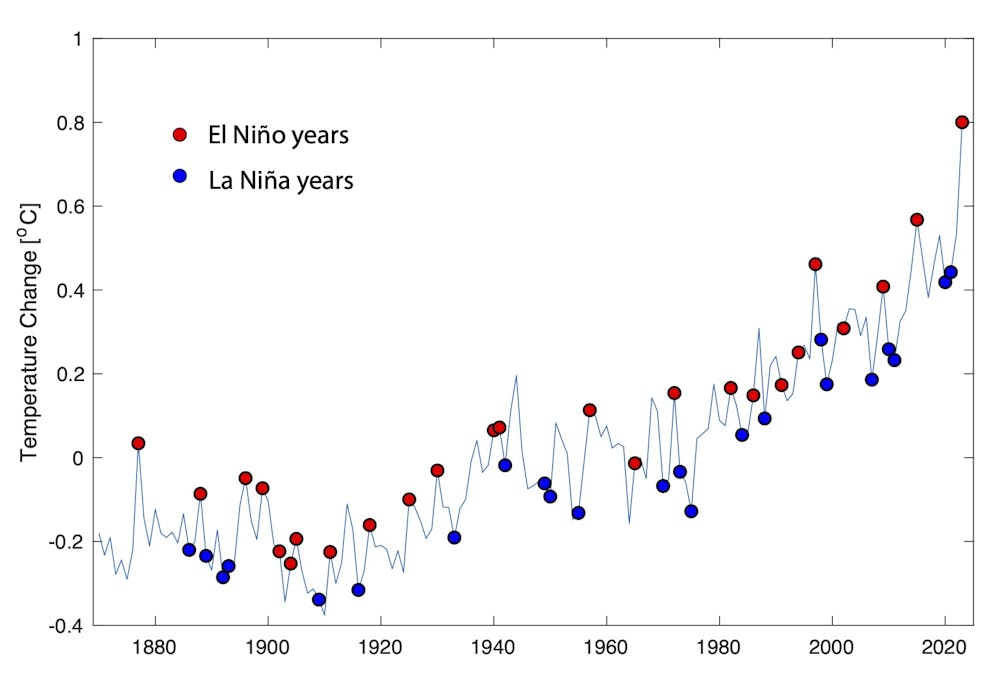 This figure shows global ocean temperatures with El Niño years (red dots) and La Niña years (blue dots) highlighted.
Author provided
This figure shows global ocean temperatures with El Niño years (red dots) and La Niña years (blue dots) highlighted.
Author provided
But even climate change and El Niño combined aren’t enough to explain it.
Other natural heat-transferring oscillations, such as the Indian Ocean Dipole or the North Atlantic Oscillation, may play a role.
It may also be that our successful efforts to cut aerosol pollution from the dirty fuel shipping relies on has had an unwanted side effect: more warming. With less reflective aerosols in the atmosphere, more of the Sun’s energy can reach the surface.
But there’s probably also a level of random chance. Chaotic weather systems over the ocean can reduce cloud cover, which can let in more solar radiation. Or these weather systems could weaken winds, reducing cooling evaporation.
Read more: An 'extreme' heatwave has hit the seas around the UK and Ireland – here's what's going on
Why is this important?
To us, a warmer ocean might feel pleasant. But the extra heat manifests underwater as an unprecedented series of major marine heatwaves. The ocean’s organisms are picky about their preferred temperature range. If the heat spikes too much and for too long, they have to move or die.
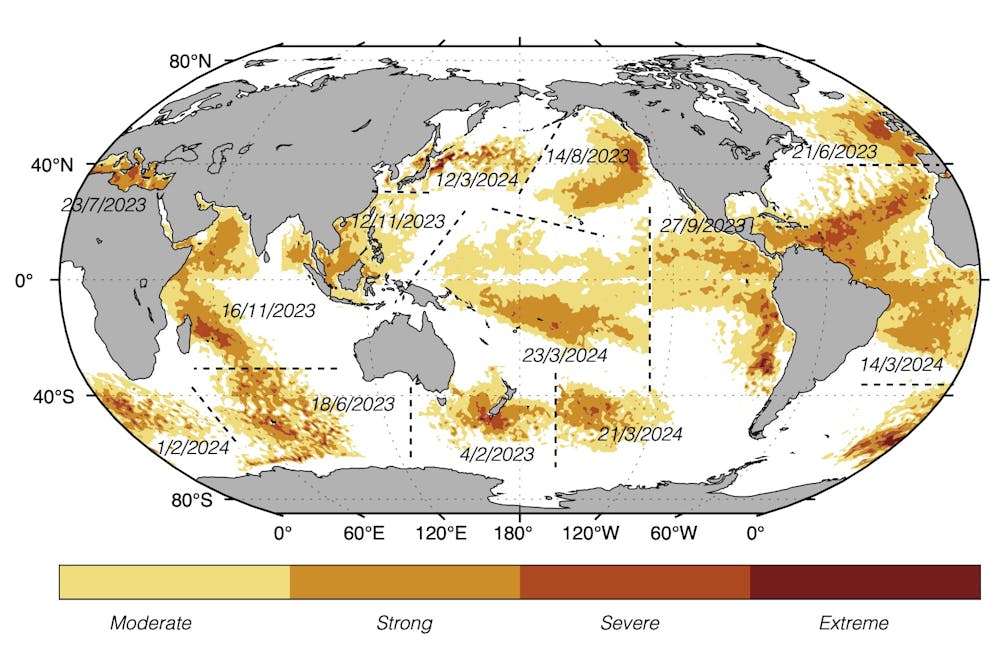 A selection of the world’s marine heatwaves over the past year.
Provided, Author provided (no reuse)
A selection of the world’s marine heatwaves over the past year.
Provided, Author provided (no reuse)
Marine heatwaves can lead to mass death or mass migration for marine mammals, seabirds, fish and invertebrates. They can cause vital kelp forests and seagrass meadows to die, leaving the animals depending on them without shelter or food. And they can disrupt species important for fisheries and tourism.
This year’s heat stress has caused widespread coral bleaching around the world. Bleaching has been seen on reefs in the Caribbean, Florida, Egypt, and the Great Barrier Reef.
In the cooler waters of Tasmania, extraordinary conservation efforts have been put in place to try and protect endangered fish species such as the red handfish from the heat, while in the Canary Islands, small scale commercial fisheries have popped up for species not normally found there.
 To save the red handfish from heat meant taking it out of warming oceans.
Rick Stuart-Smith/AAP
To save the red handfish from heat meant taking it out of warming oceans.
Rick Stuart-Smith/AAP
Last year, Peru’s anchovy fishery – the country’s largest – was closed for long periods, leading to export losses estimated at A$2.1 billion.
Read more: Marine heatwaves don't just hit coral reefs. They can cause chaos on the seafloor
What’s going to happen next?
Given the record temperatures stem from a combination of human-induced climate change and natural sources, it’s very likely ocean temperatures will drop back to more “normal” temperatures. Normal now is, of course, much warmer than in previous decades.
In the next few months, forecasts suggest we have a fair chance of heading into another La Niña.
If this eventuates, we might see slightly cooler temperatures than the new normal, but it’s still too early to know for sure.
One thing is certain though. As we struggle to rein in greenhouse gas emissions, the steady march of global warming will keep adding more heat to the oceans. And another spike in global ocean warming won’t be too far away.
Read more: Ocean heat is off the charts – here's what that means for humans and ecosystems around the world
Authors: Alex Sen Gupta, Senior Lecturer, School of Biological, Earth and Environmental Sciences, UNSW Sydney



















