

Rogue waves in the ocean are much more common than anyone suspected, says new study
- Written by: Alessandro Toffoli, Professor in Ocean Engineering, The University of Melbourne

We used three-dimensional imaging of ocean waves to capture freakish seas that produce a notorious phenomenon known as rogue waves. Our results are now published in Physical Review Letters*.
Rogue waves are giant colossi of the sea – twice as high as neighbouring waves – that appear seemingly out of nowhere. Stories of unimaginable mountains of water as tall as ten-storey buildings have populated maritime folklore and literature for centuries.
Recent technology has allowed scientists to spot rogue waves out at sea, making legend become reality. The first and most famous measurement was of the Draupner wave, a 25.6-metre monster recorded in the North Sea on January 1 1995.
Despite observations, we still don’t know how often rogue waves occur, or if we can predict them. A record of a rogue wave doesn’t include specific features that distinguish the sea around it, so we can’t make comparisons or predict the conditions needed.
Our team set sail on the South African icebreaker S.A. Agulhas-II to chase rogue waves across the Southern Ocean, where mighty winds shape Earth’s fiercest waves.
Read more: The South African ship that found Antarctica's Endurance wreck is vital for climate science
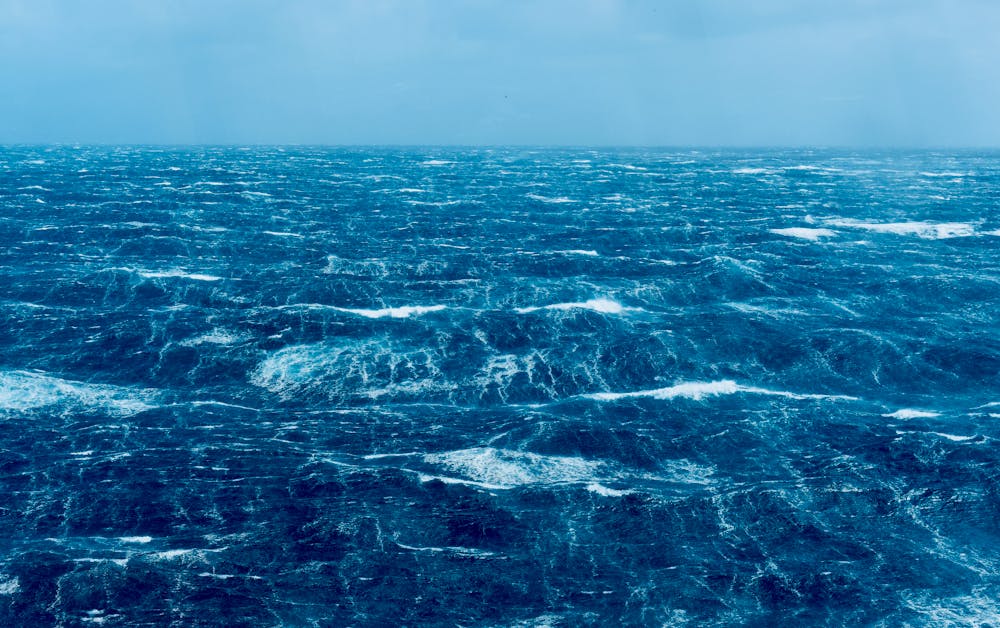
What creates rogue waves?
In the random environment of ocean waves, several mechanisms give rise to rogue ones. One primary source involves the overlap of multiple waves at the same location and time. This results in concentrated energy, leading to tall waves.
Under consistent ocean conditions, rogue waves generated this way may occur once every two days at a set location. But the ocean is dynamic, so conditions are rarely consistent for long – making it less likely for rogue waves to occur. The overlap of waves may be minimal or non-existent even during prolonged and intense storms.
Numerical and laboratory studies suggest strong winds also contribute to the development of rogue waves, because they push harder on some already tall wave forms. But wind has seldom been considered in rogue wave analysis.
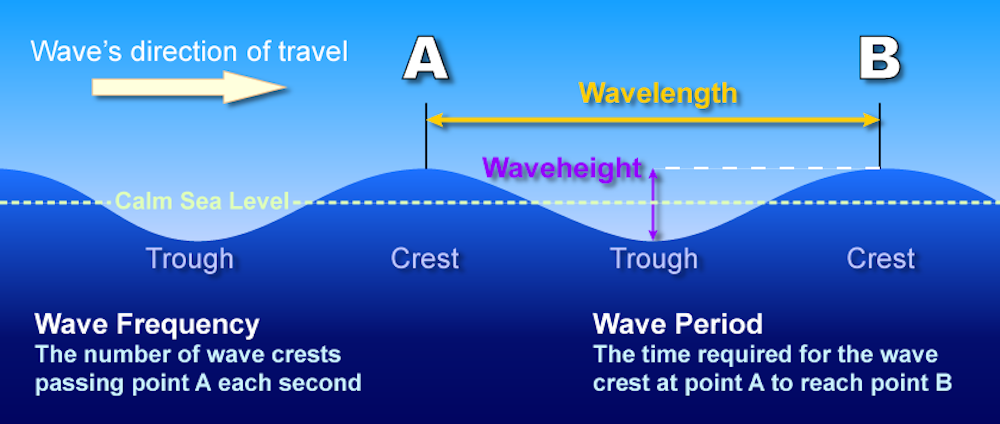 A simplified anatomy of ocean waves.
NOAA
A simplified anatomy of ocean waves.
NOAA
Wind prompts ocean waves to grow progressively higher, longer and faster. During this stage, waves are “young” and hungry for wind input. When waves go faster than wind, they stop being accelerated by it and reach a “mature” stage of full development.
Through this process, the wind creates a chaotic situation where waves of different dimensions and directions coexist.
Our recent observations show that unique sea conditions with rogue waves can arise during the “young” stage – when waves are particularly responsive to the wind. This suggests wind parameters could be the missing link. However, there’s even more to consider.
Powerful waves amplify each other
Ocean waves are one of the most powerful natural forces on Earth and could become even more powerful in the future due to climate change. If the wave field possesses an extreme amount of energy – when waves are steep and most of them have a similar amplitude, length and direction – another mechanism can trigger the formation of rogue waves.
This mechanism involves an exchange of energy between waves that produces a “self-amplification”, where one wave grows disproportionately at the expense of its neighbours. Theoretically, studies show this could increase the likelihood of rogue waves ten-fold.
While self-amplification manifests as whitecaps – frothy, aerated crests of choppy waves – until now there has been no evidence it can make rogue waves more likely in the ocean.
Recent experiments suggest wind can make extreme events like rogue waves more common. But this aspect has not been thoroughly explored.
What did we find in the Southern Ocean?
We used a new three-dimensional imaging method for scanning the ocean surface throughout the expedition. It mimics human vision: closely located sensors record sequences of simultaneous images. Computer algorithms then match pairs of them to reconstruct the three-dimensional depths – the wavy surface.
As our ship passed through several storms, the sensors captured data during various phases of wave growth – from the early stages of young waves fuelled by the wind, to mature waves that aren’t influenced by it.
Our results show young waves display signs of self-amplification and an increased likelihood of rogue waves. We recorded waves twice as high as their neighbours once every six hours.
This mirrors what lab models have reported: sea conditions theoretically more prone to self-amplification would produce more rogue waves.
In contrast, mature seas don’t show an increased probability of rogue waves. We detected none under those conditions.
Our findings challenge previous thinking: that self-amplification doesn’t change the likelihood of rogue waves in the ocean. We have also shown that when developing tools for predicting rogue waves, we need to take wind into thorough consideration. After all, it’s a natural feature of the open sea.
Authors: Alessandro Toffoli, Professor in Ocean Engineering, The University of Melbourne


















