

Why the kookaburra’s iconic laugh is at risk of being silenced
- Written by: Diana Kuchinke, Lecturer in Ecology, Federation University Australia
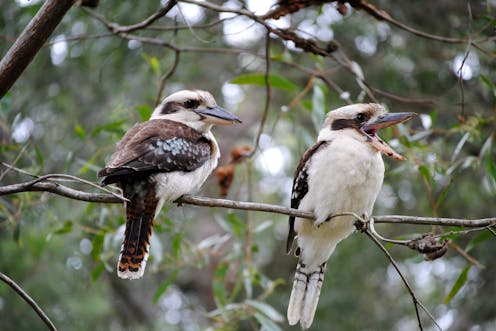
Once, while teaching a class of environmental science students in China’s Hebei University of Science and Technology, I asked who knew what a laughing kookaburra was. There were many blank faces. Then I tilted my head, much like a kookaburra does, and opened my mouth: “kok-kak-KAK-KAK-KAK-KOK-KAK-KOK-kook-kook-kok, kok, kok”. I became the “bushman’s alarm clock”.
Students burst out laughing. Hands waved in the air. They knew. They all knew. The call of the kookaburra is known worldwide.
Why do kookaburras “laugh”? It’s a declaration of territory. “I am here. This is my space.”
How long has it been part of the Australian landscape? Indigenous Kamilaroi/Gamilaraay and Wiradjuri people named the “guuguubarra”, so for at least 65,000 years.
Genetic analysis suggests its ancestors can be traced back roughly 16.3 million years. So we can be sure kookaburras have been laughing for a very, very long time.
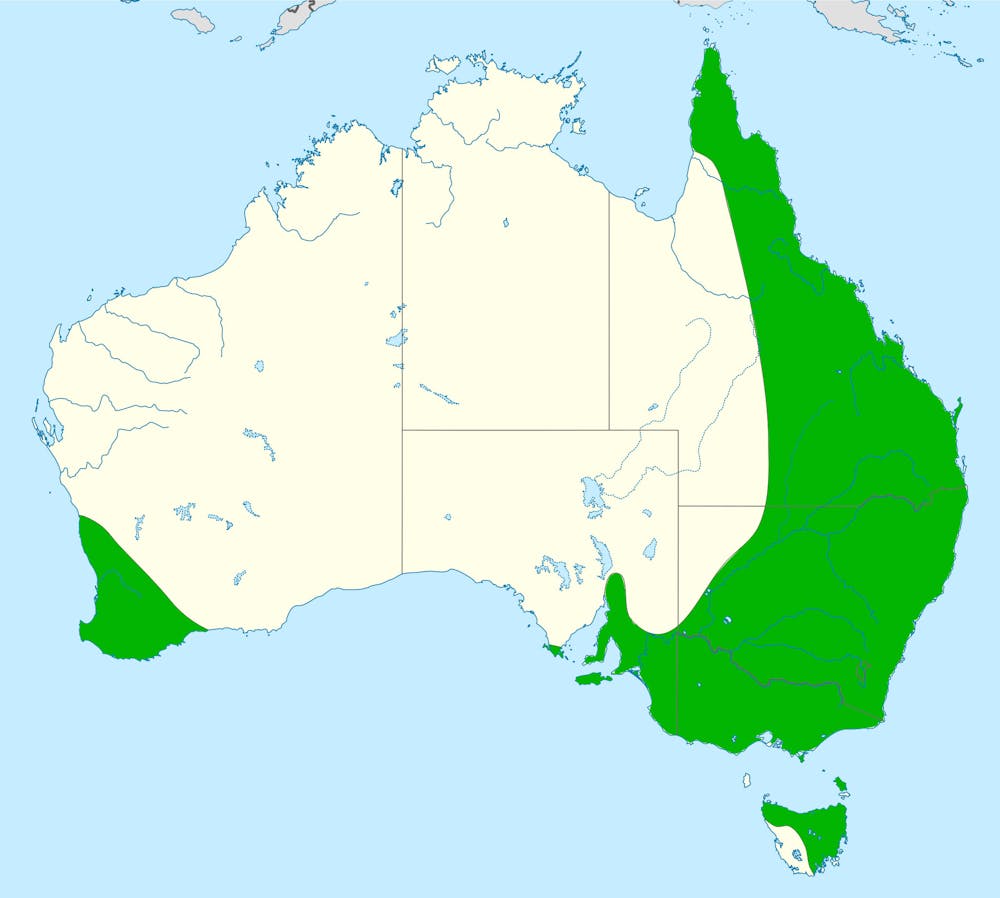
It is shocking, then, that the laughing kookaburra is now in trouble. A combination of human-driven factors – climate change, bushfires and land clearing – is rapidly driving down numbers of this iconic kingfisher species across its range along Australia’s east coast.
The laughing kookaburra’s call is one of the iconic sounds of Australia.Read more: Citizen scientists count nearly 2 million birds and reveal a possible kookaburra decline
Why are kookaburra numbers falling?
In 2003, the New Atlas of Australian Birds listed the laughing kookaburra as abundant. By 2015, The State of Australia’s Birds report noted them as being in major decline.
What changed? Recent research shows worsening fires are adding to the woes of kookaburras, on top of land clearing, removal of old trees with nesting hollows, state permits to control local numbers and being regarded as an exotic species in Western Australia and Tasmania, where they were introduced more than a century ago.
The tree hollows kookaburras need to breed can take a hundred years to develop. Every forest patch felled means hollows are lost.
Over the past 200 years, nearly 50% of our forest cover has been felled. Urban development all along Australia’s east coast has continued.
Fire is a growing threat
Increasing fire frequency and severity due to climate change are having damaging impacts on kookaburras across south-eastern Australia. Megafires – those that burn more than 10,000 hectares – used to occur about once a decade. Now they are happening more often.
The 2019-2020 “Black Summer” fires were not confined to one state or season. From September 2019 through to March 2020 they burnt more than ten million hectares of native vegetation. The impacts on wildlife were huge.
In the years after fire, the dense regrowth of vegetation gives many birds a flush of abundant resources for food, nesting, cues for breeding and protection from predators.
However, dense new ground growth could hinder the kookaburra’s hunting by making it harder to spot prey. This species sits high in a tree from where it pounces on its prey, which is mostly taken on the ground.
Research has also shown dense post-fire vegetation has less prey, such as basking lizards, a vital part of the kookaburra’s diet.
Research shows laughing kookaburras leave areas of dense post-fire growth. They prefer areas that haven’t burnt for decades.
Kookaburras also compete for prey with other birds, such as the currawong. A currawong forages both on the ground and in the canopy. In denser vegetation, this gives it a competitive advantage over the kookaburra.
If trees with hollows are burnt down, kookaburras also cannot nest. Kookaburras forced to move to new unburnt or uncleared areas must compete for hollows with other highly territorial kookaburras and species such as parrots, owls and possums.
Read more: 200 experts dissected the Black Summer bushfires in unprecedented detail. Here are 6 lessons to heed
State policies aren’t helping
The Victorian government has issued permits to remove kookaburras from their territories in certain areas. These included three “Authorities to Control Wildlife” by lethal means in 2022 and another in 2023.
The government website says these permits can be issued when wildlife causes damage to property, poses a risk to human health and safety, or is harmful for biodiversity. It is hard to imagine which of these categories justifies permits to kill kookaburras in their native habitat.
The maximum number for lethal control across 2022 was four, and three in 2023. However, kookaburras are highly social birds. They live in family groups of about a dozen individuals with a dominant pair, juvenile helpers and young. If the dominant pair has been dealt with “by lethal means”, it’s devastating for the group.
Two Australian states, Tasmania and Western Australia, treat the laughing kookaburra as an introduced species. In Tasmania (but not WA), the species is unprotected because of its status as an exotic species.
Anecdotal evidence suggests the “first pair” to breed successfully was taken to Tasmania around 1906. But this assumes kookaburras, which are found on other Bass Strait islands, were not already there and could not fly across Bass Strait.
In Tasmania, kookaburras are much maligned and it’s legal to kill them – despite this being the one state where the species isn’t in trouble. One concern is that, as a carnivorous bird, its impact on small reptiles and birds is immense. But other birds, such as the two species of currawong on the island, hunt the same prey as kookaburras.
Read more: We rely on expert predictions to guide conservation. But even experts have biases and blind spots
We can no longer take common species for granted
As climate change results in more bushfires and we continue to clear-fell old habitat trees, the fate of the laughing kookaburra – our icon of the ages – could be sealed. That once-ubiquitous call will be heard no more.
While considerable resources necessarily go to threatened species programs, it is imperative, too, to give more resources and attention to species we have long thought of as common. If species such as kookaburras and koalas are disappearing, then the threatened species have no hope.
Authors: Diana Kuchinke, Lecturer in Ecology, Federation University Australia
Read more https://theconversation.com/why-the-kookaburras-iconic-laugh-is-at-risk-of-being-silenced-208181



















