

First evidence of ancient human occupation found in giant lava tube cave in Saudi Arabia
- Written by: Mathew Stewart, Research Fellow, Australian Research Centre for Human Evolution, Griffith University
If you look from above, you can see thousands of stone structures dotting the landscape of the Arabian peninsula. On the ground, you can find a bounty of stone tools and ancient fireplaces scattered along the edges of ancient lakes, as well as rock art depicting hunting and herding scenes in the surrounding mountains.
Despite the visibility of these sites, only in the past decade or so have archaeologists taken a dedicated interest in them. Some of the structures have now been dated at up to 10,000 years old.
However, the arid climate, baking days and freezing nights, and intense wind erosion are not kind to some of the other relics archaeologists prize. To date, there has been little found in the way of fossils or the kind of deeply buried, layered deposits that can open a window onto the history of a place.
Until recently, no archaeologists had surveyed any of the hundreds of caves and lava tubes recorded across northern Arabia. In 2019, our team began to look in these subterranean locations – and in a new study published today in PLoS ONE, we report on the first documented occupation of a lava tube in the Arabian Peninsula.
The Umm Jirsan lava tube
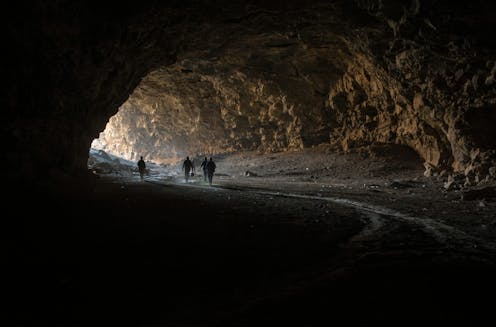
The Umm Jirsan lava tube lies some 125 kilometres north of the city of Madinah, in the Harrat Khaybar lava field. The tube formed long ago by cooling lava. It winds an impressive 1.5 kilometres, and reaches 12 metres in height and 45 metres in width in some sections.
The first thing you notice when venturing into the tube’s dark and meandering tunnels is the sheer number of animal remains. The floor is strewn with piles of bones containing thousands – if not hundreds of thousands – of exceptionally preserved fossils.
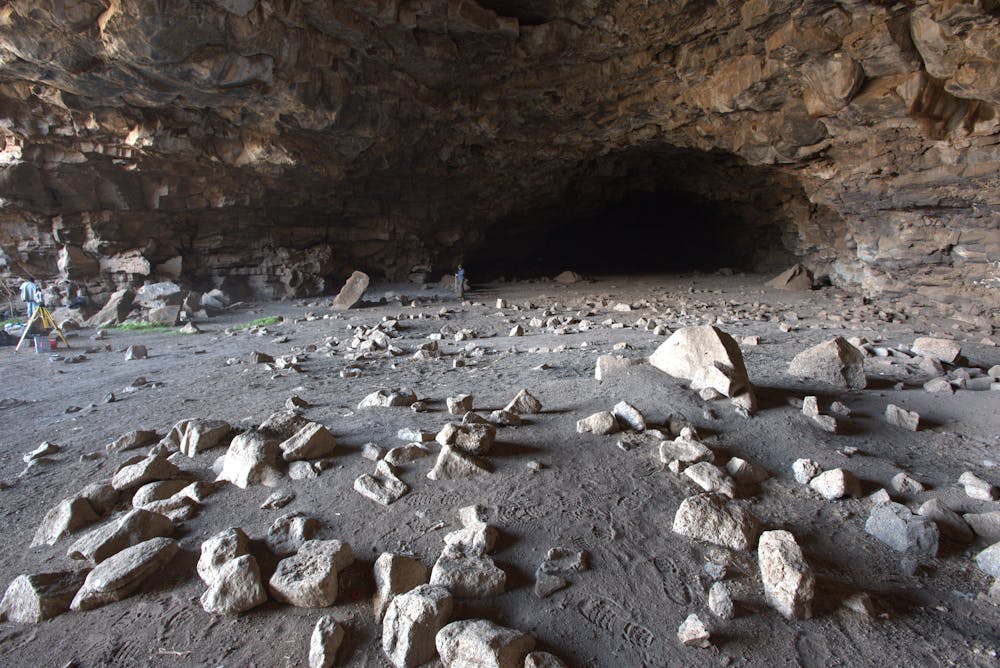
These bone-piles are the work of striped hyenas, which drag bones underground to eat, stash away for times of food scarcity, or process and feed to cubs. This process, repeated over millennia, has produced some of the most incredible accumulations of fossils seen anywhere in the world.
But it’s not all just bones. When we surveyed the entrances of Umm Jirsan – essentially areas where the roof has collapsed, providing access to the lava tube – we uncovered hundreds of stone artefacts made from obsidian, chert and basalt.
Although exciting, these artefacts were all surface finds, making them extremely difficult to date. We needed to look deeper.
Digging in
We excavated in the mouth of the eastern passage, near a series of semi-circular stone structures of an unknown age or function. The excavation uncovered more stone artefacts – all made from fine-grained green obsidian – as well as animal bones and charcoal.
Most of the stone artefacts came from a discrete sediment layer roughly 75 centimetres beneath the surface. Radiocarbon dating of the charcoal, and dating of the sediments using a method known as optically stimulated luminescence dating, revealed this main occupation phase likely occurred between 7,000 and 10,000 years ago.
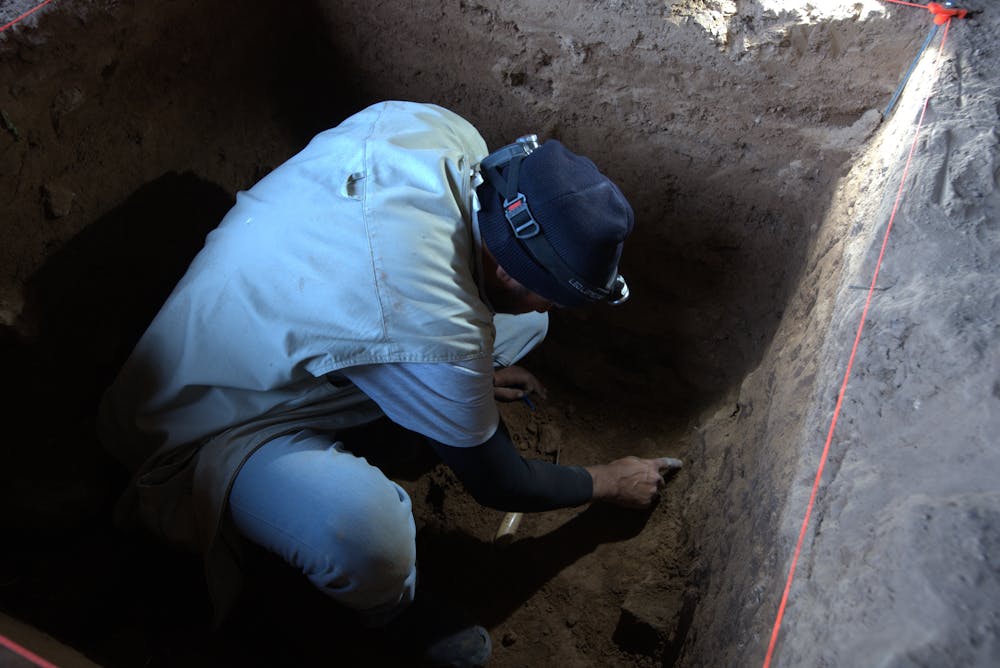 Saudi archaeologist Badr Zahrani working on the excavation.
Green Arabia Project
Saudi archaeologist Badr Zahrani working on the excavation.
Green Arabia Project
We also found some interesting objects in the surrounding landscape. These included more stone artefacts and circular structures, as well as a so-called “I-type” structure. These constructions are believed to date to around 7,000 years ago, based on their association with large rectangular structures known as mustatils, which we believe were used for ritual animal sacrifices.
Read more: Enigmatic ruins across Arabia hosted ancient ritual sacrifices
We also found the first rock art discovered in the area. This includes depictions of herding scenes of cattle, sheep and goat, and even hunting scenes involving dogs. This art has similarities with other rock art in Arabia from the Neolithic and the later Bronze Age. It includes overlapping engravings, suggesting people visited the area repeatedly over thousands of years.
 Rock art found near Umm Jirsan shows animals and people.
Stewart et al. 2024 / PLoS ONE, CC BY
Rock art found near Umm Jirsan shows animals and people.
Stewart et al. 2024 / PLoS ONE, CC BY
We also found human remains at Umm Jirsan, which we dated to the Neolithic and Bronze Age periods. By analysing the carbon and nitrogen in these remains, we found these people’s diets were consistently high in protein – though they ate more fruit and cereals over time.
Interestingly, this change in diet appears to coincide with the arrival of oasis agriculture in the region. This saw the emergence of sophisticated farming and water management techniques that enabled people to settle in the deserts more permanently and cultivate plants such as dates and figs.
We made another interesting finding after coming home from the dig. Studying maps of archaeological structures in the wider area, we noticed Umm Jirsan sits along a “funerary avenue” connecting two major oases.
Read more: Ancient humans may have paused in Arabia for 30,000 years on their way out of Africa
These funerary avenues, which consist of chains of tombs stretching hundreds of kilometres, are believed to have been routes used by Bronze Age pastoralists as they transported their herds between water sources.
We think Umm Jirsan may have been a stopping-off point for pastoralists, a place that offered shelter and water in an otherwise dry and harsh environment.
Archaeologists have made remarkable finds in Arabia in recent years, in settings such as ancient lakebeds. Our finds at Umm Jirsan add another important element to the story of Arabian societies over time, and how they interacted with this dramatic landscape.
Authors: Mathew Stewart, Research Fellow, Australian Research Centre for Human Evolution, Griffith University


















