

The government is basing its school truancy response on data – but by-the-numbers solutions aren’t enough
- Written by: Claire Breen, Professor of Law, University of Waikato
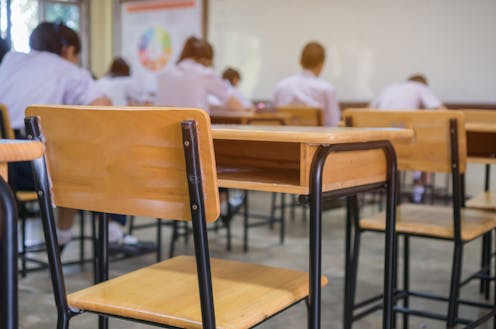
School truancy has been a concern across the political spectrum for years. But proposed solutions have largely failed to address the core reasons for unexplained school absences.
Despite the apparent difficulty in solving the truancy problem, education is a fundamental human right. Governments need to ensure children don’t face unnecessary hurdles when trying to get to and stay in school.
Legally, a truant is a student who is frequently late, misses a class, or misses entire days or weeks of schooling.
A downward trend in regular attendance (the percentage of students attending school 90% of a school term, based on the total enrolments in schools that provided attendance data electronically) has been apparent for a few years.
Absence from school may be justified or unjustified. The latter encompasses absences where no information or a trivial reason is provided (truancy).
In term 2 of 2015, regular attendance was 69.5% (with unjustified absences at 3.4%), before reaching a concerning low of 39.9% in term 2 of 2022 (during the COVID-19 pandemic), when truancy rates were 3.3%.
In term 2 of 2023, regular attendance was 47%, and truancy rates were 2.5%. By term 4 of 2023, regular attendance was 53.6%, with truancy rates at 1.7%.
Prioritising data collection
The coalition government recently announced its Attendance Action Plan in the latest effort to address the issue.
In the short term, the plan includes publishing weekly attendance data, improving awareness of the importance of school attendance, updating public health advice for parents to help them decide whether to send their child to school, and clarifying expectations for school boards.
Longer-term proposals include mandatory daily reporting of attendance data and a traffic light system to respond to different levels of school attendance.
This is underpinned by clear obligations for children, parents and schools, making attendance a strategic priority for school boards, and establishing improved data and analysis to determine the drivers for non-attendance.
It’s clear the coalition government’s current focus is on data collection, which is important for setting benchmarks. It allows the Ministry of Education to monitor and respond to truancy patterns, and can also be used to examine the correlation between student attendance and NCEA achievement.
But the data must be interpreted adequately and appropriately. Otherwise it may cause more harm than good, if the reasons for absences are masked and a one-size-fits-all approach is adopted.
Truancy as a global phenomenon
Changing attitudes to school attendance in New Zealand mirror overseas experiences.
While recognising the importance of going to school for wellbeing and educational achievement, a recent study from the Education Review Office suggests many New Zealand parents attach less importance to regular school attendance. This is similar to what parents have reported in the United Kingdom.
But persistent absences can have a cumulative effect, particularly if they occur from an early age.
Since the end of the global pandemic, truancy rates overseas have been improving. New Zealand’s are too – but at a slower pace.
New Zealand’s poverty rate and cost-of-living crisis, as well as housing shortages, bullying and a youth mental health crisis appear to be having an effect on truancy rates.
Need for cross-party solutions
The 2022 Workforce and Education Select Committee Report on school attendance made a series of recommendations.
Some aspects of that report are reflected in the government’s school attendance plan – including the emphasis on engaging with parents, teachers and schools to improve attendance.
But the select committee’s report also recognised there are societal causes of non-attendance. It recommended the continuing provision of free school lunches and free period products, accompanied by an analysis of the effectiveness of both initiatives.
The coalition government has committed nearly NZ$3 million for period products. But moves to remove or reduce school lunches go against international research which has found free school meals beneficial for student achievement.
The select committee did not believe prosecutions and sanctions to be an appropriate response to chronic absenteeism. This echoes the British findings that sanctions were seen as irrelevant to improving school attendance.
Education as a human right
The right to education has featured consistently in the international legal framework since the end of the second world war. Education must be physically and economically accessible to everyone, and it must be flexible to respond to the needs of students within diverse and changing societies.
The Convention on the Rights of the Child 1989 requires countries to encourage regular attendance at school and reduce dropout rates. This also means countries must make every reasonable effort, using available resources, to address the deeper structural reasons for children dropping out of school.
The government’s attendance plan is an important step towards achieving those goals, which are a key element of ensuring their right to education.
Read more: Being excluded or truant from school leads to mental health problems – and vice versa
Recent research shows young New Zealanders do value education. But they also want to be heard and valued. The support of whānau and friends, as well as the respect and understanding of their teachers, are important factors in keeping them engaged with school.
Improving school attendance and educational outcomes requires an action plan that addresses the structural issues that interfere with attendance and undermine the child’s right to education.
The UN Committee on Economic, Social and Cultural Rights has stated that education is one of the best financial investments a state can make, not only for social and economic reasons, but because “a well-educated, enlightened and active mind is one of the joys and rewards of human existence”.
Getting to our children to school, then, is only the beginning of this journey.
Authors: Claire Breen, Professor of Law, University of Waikato


















