

Geoffrey Robertson rehearses the scenarios
- Written by: Rowan Nicholson, Senior Lecturer in Law, Flinders University
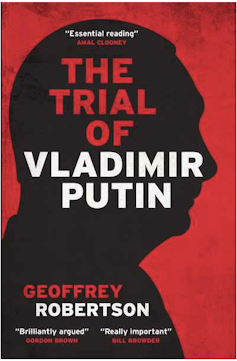
Is Russian president Vladimir Putin guilty of the crime of aggression? In The Trial of Vladimir Putin, barrister Geoffrey Robertson answers that question by dramatising what might happen within the walls of a future courtroom.
The question of whether Putin is guilty of aggression is fairly straightforward. Robertson’s book discusses that issue in detail but does not grapple seriously enough with harder questions, such as whether it would be wise to try Putin in his absence – while he remains at liberty in Moscow – instead of physically in the dock.
Review: The Trial of Vladimir Putin – Geoffrey Roberston (New South)
To simplify the law only slightly: a leader who orders an invasion of another country is generally guilty of aggression except where the act is in self-defence or authorised by the United Nations Security Council.
In 2022, Putin ordered an invasion of Ukraine. Russia claimed this was self-defence, but its arguments are made of cardboard, props from a pantomime staged for its allies and domestic audience. You only have to breathe on them to knock them over.
Robertson generally does a sound job of this, though he overlooks the most elaborately constructed of Russia’s cardboard arguments: the fiction that two parts of eastern Ukraine, Donetsk and Luhansk, were independent countries that Russia intervened to assist.
He also tackles the separate question of whether Putin is guilty of war crimes. These are crimes committed during a war, as distinct from the crime of unlawfully starting one. A challenging issue here is that Putin himself is not on the ground in Ukraine. Evidence would be needed that he is responsible in his role as a commander for actions carried out by subordinates.
One of the stronger elements of the book is Robertson’s explanation of where Putin might be tried. The International Criminal Court has jurisdiction to try him for war crimes, and in 2023 it issued a warrant for his arrest for the war crime of transferring Ukrainian children to Russia.
Can it also try him for aggression? In effect it cannot, for reasons that ultimately reflect the reluctance of countries to expose their leaders to prosecution. Instead, a special aggression tribunal would have to be established in the tradition of the trials of Nazis at Nuremberg.
Robertson takes his readers through each step of the process: the construction of a tribunal, the case against Putin, the case in his defence, a separate trial for war crimes, and the aftermath – including whether Putin should be executed, which is unlikely but which Robertson controversially argues “must be seriously considered”.

 Geoffrey Robertson.
Elizabeth Allnutt/Penguin
The problem is not that Robertson’s views on these issues are necessarily wrong. They are complex issues about which people will disagree. It is that he gives the impression that the complexities do not exist.
Dismissive language is a more general feature of his writing style. Some will enjoy it; it will bother others. He reserves his most biting remarks for his fellow lawyers. They suffer from “the affectation of Latin citations and lengthy case precedents”. They are “long-winded”. Putin, who has a law degree, “is intelligent, as lawyers go”.
The implication is that Robertson is atypical among lawyers, someone who will sweep aside conventions and assumptions. In fact, the book contains a fair amount of Latin – tu quoque and a fortiori and so on – and only a few of his arguments are genuinely bold.
But if there is something to be said here, it is that not many experts take the time to explain how international law works in books for a wide audience. That is hugely valuable, especially in a period when expertise is often drowned out by falsehoods. These are sometimes spread intentionally to undermine democracies such as Ukraine or Western countries, and sometimes spread recklessly by the misinformed, the opinionated and the loud. Robertson has taken the time.
Read more:
An inside look at the dangerous, painstaking work of collecting evidence of suspected war crimes in Ukraine
The United Nations
One of the bolder elements in the book is what Robertson says about the United Nations. As he points out, five major powers – Britain, China, France, Russia and the United States – cannot be held accountable by the UN Security Council because they have the right to veto its decisions.
He makes the surprising claim that the “diplomats who designed the UN in 1945 did not appreciate this fatal flaw” – as if they handed out these vetoes absentmindedly, when in reality they made open-eyed political choices after hundreds of hours of negotiation and compromise.
Robertson asserts that the “most obvious, and obviously right, reform” would be to prevent one of these major powers from using its veto “if it had a conflict of interest”.
Certainly, there is a debate to be had about the vetoes. But has Robertson thought through the consequences of this “obvious” reform? One of them is that the Security Council could authorise, say, the United States to take military action against another nuclear-armed major power: is that outcome “obviously right”? Robertson does not elaborate.
He also argues that the UN should be able to expel Russia. The same logic might be used to justify expelling the United States, Britain and Australia, which were accused of unlawfully invading Iraq in 2003. Robertson compares the UN unfavourably with its predecessor, the League of Nations, which “expelled the USSR for attacking Finland”.
This is a strange comparison. The League of Nations is famous for its catastrophic failure. One of the several reasons for that failure was that by the second world war most major powers were not members. The UN was designed to avoid repeating its mistakes, to keep everyone inside the tent, on the theory that a global organisation that can achieve some things – even if not everything – is better than none at all.
Though these elements of the book are bold, they come across as a little politically naïve.
Readers who are alert to this and other weaknesses of the book will still learn a lot from its areas of strength, in particular the discussion of what a trial of Putin might look like, either in the unlikely event that he is arrested and physically brought to trial, or if enough countries accept Robertson’s view that he should be tried in his absence.
Those interested in this broad area of law, if not this precise topic, might also look at alternatives such as the thoroughly researched books of Philippe Sands.
Authors: Rowan Nicholson, Senior Lecturer in Law, Flinders University
Geoffrey Robertson.
Elizabeth Allnutt/Penguin
The problem is not that Robertson’s views on these issues are necessarily wrong. They are complex issues about which people will disagree. It is that he gives the impression that the complexities do not exist.
Dismissive language is a more general feature of his writing style. Some will enjoy it; it will bother others. He reserves his most biting remarks for his fellow lawyers. They suffer from “the affectation of Latin citations and lengthy case precedents”. They are “long-winded”. Putin, who has a law degree, “is intelligent, as lawyers go”.
The implication is that Robertson is atypical among lawyers, someone who will sweep aside conventions and assumptions. In fact, the book contains a fair amount of Latin – tu quoque and a fortiori and so on – and only a few of his arguments are genuinely bold.
But if there is something to be said here, it is that not many experts take the time to explain how international law works in books for a wide audience. That is hugely valuable, especially in a period when expertise is often drowned out by falsehoods. These are sometimes spread intentionally to undermine democracies such as Ukraine or Western countries, and sometimes spread recklessly by the misinformed, the opinionated and the loud. Robertson has taken the time.
Read more:
An inside look at the dangerous, painstaking work of collecting evidence of suspected war crimes in Ukraine
The United Nations
One of the bolder elements in the book is what Robertson says about the United Nations. As he points out, five major powers – Britain, China, France, Russia and the United States – cannot be held accountable by the UN Security Council because they have the right to veto its decisions.
He makes the surprising claim that the “diplomats who designed the UN in 1945 did not appreciate this fatal flaw” – as if they handed out these vetoes absentmindedly, when in reality they made open-eyed political choices after hundreds of hours of negotiation and compromise.
Robertson asserts that the “most obvious, and obviously right, reform” would be to prevent one of these major powers from using its veto “if it had a conflict of interest”.
Certainly, there is a debate to be had about the vetoes. But has Robertson thought through the consequences of this “obvious” reform? One of them is that the Security Council could authorise, say, the United States to take military action against another nuclear-armed major power: is that outcome “obviously right”? Robertson does not elaborate.
He also argues that the UN should be able to expel Russia. The same logic might be used to justify expelling the United States, Britain and Australia, which were accused of unlawfully invading Iraq in 2003. Robertson compares the UN unfavourably with its predecessor, the League of Nations, which “expelled the USSR for attacking Finland”.
This is a strange comparison. The League of Nations is famous for its catastrophic failure. One of the several reasons for that failure was that by the second world war most major powers were not members. The UN was designed to avoid repeating its mistakes, to keep everyone inside the tent, on the theory that a global organisation that can achieve some things – even if not everything – is better than none at all.
Though these elements of the book are bold, they come across as a little politically naïve.
Readers who are alert to this and other weaknesses of the book will still learn a lot from its areas of strength, in particular the discussion of what a trial of Putin might look like, either in the unlikely event that he is arrested and physically brought to trial, or if enough countries accept Robertson’s view that he should be tried in his absence.
Those interested in this broad area of law, if not this precise topic, might also look at alternatives such as the thoroughly researched books of Philippe Sands.
Authors: Rowan Nicholson, Senior Lecturer in Law, Flinders University 

















