

Look up! Your guide to some of the best meteor showers for 2019
- Written by: Jonti Horner, Professor (Astrophysics), University of Southern Queensland
The year gets off to a bang with the Quadrantids, the first of the annual big three meteor showers. Active while the Moon is new, it gives northern hemisphere observers a show to enjoy during the cold nights of winter. Sadly, the shower is not visible from southern skies.
The other two members of the big three — the Perseids and Geminids — are not so fortunate this year, with moonlight set to interfere and reduce their spectacle.
So, with that in mind, where and when should you observe to make the best of 2019’s meteoric offerings? Here we present the likely highlights for this year – the showers most likely to put on a good show.
Read more: Explainer: why meteors light up the night sky
We provide details of the full forecast activity period for each shower, and the forecast time of maximum. We also give sky charts, showing you where best to look, and give the theoretical peak rates that could be seen under ideal observing conditions – a number known as the Zenithal Hourly Rate, or ZHR.
It is important to note that the ZHR is the theoretical maximum number of meteors you would expect to see per hour for a given shower, unless it were to catch us by surprise with an unexpected outburst!
In reality, the rates you observe will be lower than the ZHR – but the clearer and darker your skies, and the higher the shower’s radiant in the sky, the closer you will come to this ideal value.
For any shower, to see the best rates, it is worth trying to find a good dark site (the darker the better) – far from streetlights and other illuminations. Once you’re outside, give your eyes plenty of time to adapt to the dark - half an hour should do the trick.
Showers that can only really be seen from one hemisphere or the other are denoted by either [N] or [S], while those that can be seen globally are marked as [N/S].
You can download this ics file and add to your calendar to stay informed on when the meteor showers are due.
Quadrantids [N]
Active: December 28 - January 12
Maximum: January 4, 2:20am UT = 2:20am GMT = 3:20am CET
ZHR: 120 (variable, can reach ~200)
Parent: It’s complicated (comet 96P/Macholz and asteroid 2003 EH1)
Despite being one of this year’s three most active annual showers, the Quadrantids are often overlooked and under-observed. This is probably the result of their peak falling during the depths of the northern hemisphere winter, when the weather is often less than ideal for meteor observations.
For most of the fortnight they are active, Quadrantid rates are very low (less than five per hour). The peak itself is very short and sharp, far more so than for the year’s other major showers. As a result, rates exceed a quarter of the maximum ZHR for a period of just eight hours, centred on the peak time.
 The Quadrantid radiant lies in the northern constellation Boötes, relatively near the tail of Ursa Major, the Great Bear. The radiant is shown here at around midnight, local time, as it begins to climb higher in the northeastern sky.
Museums Victoria/Stellarium, Author provided
The Quadrantid radiant lies in the northern constellation Boötes, relatively near the tail of Ursa Major, the Great Bear. The radiant is shown here at around midnight, local time, as it begins to climb higher in the northeastern sky.
Museums Victoria/Stellarium, Author provided
The Quadrantid radiant lies in the northern constellation Boötes, the Herdsman, and is circumpolar (never sets) for observers poleward of 40 degrees north. As a result, observers in northern Europe and Canada can see Quadrantids at any time of night. The radiant is highest in the sky (and the rates are best) in the hours after midnight.
For this reason, this year’s peak (at 2:20am UT) is best suited for observers in northern Europe - and given that peak rates can exceed 100 per hour, it is certainly worth setting the alarm for, to get up in the cold early hours, and watch the spectacle unfold.
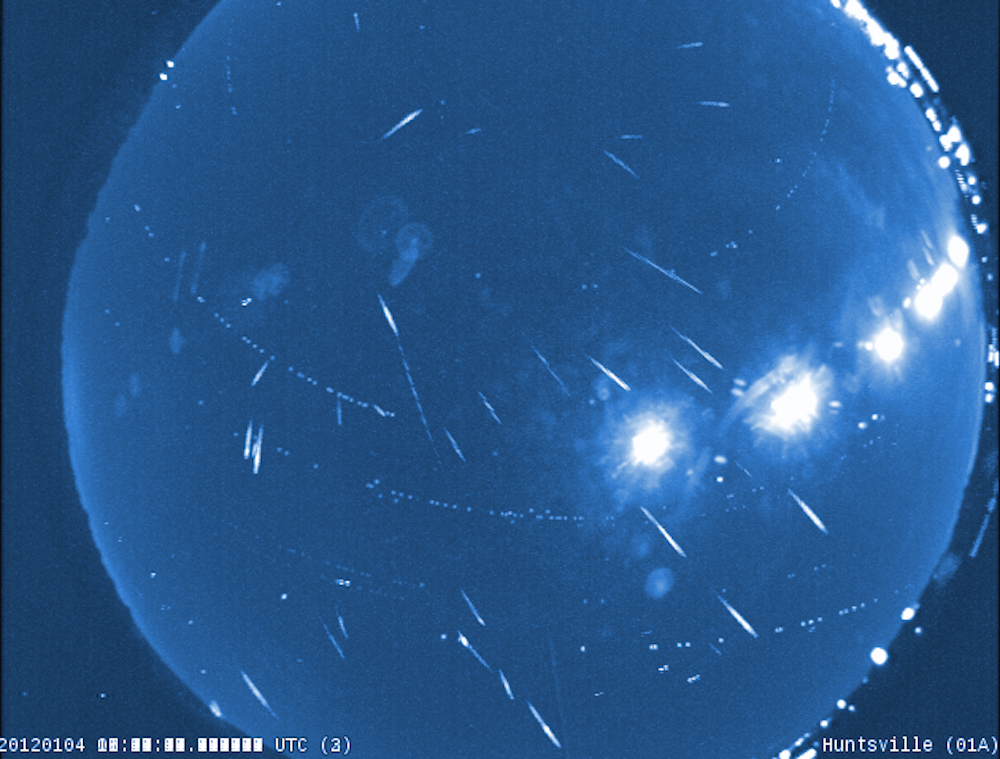 This false-color composite image shows a combination of Quadrantid and non-Quadrantid meteors streaking through the skies over NASA’s Marshall Space Flight Center, in the US, on the night of January 3-4, 2012.
NASA/MSFC/Meteoroid Environments Office/Danielle Moser and Bill Cooke, CC BY-NC
This false-color composite image shows a combination of Quadrantid and non-Quadrantid meteors streaking through the skies over NASA’s Marshall Space Flight Center, in the US, on the night of January 3-4, 2012.
NASA/MSFC/Meteoroid Environments Office/Danielle Moser and Bill Cooke, CC BY-NC
Alpha Centaurids [S]
Active: January 31 - February 20
Maximum: February 8, 1:00pm UT = February 8, 9pm (WA) = February 8, 11pm (QLD) = February 9, 12am (NSW/ACT/Vic/Tas)
ZHR: Variable; typically 6, but can exceed 25
Parent: Unknown
The Alpha Centaurids are a minor meteor shower, producing typical rates of just a few meteors per hour. But they are famed as a source of spectacular fireballs for southern hemisphere observers and so are worth keeping an eye out for in southern summer skies.
Alpha Centaurids are fast meteors, and are often bright. As with most showers that are only visible from the southern hemisphere, they remain poorly studied. Though typically yielding low rates, several outbursts have occurred where rates reached or exceeded 25 per hour.
The shower’s radiant lies close to the bright star Alpha Centauri – the closest naked-eye star to the Solar System and the third brightest star in the night sky.
 The Alpha Centaurids are well placed for the southern hemisphere. This view from Brisbane around the time of maximum activity.
Museums Victoria/Stellarium
The Alpha Centaurids are well placed for the southern hemisphere. This view from Brisbane around the time of maximum activity.
Museums Victoria/Stellarium
Alpha Centauri is just 30 degrees from the south celestial pole. As a result, the radiant essentially never sets for observers across Australia. The best rates will be seen from late evening onward, as the radiant rises higher into the southern sky.
This year, the peak of the Alpha Centaurids coincides with the New Moon, making it an ideal time to check out this minor but fascinating shower.
Eta Aquariids [S preferred]
Active: April 19 - May 28
Maximum: May 6, 2pm UT = May 6, 10pm (WA) = May 7, 12am (QLD/NSW/ACT/Vic/Tas)
ZHR = 40+
Parent: Comet 1P/Halley
The Eta Aquariids are possibly the year’s most overlooked treat, particularly for observers in the southern hemisphere. The first of two annual showers produced by comet 1P/Halley, the Eta Aquariids produce excellent rates for a whole week around their peak.
The radiant rises in the early hours of the morning, after the forecast maximum time, and best rates are seen just as the sky starts to brighten with the light of dawn. It can be well worth rising early to observe them, as rates can climb as high as 40 to 50 meteors per hour before the brightening sky truncates the display.
 Look for the Eta Aquariids before sunrise and catch Venus and Mercury too.
Museums Victoria/Stellarium
Look for the Eta Aquariids before sunrise and catch Venus and Mercury too.
Museums Victoria/Stellarium
Eta Aquariid meteors are fast and often bright, and the shower regularly rewards those who are willing to rise early. Spectacular Earth-grazing meteors that tear from one side of the sky to the other can be seen shortly after the radiant rises above the horizon.
This year conditions are ideal to observe the shower, with New Moon falling on May 4, just two days before the forecast maximum. As a result, the whole week around the peak will be suitable for morning observing sessions, giving observers plenty of opportunity to see the fall of tiny fragments of the most famous of comets.
Southern Delta Aquariids, Piscis Austrinids and Alpha Capricornids [N/S; S favoured]
Active: Early-July to Mid-August
Maximum: July 28 - 30
Combined ZHR: 35
Parent: Comet 96P/Macholz (Southern Delta Aquariids); Unknown (Piscis Austrinids); Comet 169P/NEAT (Alpha Capricornids)
In most years, the approach of August is heralded by keen meteor observers as the build up to the Perseids – the second of the year’s big three showers. This year, moonlight will interfere, spoiling them for most observers.
But this cloud comes with a silver lining. A fortnight or so before the peak of the Perseids, three relatively minor showers come together to provide an excellent mid-winter show for southern hemisphere observers. This year, the Moon is perfectly placed to allow their observation.
These three showers – the Southern Delta Aquariids, Alpha Capricornids and Pisces Austrinids – favour observers in the southern hemisphere, though they can also be observed from northern latitudes.
Regardless of your location, the best rates for these showers are seen in the hours after midnight. Reasonable rates begin to be visible for southern hemisphere observers as early as 10pm local time.
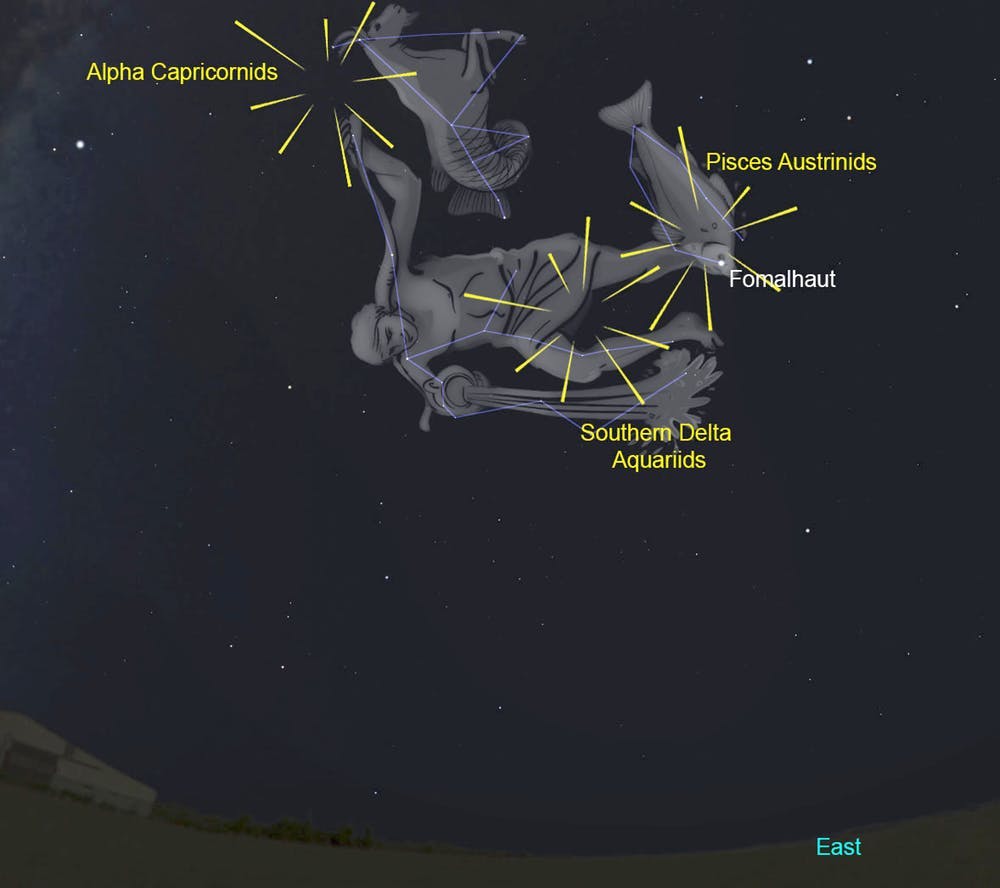 The radiants of the Southern Delta Aquariids, Alpha Capricornids and Piscis Austrinids ride high in the southern hemisphere sky around local midnight.
Museums Victoria/Stellarium
The radiants of the Southern Delta Aquariids, Alpha Capricornids and Piscis Austrinids ride high in the southern hemisphere sky around local midnight.
Museums Victoria/Stellarium
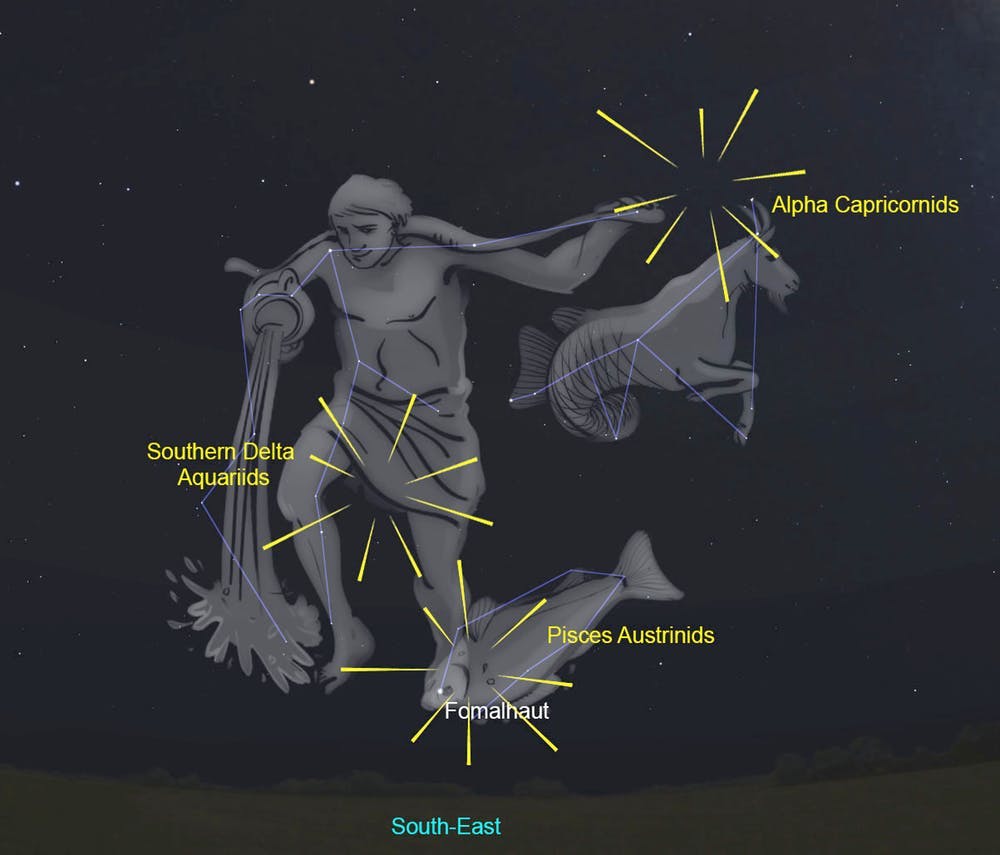 For northern hemisphere observers, the radiants of the same three showers sit low to the horizon around local midnight.
Museums Victoria/Stellarium
For northern hemisphere observers, the radiants of the same three showers sit low to the horizon around local midnight.
Museums Victoria/Stellarium
The Southern Delta Aquariids are the most active of the three, producing up to 25 fast, bright meteors per hour at their peak, which spans the five days centred on July 30.
The Alpha Capricornids, by contrast, produce lower rates typically contributing just five meteors per hour. But where the Southern Delta Aquariids are fast, the Alpha Capricornids are very slow meteors and are often spectacular.
Like the Alpha Centaurids, in February, they have a reputation for producing large numbers of spectacular fireballs. This tendency to produce meteors that are both very bright and also slow moving makes them an excellent target for astrophotographers, as well as naked-eye observers.
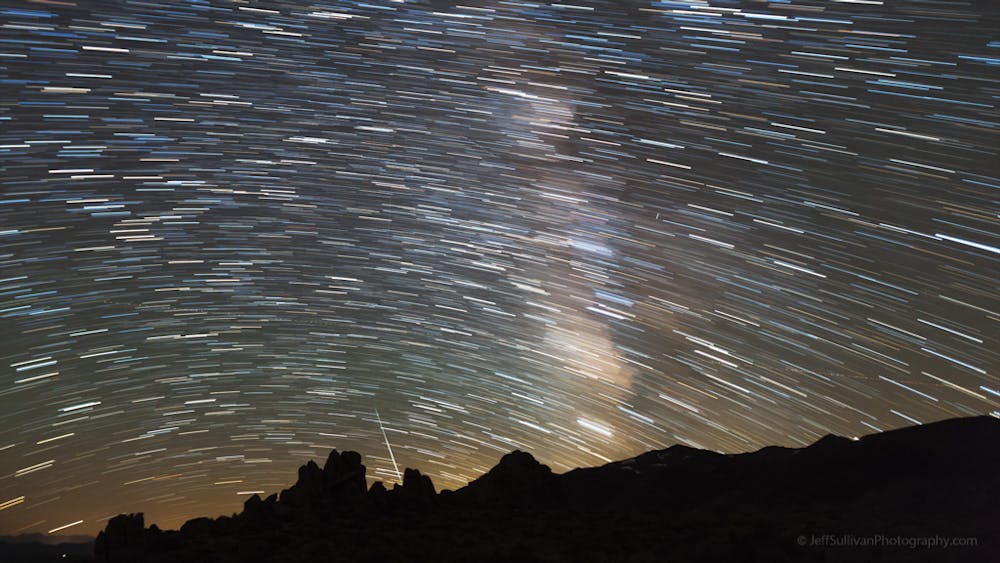 An Alpha Capricornid meteor captured among the star trails in 2013.
Flickr/Jeff Sullivan, CC BY-NC-ND
An Alpha Capricornid meteor captured among the star trails in 2013.
Flickr/Jeff Sullivan, CC BY-NC-ND
Taurids [N/S]
Active: September 10 - December 10
Maxima: October 10 (Southern Taurids); November 13 (Northern Taurids)
ZHR: 5 + 5
Parent: Comet 2P/Encke
The Taurids are probably the most fascinating of all the annual meteor showers. Though they only deliver relatively low rates (approximately five per hour from each of the two streams, north and south), they do so over an incredibly long period – three full months of activity.
In other words, the Earth spends a quarter of a year passing through the Taurid stream. In fact, we cross the stream again in June, when the meteors from the shower are lost due to it being exclusively visible in daylight.
So a third of our planet’s orbit is spent ploughing through a broad stream of debris, known as the Taurid stream. In total, the Taurid stream deposits more mass of meteoric material to our planet’s atmosphere than all of the other annual meteor showers combined.
So vast is the Taurid stream that there is speculation that it originated with the cataclysmic disintegration of a super-sized comet, thousands or tens of thousands of years in the past, and that the current shower is a relic of that ancient event.
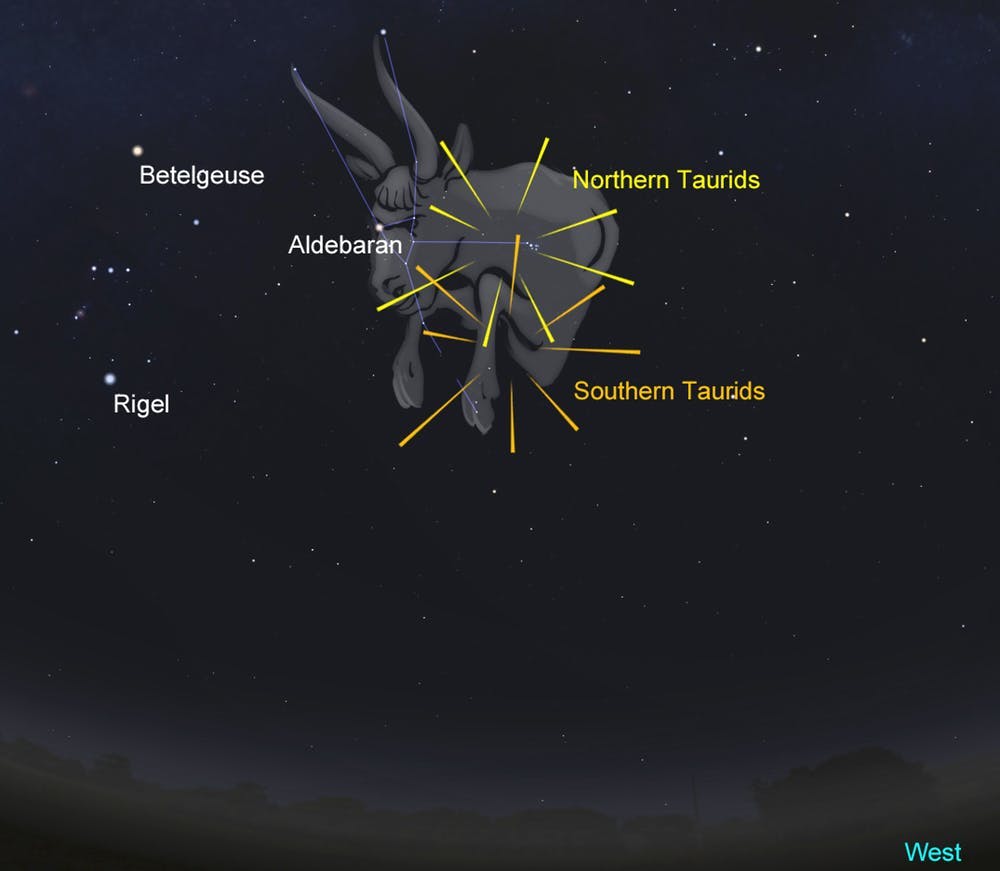 The two Taurid radiants, as seen from northern Europe before dawn [Paris 6:30am, October 10]
Museums Victoria/Stellarium
The two Taurid radiants, as seen from northern Europe before dawn [Paris 6:30am, October 10]
Museums Victoria/Stellarium
 The November maximum will be hindered by the Moon, this view as seen from Melbourne during the early hours of November 13.
Museums Victoria/Stellarium
The November maximum will be hindered by the Moon, this view as seen from Melbourne during the early hours of November 13.
Museums Victoria/Stellarium
Taurid meteors are slow, and are often spectacularly bright. Like the Alpha Capricornids, they have a reputation for producing regular fireballs, making them another good target for the budding astrophotographer.
Rather than having a single, sharp peak, Taurid activity stays at, or close to, peak rates for the best part of a month, between the maxima of the northern and southern streams, meaning that it is always possible to find some time when moonlight does not interfere to observe the shower.
Geminids [N/S]
Active: December 4 - December 17
Maximum: December 14, 6:40pm UT = December 15, 4:40am (QLD) = December 15, 5:40am (NSW/ACT/Vic/Tas)
ZHR: 140+
Parent: Asteroid 3200 Phaethon
Another of the big three annual meteor showers, the Geminids are probably the best, with peak rates in recent years exceeding 140 meteors per hour.
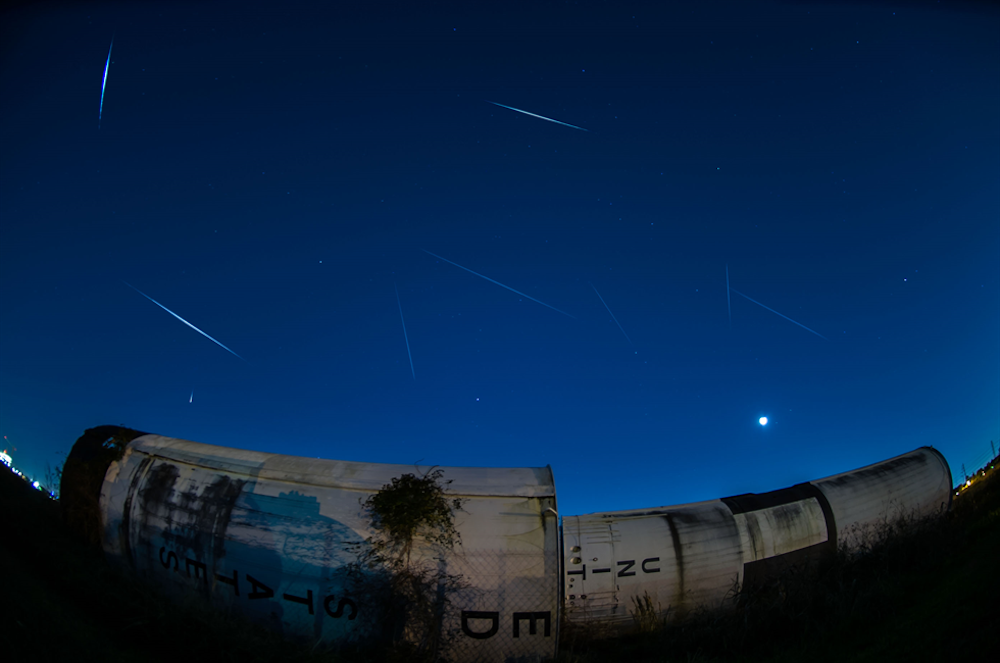 A composite image of the Geminids shower from the vantage point of Johnson Space Center, US.
NASA/Lauren Harnett, CC BY-NC
A composite image of the Geminids shower from the vantage point of Johnson Space Center, US.
NASA/Lauren Harnett, CC BY-NC
The Geminids are visible from both hemispheres – although the radiant rises markedly earlier for northern observers. Even in the south of Australia, the radiant rises well before midnight, giving all observers the rest of the night to enjoy the spectacle.
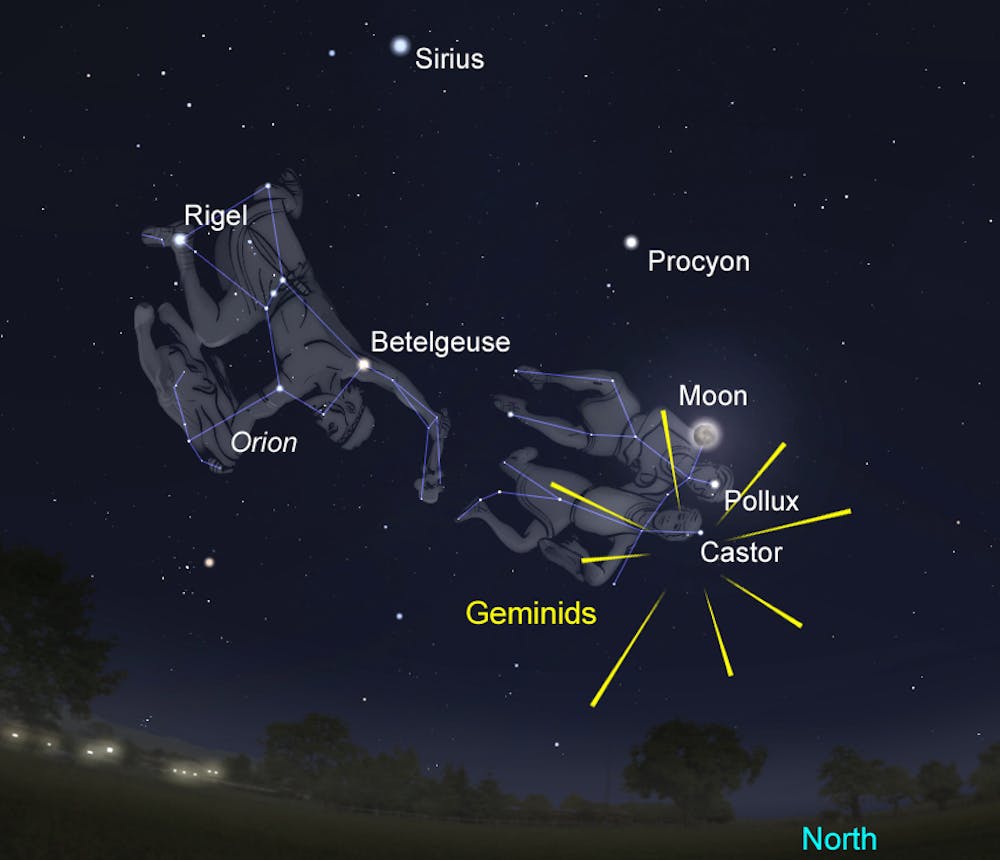 The Moon interferes with the Geminids, which radiate close to the bright star Castor. This view is from Perth in the hours before sunrise.
Museums Victoria/Stellarium
The Moon interferes with the Geminids, which radiate close to the bright star Castor. This view is from Perth in the hours before sunrise.
Museums Victoria/Stellarium
Moonlight will seriously interfere with the peak of the shower this year, washing out the fainter meteors, with the result that observed rates will be lower than the ZHR might otherwise suggest.
But the shower regularly produces abundant bright meteors, and yields such high rates that it is still well worth checking out, even through the glare of the full Moon.
Ursids [N]
Active: December 17 - December 26
Maximum: December 23, 3:00am UT
ZHR: 10+
Parent: Comet 8P/Tuttle
The final shower of the year – the Ursids – is a treat for northern hemisphere observers alone. Much like the shower that started our journey through the year, the Quadrantids, the Ursids remain poorly observed, often lost to the bleak midwinter weather that plagues many northern latitudes.
But if skies are clear the Ursids are visible throughout the night, as their radiant lies just 12 degrees from the north celestial pole. As such, they make a tempting target for observers to check out in the evening, even if the radiant is at its highest in the early hours of the morning.
Most years, the Ursids are a relatively minor shower, with peak rates rarely exceeding ten meteors per hour. They have thrown up a few surprises over the past century, with occasional outbursts of moderately-fast meteors yielding rates up to, and in excess of, a hundred meteors per hour.
 The Ursid radiant, in the constellation Ursa Minor, is circumpolar for almost the entire northern hemisphere, as it lies just 12 degrees from the north celestial pole. It is shown here as it would be seen at 11pm from near Tokyo, Japan.
Museums Victoria/Stellarium
The Ursid radiant, in the constellation Ursa Minor, is circumpolar for almost the entire northern hemisphere, as it lies just 12 degrees from the north celestial pole. It is shown here as it would be seen at 11pm from near Tokyo, Japan.
Museums Victoria/Stellarium
While no such outburst is predicted for 2019, the Ursids have proven to be a shower with a surprise or two left to show and so may just prove to be an exciting way to end the meteoric year.
If you have a good photo of any of this year’s meteor showers that you’d like to share with The Conversation’s readers then please send it to readerspic@theconversation.edu.au. Please include your full name and the location the photo (or any composite) was taken.
Authors: Jonti Horner, Professor (Astrophysics), University of Southern Queensland
Read more http://theconversation.com/look-up-your-guide-to-some-of-the-best-meteor-showers-for-2019-106863


















