

We mapped a massive explosion in space, showing how galaxies ‘pollute’ the cosmos
- Written by: Adam B. Watts, Research Associate in galaxy evolution, The University of Western Australia
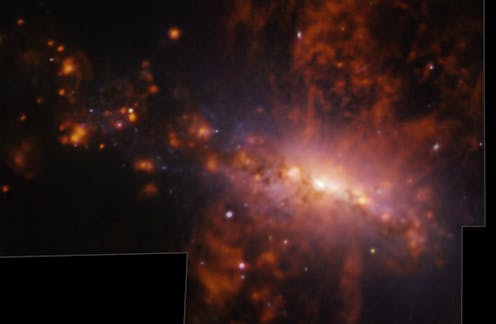
We breathe oxygen and nitrogen gas in our atmosphere every day, but did you know that these gases also float through space, around and between galaxies?
Our team captured a high-resolution view of how these elements make it so far out into the universe. Our study is now published in Monthly Notices of the Royal Astronomical Society.
Gas outflows from galaxies happen when supernovae – the explosive deaths of stars – eject a mixture of gas and heavy elements such as oxygen, sulphur and even nickel. In addition to “polluting” space with heavy elements, these outflows also play a key role in star formation within galaxies as a whole.
Observing outflows from galaxies is hard, because the gas is many times fainter than the light from the galaxy itself. As a result, we have observed outflows in only a handful of galaxies in the nearby universe.
This lack of data has significantly limited our understanding of their physical nature. It means that every time we do find a new outflow, we gain a wealth of new information.
Gas outflows regulate how stars form
Galaxies grow through star formation, a process regulated by the gas supply: the raw fuel for new stars. While new stars are constantly forming, the most massive stars are also ending their lives as supernovae: chemically enriched explosions that sweep up the surrounding gas and carry it out of the galaxy.
This forms an outflow, one of the main methods for removing gas from galaxies. This makes them a key regulator of star formation, and thus the growth of galaxies.
They’re also an effective method for distributing the elements necessary for forming planets like Earth.
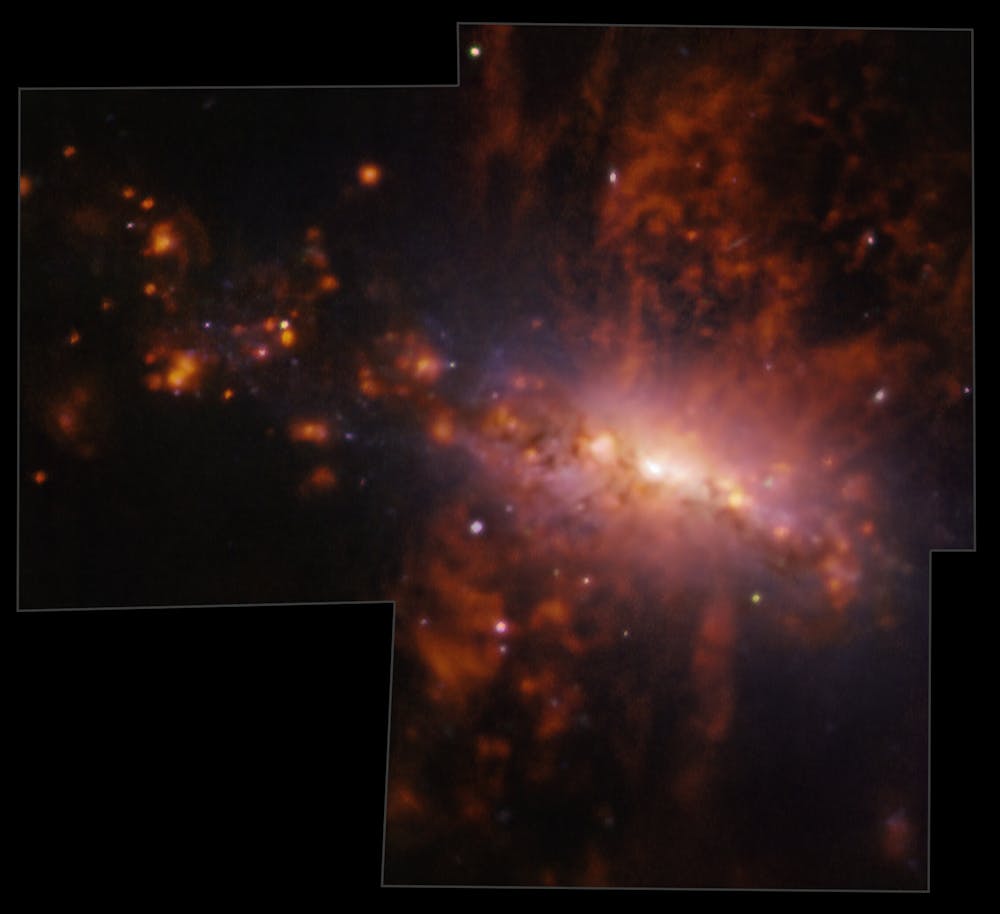
The focus of our research was the spiral galaxy NGC 4383, a peculiar object forming many stars in its centre. We had an inkling that something more was going on, perhaps even the presence of an outflow.
Still, we needed more information to pinpoint how this galaxy was evolving. To this end, we observed NGC 4383 with one of the most sensitive ground-based instruments in the world: the Multi Unit Spectroscopic Explorer (MUSE) mounted on the European Southern Observatory’s VLT (Very Large Telescope) on Cerro Paranal, a mountain in northern Chile.
A spectacular image
The data we got were more spectacular than we ever could have imagined.
We see clearly the presence of a massive outflow of gas extending 20,000 light-years from the galaxy’s centre. The total mass of gas contained in the outflow is equivalent to 50 million times the mass of our own Sun. That is a significant number of stars this galaxy won’t form any time soon.
MUSE takes more than just a picture of a galaxy. Each pixel in the image contains a spectrum of light, similar to how a rainbow shows us the spectrum of sunlight.
Each element in the universe has a unique spectral signature, and the locations of these signatures are shifted by how fast gas in a galaxy moves. As a result, we could also map the movement of gas and chemical elements in NGC 4383 in great detail.
The galaxy NGC 4383 in myriad colours or wavelengths of light. Different elements like hydrogen, oxygen, sulphur or nitrogen emit light at very specific wavelengths, highlighted here as the animation scans through different colours.We found that there is no smooth escape for this gas, and the outflow contains turbulent shells and chimney-like structures resulting from the violent nature of the supernova explosions that are expelling it.
Our ability to trace the gas motions lets us clock the gas as escaping at the mind-blowing rate of over 200 kilometres per second.
We observed the chemical signatures of several heavy elements – among them, oxygen, sulphur and nitrogen – being carried by the outflowing gas to pollute the space around the galaxy. Now, if I’ve made you worried about space pollution, don’t fret. This is the good kind of pollution, as these heavy elements are the same ones that make up the world around us and are essential for life as we know it.
Our results are the first from a new project, called MAUVE, aimed at building a detailed understanding of star formation and the chemical evolution of galaxies. If these data are anything to go by, I’d say the biggest surprises are still to come.
Read more: To find out how galaxies grow, we're zooming in on the night sky and capturing cosmic explosions
Authors: Adam B. Watts, Research Associate in galaxy evolution, The University of Western Australia


















