

First Nations Anzacs sacrificed life and limb for Country. Why aren’t their stories shown onscreen?
- Written by: Cally Jetta, Senior Lecturer and Academic Lead; College for First Nations, University of Southern Queensland
Aboriginal and Torres Strait Islander readers are advised this article contains names and images of deceased people, as well as sensitive historical information related to Indigenous war service.
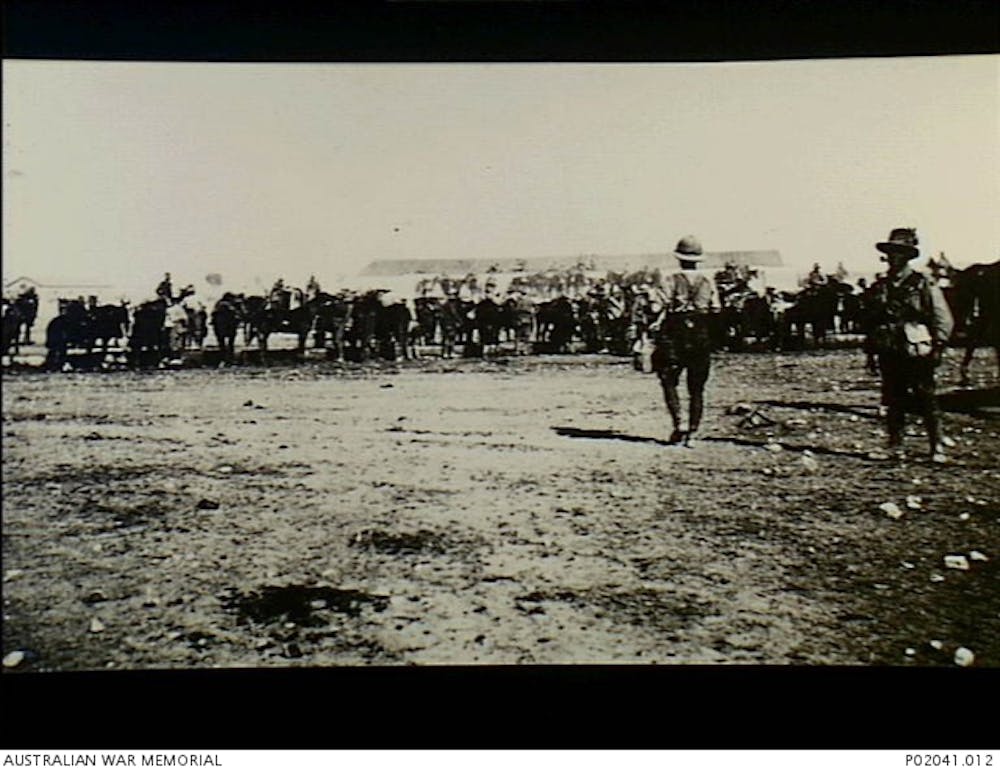
Since the 1860s, thousands of Aboriginal and Torres Strait Islander peoples have served in the Australian Defence Force. They have fought in every major war from the Boer War to Afghanistan. More than 1,000 Aboriginal and Torres Islanders served in the first world war, with at least 70 stationed on the front lines and in the trenches at Gallipoli.
At the outbreak of WWI, the 1910 amendment to the Australian Defence Act of 1903 prevented persons “not substantially of European origin or descent” from enlisting. In addition, Aboriginal and Torres Strait Islanders weren’t yet considered Australian citizens and were therefore automatically excluded from enlisting.
Despite this, many Aboriginal and Torres Strait Islanders answered the call to defend their country by hiding their racial identity to enlist.
This Anzac Day, we can point to many examples of mainstream media projects, both fiction and non-fiction, dedicated to the Australian experience of WWI. But within these stories is a striking lack of Aboriginal or Torres Strait Islander people or characters that represent the wartime sacrifices made by First Nations peoples.
Why have their contributions been erased? And when will they be remembered?
Fighting for Country
Serving on the ground, in the air and on the sea, Aboriginal and Torres Strait Islander people entered the war effort for several reasons.
The propaganda that encouraged white Australians to enlist in search of travel and adventure also reached Aboriginal reserves and communities, having a similar impact. The chance to earn a wage and gain an education were also attractive causes as these rights were heavily restricted for Indigenous Australians at the time.
For the most part, however, the Aboriginal and Torres Strait Islander people who joined the war effort did so out of a deep love for their country. As the Australian War Memorial’s first Indigenous liaison officer, Gary Oakley, explains:
They had that warrior spirit and they wanted to prove themselves.
These men were willing to fight for their country’s freedom alongside countrymen who were not willing to fight for their freedom. Their loyalty to the land, and responsibility to protect it, were too powerful to ignore.
Yet, once the war ended, they returned to as much discrimination (if not more) than before it began. Any hopes of equal treatment by the Australian government and white society on account of their service were quickly dashed.
Returned Aboriginal and Torres Strait Islander soldiers were denied the recognition and support schemes provided to their non-Indigenous comrades. Even today, many families and communities continue to seek due recognition for Indigenous peoples’ contributions to the war effort.
Read more: Telling the forgotten stories of Indigenous servicemen in the first world war
(A lack of) Indigenous recognition in media
Indigenous people’s contributions during WWI continue to be left out of major mainstream media productions. Before Dawn (2024), the most recent Australian film based on the war, fails to include a single Aboriginal or Torres Strait Islander person in its cast.
This trend continues in Beneath Hill 60 (2010), Ghosts of War (2010), Forbidden Ground (2013), An Accidental Hero (2013), William Kelly’s War (2014) and Water Diviner (2014). Earlier films such as The Lighthorsemen (1987) and Gallipoli (1981) – perhaps the most iconic Australian WWI film – also fails to include or even mention an Indigenous presence.
And there was indeed a presence. Consider James Lingwoodock, a Kabi Kabi from Queensland. A renowned horseman, Lingwoodock joined the 11th Light Horse Regiment and fought in (and survived) the 1917 Battle of Beersheba – a significant victory for Australia. He returned to Australia in 1919.
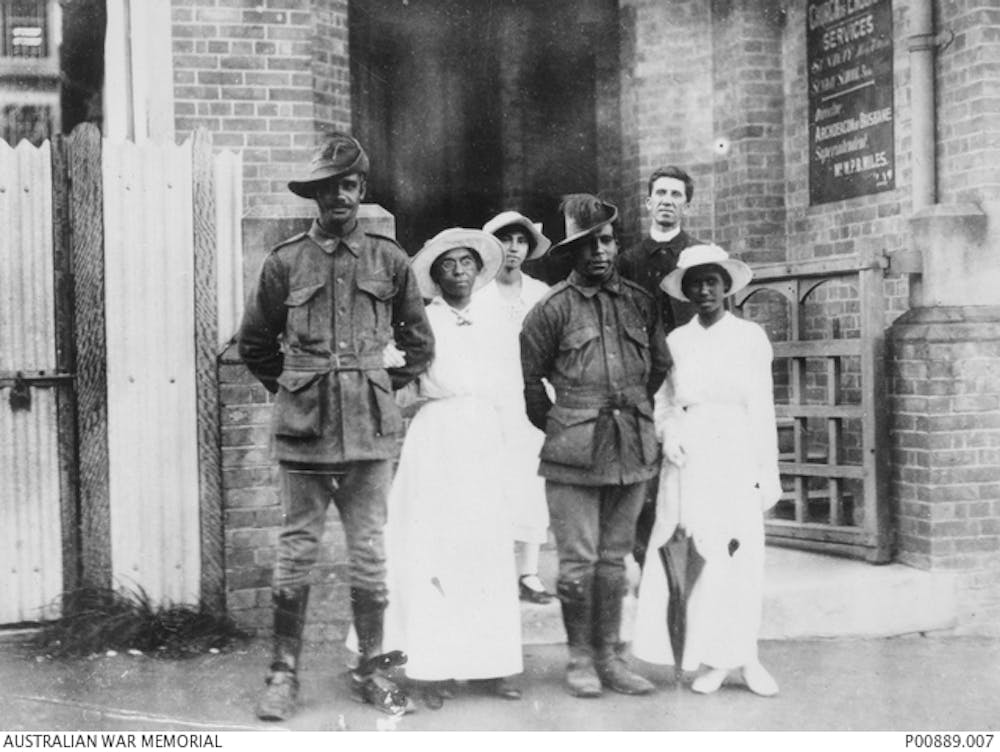 The double wedding party of 11th Light Horse Regiment members James Lingwoodock (left) and John Geary (fourth from left), along with Daisy Lingwoodock (nee Roberts) (second from left), an unidentified woman, the Reverend W.P.B. Miles (second from right) and Alice Geary (nee Bond) (right).
State Library of Queensland
The double wedding party of 11th Light Horse Regiment members James Lingwoodock (left) and John Geary (fourth from left), along with Daisy Lingwoodock (nee Roberts) (second from left), an unidentified woman, the Reverend W.P.B. Miles (second from right) and Alice Geary (nee Bond) (right).
State Library of Queensland
Consider also the four Noongar brothers from the township of Katanning, Western Australia, who entered the battlefields of WWI. Lewis and Larry Farmer both fought and survived at Gallipoli, but Larry was later killed on the Western Front. A third brother, Augustus Pegg Farmer – the first Aboriginal soldier awarded the Military Medal for bravery – was killed in action several months later.
Lewis eventually made it home to Katanning, along with the fourth brother, Kenneth.
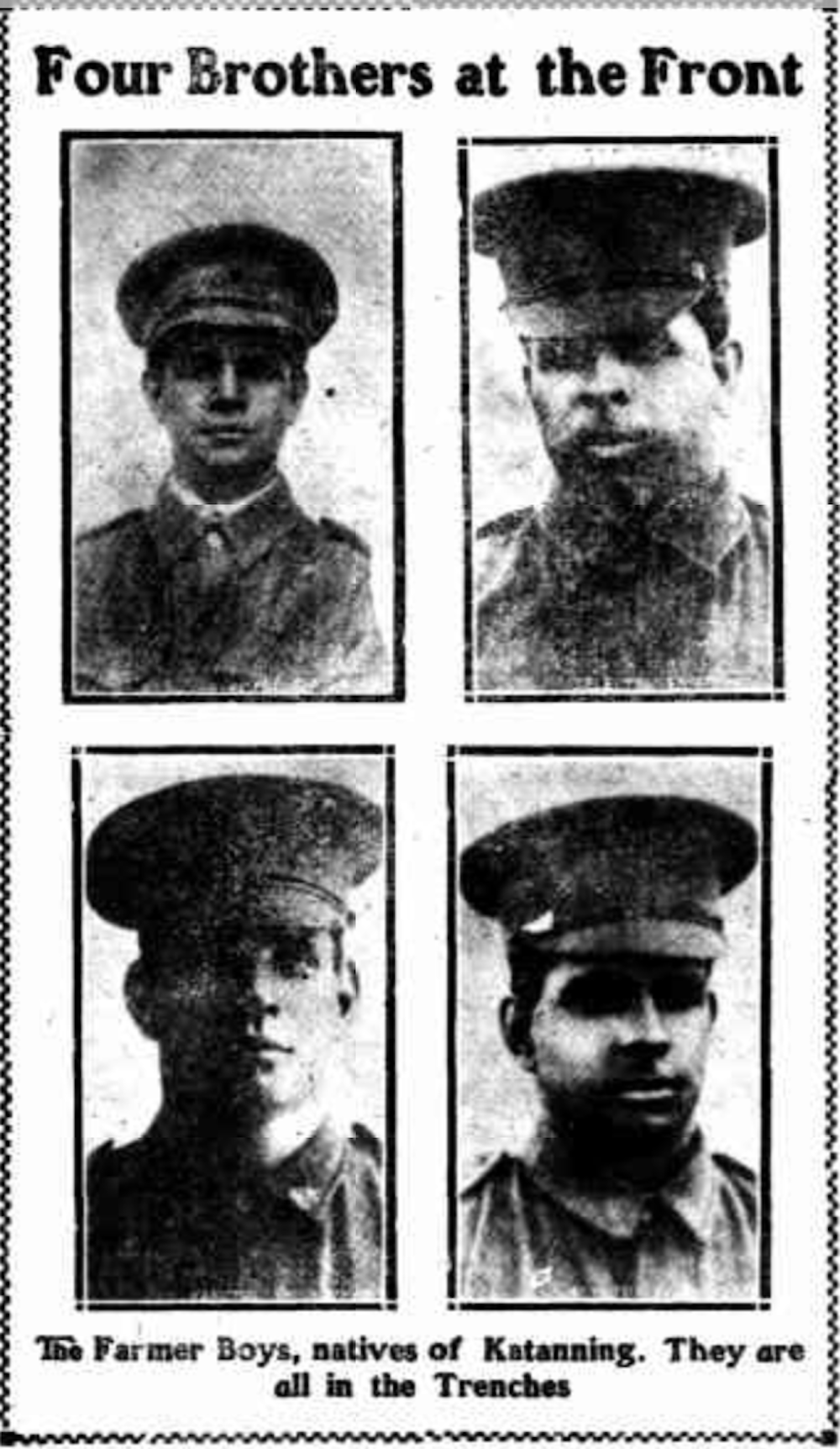 Kenneth Farmer (top left), Pegg Farmer (bottom left), Larry Farmer (top right) and Lewis Farmer (bottom right) pictured in a 1916 edition of the Sunday Times.
Trove
Kenneth Farmer (top left), Pegg Farmer (bottom left), Larry Farmer (top right) and Lewis Farmer (bottom right) pictured in a 1916 edition of the Sunday Times.
Trove
Untold stories
There have been some film and television projects dedicated to the Australian Frontier Wars, which were fought between First Nations peoples and the first waves of British invaders. Two examples are the documentary The Australian Wars (2022) and the film Higher Ground (2020).
Similarly, the Australian War Memorial collection includes Indigenous-produced documentaries and short films that capture the varied experiences of Aboriginal and Torres Strait Islander servicemen and women. But it’s fair to say such projects sit outside the popular media most Australians are exposed to.
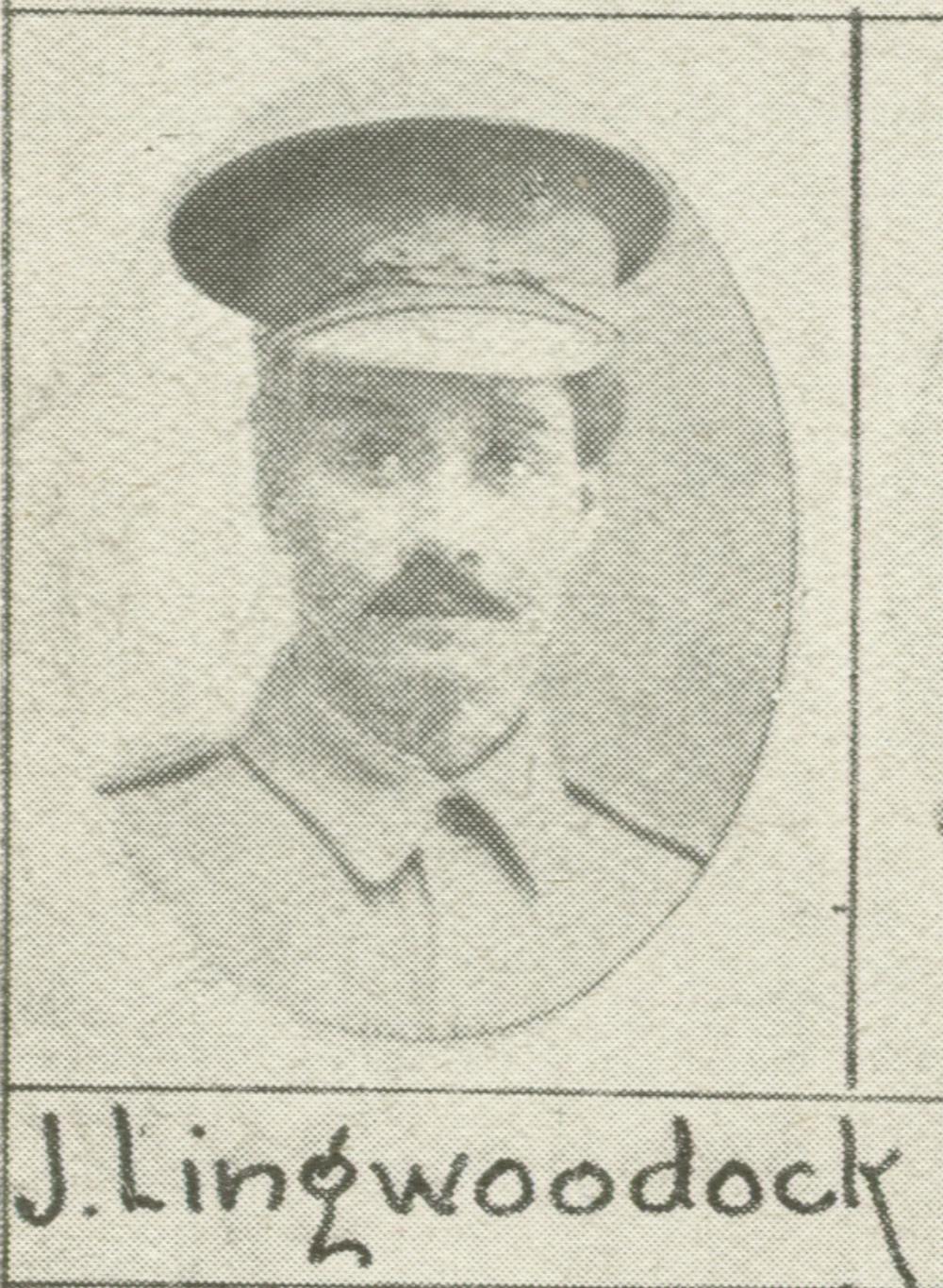 James Lingwoodock pictured in The Queenslander Pictorial in 1917.
State Library of Queensland
James Lingwoodock pictured in The Queenslander Pictorial in 1917.
State Library of Queensland
We need more collaborations that will bring Indigenous wartime stories to mainstream audiences, while retaining their cultural integrity. We also need to ensure Indigenous ownership and control over these stories.
Where is the onscreen tale of the Indigenous Anzac soldier who obscured his racial identity to enlist? The solider who risked life and limb for Country? Who survived through horrors, only to be excluded from all forms of post-war recognition and compensation? Whose traditional land was portioned up and gifted to returned white soldiers? Who struggled with post-war trauma in silence and isolation and who died without being acknowledged?
These stories, along with a great many others, are waiting to be told. The Indigenous persons who served in WWI, and their descendants, deserve to have them heard – just as all Australians deserve the opportunity to hear them.
I would like to sincerely acknowledge the diverse traditional custodians of this great land – their respective communities, Elders and Countries. I particularly acknowledge the Binjarub, Noongar nation, peoples and Country where I reside. I acknowledge the collective contributions, past and present, and pay my deepest respects to all Aboriginal and Torres Strait Islander service peoples for their courage and sacrifices: an ongoing source of strength and pride for us all.
Authors: Cally Jetta, Senior Lecturer and Academic Lead; College for First Nations, University of Southern Queensland



















