

Juvenal, the true satirist of Rome
- Written by: Robert Cowan, Senior Lecturer in Classics, University of Sydney
An angry man stands at the crossroads and rails against the moral cesspit around him, teeming with sexual deviants and jumped-up immigrants. This is the image which the Roman poet Juvenal paints of the satirist castigating the vices of contemporary Rome.
Juvenal’s Satires provide a fascinating window onto the social melting-pot that was early second century CE Rome. But they also hold up a mirror to those whose feelings of alienation and disempowerment produce a bitter distortion of that society.
Juvenal wrote 16 satires, divided into five books. Most are between 150 and 300 lines in length, except for the monstrous sixth satire attacking women and marriage, which rants on for over 650 lines and takes up a whole book on its own. Each satire has its own theme or target, ranging from decadent aristocrats and hypocritical moralists to giant turbots (a fish) and Egyptian cannibals, but this theme only loosely constrains a free-flowing structure which follows the satirist’s fulminating stream of consciousness.
Contradiction is the essence of these poems. The satirist indignantly condemns Rome’s vices as he pruriently lingers on their salacious details. The sheer force of his outrage and the vigour of his rhetoric sweep the reader along at the same time as she recoils from his bigotry. In Juvenal’s own words, it’s difficult not to write satire, and once you are sucked into its twisted world, it is difficult not to read it. But working out what to make of it is really difficult.
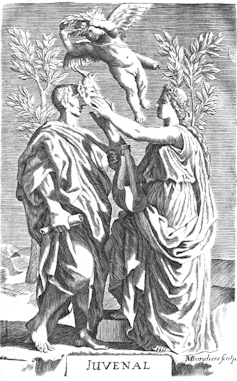 Frontispiece from the 1711 publication of Juvenal’s Satires.
Wiki Commons
Frontispiece from the 1711 publication of Juvenal’s Satires.
Wiki Commons
The beginning of Roman satire
Roman satire bears only a distant family resemblance to the modern idea of satire. Instead of John Clarke parodically impersonating an incompetent politician, Juvenal and his predecessors take direct aim at the follies and vices of their day, lambasting any who deviate from social norms with moralizing fervour, scathing mockery, and stomach-turning obscenity.
The Romans admitted that they inherited all other genres of poetry — epic, tragedy, comedy, pastoral, and the rest — from the Greeks, but they proudly declared that satire was “totally ours”. It was written in hexameters, the lofty metre of epic poetry, but it always sets itself up as epic’s “evil twin”. Instead of heroes, noble deeds, and city-foundations recounted in elevated language, satire presents a hodgepodge of scumbags, orgies, and the breakdown of urban society, spat out in words as filthy as the vices they describe.
The first great Roman satirist was Lucilius, writing in the latter half of the second century CE at the height of the free Republic. Only tantalising fragments of his work remain, but his reputation among later generations was unambiguous: a fearless exponent of extreme free speech who would lay into the powerful, stripping away the skin of respectability to reveal the foulness beneath.
Every later satirist lamented his inability to live up to Lucilius’ freedom and aggression. During the rise of the first emperor Augustus, as the free Republic gives way to the monarchical Empire, the poet Horace wrote satire whose buzzword was moderation, a contradiction in terms if ever there was one. Self-consciously playing it safe, his satirist chooses not to see — he even blames conjunctivitis — and not to talk about the death of political freedom.
Ninety years later, under Nero, the reclusive poet Persius turned satire inwards, boiling it down to dense, almost unreadable Latin which he doesn’t care if anyone reads. His image of the satirist is the barber whispering into a hole in the ground, “Midas has ass’s ears!” You can tell the truth, as long as you don’t need let anyone hear it.
Chariots of ire
With Juvenal, another half-century later, satire seemed to get its balls back. He dismisses epic and tragedy as tedious and irrelevant. Satire is the only possible response to the swamp that is Rome. Indignation is his Muse and the vices of Rome flow unmediated from the crossroads into his notebook. This is barely poetry at all. It is the unvarnished truth about Rome there on the page in front of you.
What folks have done ever since — their hopes and fears and anger, their pleasures, joys, and toing and froing — is my volume’s hotch-potch. Was there, at any time, a richer harvest of evil?
Except, of course, it isn’t. Juvenal goes through the same crisis as Horace and Persius. This isn’t the Republic and he isn’t Lucilius. It isn’t safe to tell it like it is when the rich and powerful can silence you. Juvenal’s solution is that he will only criticise the dead. The fearless satirist is compromised before he has even begun.
 A depiction of Juvenal in the Nuremberg Chronicle, late 1400s.
Wiki Commons
A depiction of Juvenal in the Nuremberg Chronicle, late 1400s.
Wiki Commons
Yet it isn’t just his caginess about causing offence which problematises the satirist’s voice. His strident attacks on women, on homosexuals, on Greek and Egyptian immigrants are often put in the mouths of characters who sound remarkably like the satirist himself.
Satire 3’s panoramic view of a decadent Rome is presented through the skewed vision of Umbricius, “Mr Shady”, about to abandon the city because Greek immigrants take all the jobs.
I now proceed to speak of the nation specially favoured by our wealthy compatriots, one that I shun above all others. I shan’t mince words. My fellow Romans, I cannot put up with a city of Greeks; yet how much of the dregs is truly Achaean? The Syrian Orontes has long been discharging into the Tiber, carrying with it its language and morals and slanting strings, complete with piper, not to speak of its native timbrels.
But his main complaint is that they get away with the same things he tries.
We, of course, can pay identical compliments; yes, but they are believed.
This isn’t moralising, or even simple bigotry, but sour grapes.
Readers take the first-person voice of the satires as reflecting Juvenal’s personal opinion in a sort of autobiographical confession. Indeed, we know nothing about him except what we can try to deduce from his poems. More recently, the satirist’s voice has been seen as a persona, a mask, a character just like Umbricius.
Is Juvenal satirising immigrants or the bigots who rail against them? The latter is certainly the more comfortable reading, but we need to be careful not to make the Romans too like us. Satire is meant to be uncomfortable.
Beyond Anger
 biblioteca de humanidades/flickr
Juvenal’s satirist doesn’t only “punch down” against easy targets. He also “punches up” and fights the corner of the little guy oppressed by the rich and powerful. Satire 5 condemns a rich patron for the humiliation he heaps on his poor client, though he acutely criticises the client for his complicity. Throughout, Juvenal’s main targets are hypocrites from all levels of society. The satirist stands outside and inveighs against what is wrong with Rome, but he has few suggestions on how to improve it.
In his later satires, Juvenal moves away from indignation altogether and adopts a new model. He will not be the philosopher Heraclitus, weeping at the state of the world, but another philosopher, Democritus, ironically laughing at it with a sense of detachment.
This is the spirit of satire 10, on the dangers of getting what we wish for. The satirist is not angry, but mockingly – and sometimes pityingly – amused by Sejanus, who got the power he wanted but was dragged through the streets on a meat-hook.
Now the flames are hissing; bellows and furnace are bringing
a glow to the head revered by the people. The mighty Sejanus
is crackling. Then, from the face regarded as number two
in the whole of the world, come pitchers, basins, saucepans, and piss-pots.
Frame your door with laurels; drag a magnificent bull,
whitened with chalk, to the Capitol. They’re dragging Sejanus along
by a hook for all to see.
Or the man whose prayer for long life is answered with impotent, incontinent senility.
The poor old fellow must mumble his bread with toothless gums.
He is so repellent to all (wife, children, and himself),
that he even turns the stomach of Cossus the legacy-hunter.
He loses his former zest for food and wine as his palate
grows numb. He has long forgotten what sex was like; if one tries
to remind him, his shrunken tool, with its vein enlarged, just lies there,
and, though caressed all night, it will continue to lie there.
The angry satirist hurls unconstructive abuse, but this new version has a suggestion for self-improvement:
Pray for a healthy mind in a healthy body.
Juvenal unbound
Juvenal is the greatest Roman satirist. He, far more than Horace or Persius, defined what satire meant for most of the early modern period and it is translations and imitations of him by Pope, Dryden, Jonson, and others – not to mention Hogarth’s paintings – which dominate the great era of English Augustan satire.
His satires give us a ground-level view of a Rome we could barely guess at from the heroism of the Aeneid, the drinking-parties of Horace’s Odes, or even the histories of Tacitus. We cannot trust satire, but we can allow ourselves to enjoy it.
Recommended translation: Juvenal, The Satires, Oxford World’s Classics translation by Niall Rudd with introduction and notes by William Barr (1992).
biblioteca de humanidades/flickr
Juvenal’s satirist doesn’t only “punch down” against easy targets. He also “punches up” and fights the corner of the little guy oppressed by the rich and powerful. Satire 5 condemns a rich patron for the humiliation he heaps on his poor client, though he acutely criticises the client for his complicity. Throughout, Juvenal’s main targets are hypocrites from all levels of society. The satirist stands outside and inveighs against what is wrong with Rome, but he has few suggestions on how to improve it.
In his later satires, Juvenal moves away from indignation altogether and adopts a new model. He will not be the philosopher Heraclitus, weeping at the state of the world, but another philosopher, Democritus, ironically laughing at it with a sense of detachment.
This is the spirit of satire 10, on the dangers of getting what we wish for. The satirist is not angry, but mockingly – and sometimes pityingly – amused by Sejanus, who got the power he wanted but was dragged through the streets on a meat-hook.
Now the flames are hissing; bellows and furnace are bringing
a glow to the head revered by the people. The mighty Sejanus
is crackling. Then, from the face regarded as number two
in the whole of the world, come pitchers, basins, saucepans, and piss-pots.
Frame your door with laurels; drag a magnificent bull,
whitened with chalk, to the Capitol. They’re dragging Sejanus along
by a hook for all to see.
Or the man whose prayer for long life is answered with impotent, incontinent senility.
The poor old fellow must mumble his bread with toothless gums.
He is so repellent to all (wife, children, and himself),
that he even turns the stomach of Cossus the legacy-hunter.
He loses his former zest for food and wine as his palate
grows numb. He has long forgotten what sex was like; if one tries
to remind him, his shrunken tool, with its vein enlarged, just lies there,
and, though caressed all night, it will continue to lie there.
The angry satirist hurls unconstructive abuse, but this new version has a suggestion for self-improvement:
Pray for a healthy mind in a healthy body.
Juvenal unbound
Juvenal is the greatest Roman satirist. He, far more than Horace or Persius, defined what satire meant for most of the early modern period and it is translations and imitations of him by Pope, Dryden, Jonson, and others – not to mention Hogarth’s paintings – which dominate the great era of English Augustan satire.
His satires give us a ground-level view of a Rome we could barely guess at from the heroism of the Aeneid, the drinking-parties of Horace’s Odes, or even the histories of Tacitus. We cannot trust satire, but we can allow ourselves to enjoy it.
Recommended translation: Juvenal, The Satires, Oxford World’s Classics translation by Niall Rudd with introduction and notes by William Barr (1992).
Authors: Robert Cowan, Senior Lecturer in Classics, University of Sydney
Read more http://theconversation.com/guide-to-the-classics-juvenal-the-true-satirist-of-rome-106156




















