It’s time to strike an environmental grand bargain between businesses, governments and conservationists – and stop doing things the hard way
- Written by Peter Burnett, Honorary Associate Professor, ANU College of Law, Australian National University
April has been a bad month for the Australian environment. The Great Barrier Reef was hit, yet again, by intense coral bleaching. And Environment Minister Tanya Plibersek delayed most of her Nature Positive Plan reforms.
True, Plibersek did reject the controversial Toondah Harbour proposal, but only after a near decade-long grassroots campaign to save the wetland from an apartment and retail development deemed clearly unacceptable by her own department.
Rather than fall back into old patterns of developers versus conservationists, we have a rare chance to find a compromise. Labor’s embrace of “Nature Positive” – a promising new environmental restoration approach – opens up the possibility of a grand bargain, whereby developers and business get much faster approvals (or rejections) in exchange for ensuring nature as a whole is better off as a result of our activities.

Sustainable development was meant to save us
First, a quick recap. We were meant to have put the era of saving the environment one place at a time to bed a long time ago. Around 1990, governments worldwide took to the then-novel idea of sustainable development. We even had a special Australian variant, ecologically sustainable development, which our federal and state governments backed unanimously. This led to a national strategy and incorporation into well over 100 laws, including flagship laws like the Environment Protection and Biodiversity Conservation Act, passed in 1999.
The basic idea was, and is, sound: encourage development to improve our quality of life, while maintaining the ecological processes on which life depends.
But it’s not what ended up being legislated. The 1990’s laws did not require developers to make their projects sustainable. Typically, sustainable development was watered down into principles ministers only had to “consider”.
Meanwhile, our ecosystems have continued to go downhill. And in a 2020 review of the laws, Graeme Samuel pronounced the EPBC Act a failure.
 Some development is necessary. How can we balance this need against the need to preserve natural systems?
Joel Carrett/AAP
Some development is necessary. How can we balance this need against the need to preserve natural systems?
Joel Carrett/AAP
Nature, positive?
When Labor was elected in 2022, it promised a new goal: “Nature Positive”.
This idea is no mere slogan. Nature positive is a serious policy idea. Think of it as the biodiversity counterpart to net zero emissions.
The goal is ambitious: stop the decline by 2030 and set about restoring what has been lost for a full recovery of nature by 2050. Rather than ticking boxes on whether principles had been considered, regulators would answer a much more basic question: will this development deliver a net positive outcome for nature?
Measuring progress is core to nature positive. We would take an environmental snapshot at the outset and track the gains and losses from there.
Like sustainable development before it, nature positive has been adopted with gusto by the Australian government, internationally and domestically.
In 2022, Plibersek committed to “stop the slide” and to “bake [the Nature Positive reforms] into law”.
Now, suddenly, we have lost momentum. The crucial part of the reforms – embedding nature positive in stronger environment laws – has been kicked down the road.
Plibersek has blamed complexity, extensive consultation and the need to get it right. Others see political concerns.
Could we strike a grand environmental bargain?
By pushing these laws back, Plibersek has effectively turned the already extended consultation process into an open-ended negotiation. Given consultation will keep running indefinitely, we’re now in the realm of regulatory co-design, previously only on offer to First Nations representatives for new cultural heritage protection laws.
Co-design implies proceeding by consensus. It would be politically embarrassing to run a consultation over years only to bring down the policy guillotine.
Consensus in turn raises the possibility of a grand environmental bargain, built around nature positive. Could this work? Might environment groups settle for a limited form of nature positive? Might business, in return for much faster approvals or rejections, support much stronger legal protection, especially for particularly vulnerable or important ecosystems?
Samuel certainly thinks so. At a recent Senate Inquiry, he recounted telling a meeting during his review:
If you each stick to your aspirations 100%, you’ll end up getting nothing. If you’re prepared to accept 80%-plus of your aspirations, you’ll get them, and that will be a quantum leap forward from the abysmal failure that we’ve had for two and a half decades
What might an 80% agreement look like?
If we are to turn decline into recovery, we need to ensure each natural system is intact. That is, it retains the minimum level of environmental stocks (such as animals, plants and insects) and flows (such as water, nutrients) needed to sustain ecological health.
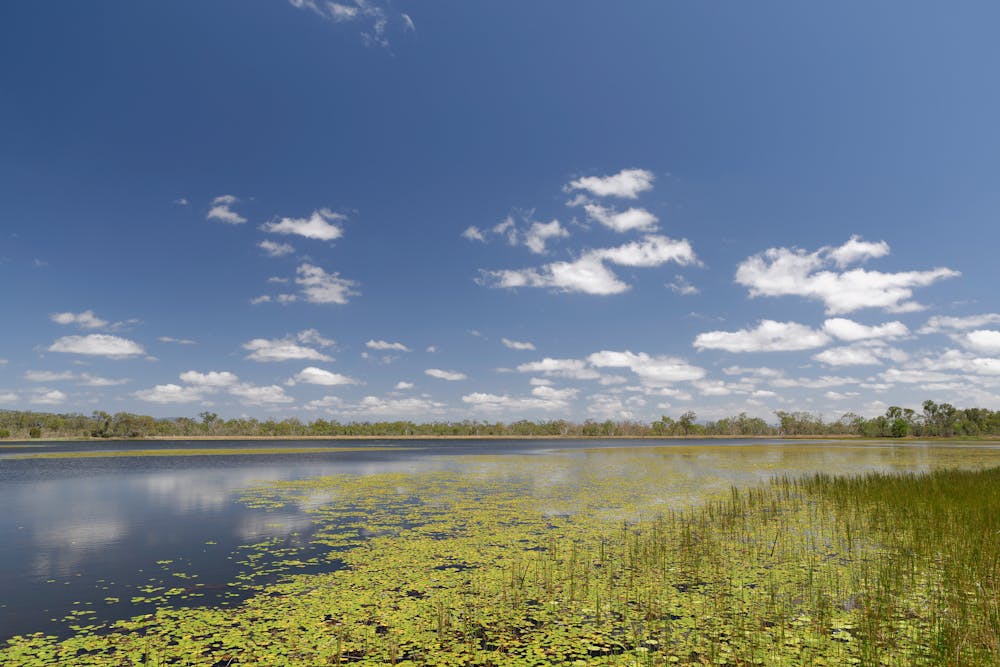 If flows of water into wetlands drop below a certain threshold, they’re not wetlands any more.
AustralianCamera/Shutterstock
If flows of water into wetlands drop below a certain threshold, they’re not wetlands any more.
AustralianCamera/Shutterstock
Such thresholds for ecological health are everywhere. For example, keeping the platypus off the endangered list would involve maintaining its population close to current levels and working out how much of its riverbank habitat should be conserved.
For policymakers, this suggests environmental laws should define minimum viability thresholds. Some thresholds would be absolute; others would be crossable in one location provided equivalent restoration was done in another.
Environmental groups could take satisfaction that thresholds would be maintained in most cases. Ecosystems would function, rivers would flow. But governments would still override thresholds for important economic and social reasons, say to approve a critical minerals project.
What’s in it for corporate Australia? Business would gain upfront certainty about what can be approved and quicker approvals for projects. Environmental litigation would fall. But development options would be narrowed and offsets would become more expensive.
The government would achieve a key goal: major environmental reform. But it would have to say no more often, and be transparent about crossing environmental thresholds.
It would have to finance the science and planning needed. And it would need to boost investment in environmental restoration, to compensate for using override powers and for the cumulative impact of smaller-scale activities.
A grand bargain along these lines would not deliver nature positive in full. We’d still be losing nature due to climate change. But it might go close enough to offer hope of long-term recovery.
Is such a deal feasible? It depends on how players read the incentives for compromise. For example, business will not want to be locked out of prospective development areas, but will also be worried about the possibility of a minority Labor government dependent on the Greens next year.
Nature positive in Australia is down – but opportunity remains.
Read more: Out of alignment: how clashing policies make for terrible environmental outcomes
Authors: Peter Burnett, Honorary Associate Professor, ANU College of Law, Australian National University