

the ancient roots of your backyard garden
- Written by: Eva Anagnostou-Laoutides, Associate Professor in Ancient History, Australian Research Council Future Fellow, Macquarie University
You don’t have to be an avid gardener or know all the Latin names of plants to appreciate the opportunity for reflection that a stroll in the garden can afford us. The explosion of colours, shapes, and textures in the garden, the tenacity and ingenuity of the plants, so determined to claim their right to life and beauty, can suspend for us the troubling aspects of everyday life.
But gardens are also bound to their political and religious history, traces of which can be found in our ongoing cultural obsession with them. The connection between the famous gardens of Versailles, once the coveted possession of Louis XIV, and our humble back garden is deeper than we might imagine.
Read more: Friday essay: what is it about Versailles?
In the book of Genesis, our creation begins in Eden, the “garden of God” which our ancestors, Adam and Eve, failed to appreciate. Having lost our privileged access to this divine garden because of their sin, we perpetually try to re-create it – in our homes, in our cities, in our heads. The earthly garden as a reflection of the paradise we can hope to experience after death is also a central motif in the Qur’an, a promise delivered by Allah himself.
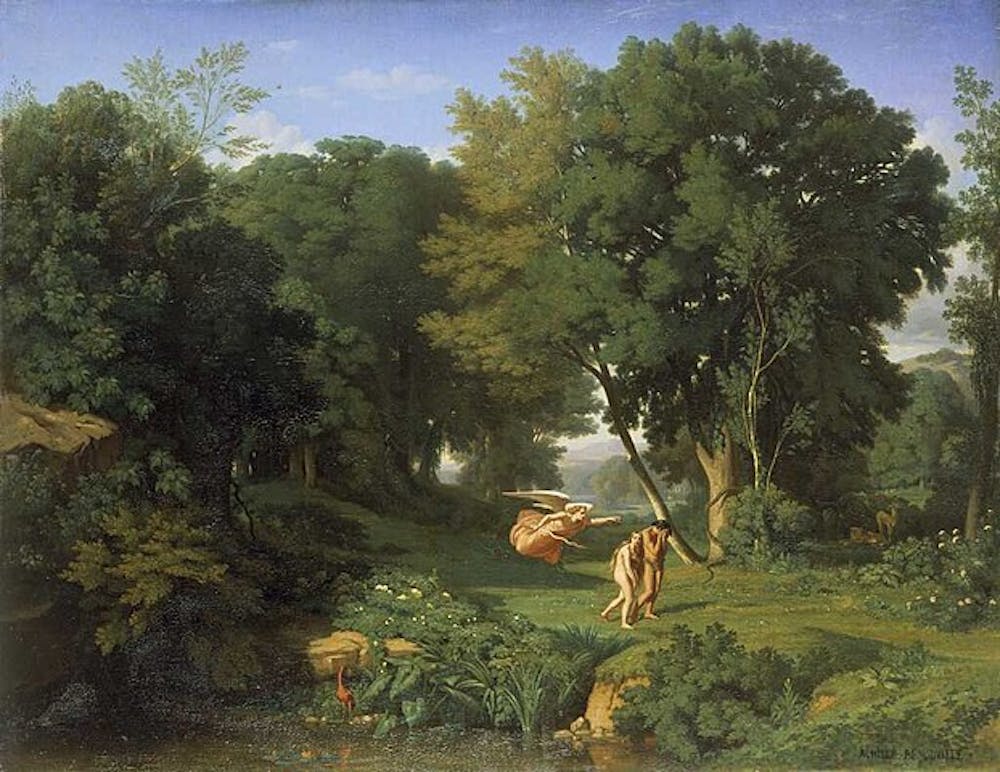 Adam and Eve Chased out of the Terrestrial Paradise. Jean Achille Benouville, 1841.
Wikimedia
Adam and Eve Chased out of the Terrestrial Paradise. Jean Achille Benouville, 1841.
Wikimedia
Gods and kings
In the ancient Near East, in whose fertile soil the Biblical traditions took shape, kings (who often assumed priestly duties) were believed to have the monopoly of communicating with the gods in the royal garden. This was seen as a microcosm of the divine garden.
In the Babylonian Epic of Gilgamesh (from around 2000 BCE), the hero-king Gilgamesh travels to the wondrous garden of the sun-god, where flowers boast precious gems instead of leaves, in a quest to claim immortality. Although immortality eludes Gilgamesh, the divine garden offers him wisdom. Thus equipped, he returns to his city, Uruk, also known as “the garden of Gilgamesh,” and builds magnificent walls which will etch his name into the memory of mankind.
Read more: Guide to the classics: the Epic of Gilgamesh
In another story, despite his uneasy relationship with the fertility goddess Inanna, whose advances he eventually rejects, Gilgamesh poses as her dedicated gardener. He carves a throne and a bed for Inanna from the Huluppu tree while she makes him a magical drum and drumstick from it to summon warriors to battle. When Inanna’s favourite tree is threatened by a serpent nesting at its roots, only Gilgamesh and his companions rush to her aid.
Throughout the Near East, the garden was a place where gods confirmed the legitimacy of kings. Sargon I (1920-1881 BCE), the founder of the Akkadian-Sumerian empire, poses in the epic The Legend of Sargon as a humble gardener, and was hand-picked by the goddess to become the king.
Ancient Near Eastern kings invested exorbitant sums of money in building magnificent royal gardens, architectural marvels which crystallised in people’s minds their unique communion with the gods. Sennacherib (704-681 BCE) likely commissioned the famous hanging gardens to be built near his capital Nineveh, although we still commonly refer to them as the Hanging Gardens of Babylon.
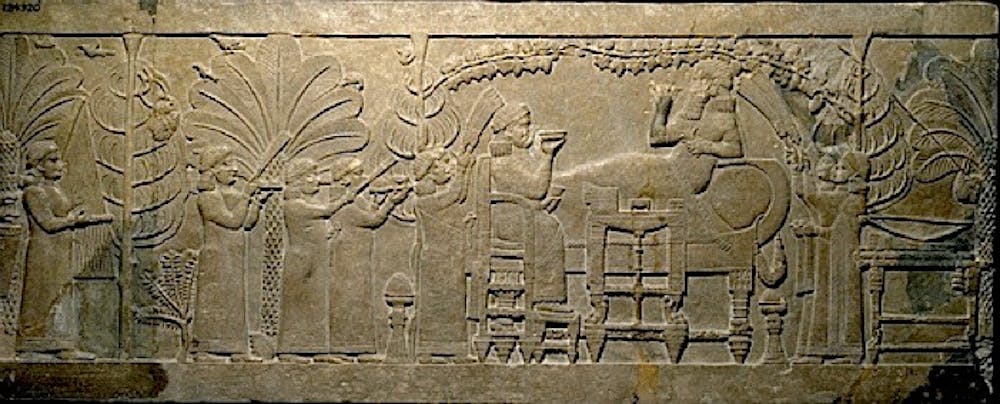 ‘Garden party of Aššurbanipal’ relief, reproduced with the permission of the Trustees of the British Museum. Found in Nineveh, Iraq, dated circa 645 BCE.
British Museum
‘Garden party of Aššurbanipal’ relief, reproduced with the permission of the Trustees of the British Museum. Found in Nineveh, Iraq, dated circa 645 BCE.
British Museum
The notion was also known to the Israelite king Solomon (circa 970-931 BCE), who proudly announced his construction of lavish, well-irrigated gardens and groves, and was widely used by the Achaemenids (a Persian dynasty). Indeed the Persian word for an enclosed garden, pairi-daêza, was introduced into Greek as paradeisos (“paradise”) by the historian Xenophon.
 A possible image of Prince Mirza Hindal in a Garden from Los Angeles County Museum of Arts (public domain). India, Mughal, 1600-1610.
Wikimedia
A possible image of Prince Mirza Hindal in a Garden from Los Angeles County Museum of Arts (public domain). India, Mughal, 1600-1610.
Wikimedia
In his biography of Cyrus the Great, the founder of the Achaemenid Empire, the Xenophon notes with admiration the king’s impeccable gardening skills which matched his royal virtue. Seleucus I, Alexander the Great’s general who came to rule Babylon, also embraced the profile of the king as gardener. His famous garden at Daphne, outside Antioch, renowned for its abundance of shady laurel trees, tall cypresses, and perennial fountains, was closely associated with the foundation of the Seleucid dynasty and Apollo, their divine patron. In the east the tradition never lost its appeal.
From the Middle East to the world
The Romans, who inherited the kingdoms of Alexander’s successors, adopted the ideology of gardens with renewed zeal, transplanting it in Europe. The Roman Empire withered, but generations of aspiring aristocrats and rulers, including Charlemagne, Count Robert II of Artois (1250-1302), Cosimo de’ Medici (1389-1464), and Henri II (1519-1559) never forgot the sense of grandeur and superhuman aura that exotic, exclusive gardens could afford them.
Dating from the Middle Ages, the Vatican Gardens, owned by the Pope, continue to evoke the political and religious dimensions of the garden, which were especially celebrated in Britain with the ascension of Henry VIII in 1509. European colonization of the Middle East saw the idea of the garden reintroduced in the places of its origin, but, also imported in the New World. Gardens such as the Victoria gardens in Mumbai showed off the legitimacy of British rule.
Read more: The science is in: gardening is good for you
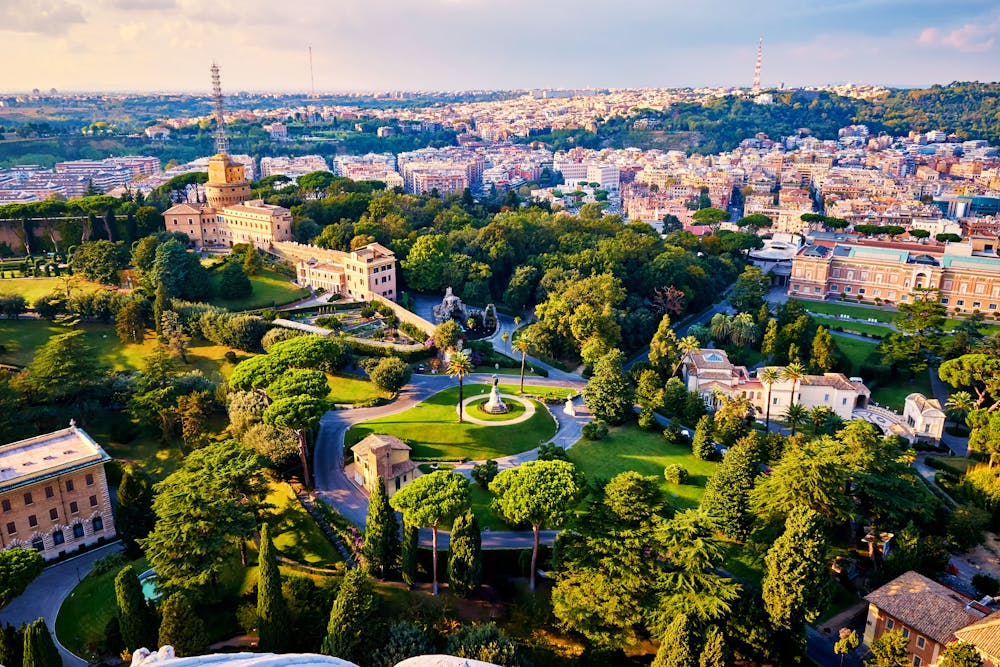 The Vatican evokes the political and religious dimensions of gardens.
Shutterstock
The Vatican evokes the political and religious dimensions of gardens.
Shutterstock
The connection of the garden with politics remains strong. Community gardens are cast as an epitome of democratic values, and the Royal Gardens in all major Australian cities advocate inclusiveness, despite their monarchical titles. Gardens surrounded ancient temples to bring worshippers closer to god; gardens surround war memorials inviting us to reflect on life lost and life gained.
So next time you’re wandering around your own garden, reflect on the fact that you’re walking in the footsteps of the kings and queens of yesteryear, in your own slice of paradise.
Authors: Eva Anagnostou-Laoutides, Associate Professor in Ancient History, Australian Research Council Future Fellow, Macquarie University
Read more http://theconversation.com/heaven-on-earth-the-ancient-roots-of-your-backyard-garden-108682



















.jpg)
_in_a_Garden_LACMA_M.89.60.jpg)