

Are Australian classrooms really the most disruptive in the world? Not if you look at the whole picture
- Written by: Jonathon Sargeant, Senior Lecturer in Inclusive Education and Classroom Management, Australian Catholic University
Recent reports suggest Australian classrooms, from the students’ perspective, are some of the most disruptive in the world. But do we have a behavioural crisis in our schools? Perhaps not.
At the end of this month, thousands of teachers and children begin or return to school. Throughout the day, each child will be expected to follow the instructions of multiple teachers, leaders, and mentors. In school, children are expected change activities with little prior notice. Some tasks require significant physical effort, while others exact a heavy intellectual toll.
Read more: How teachers are taught to discipline a classroom might not be the best way
The child’s performance in each activity is assessed in comparison with other children and with those who have gone before. The activities planned for them might occur in groups or alone, with or without technology, and with or without help.
Each child’s teacher will be focused on delivering the best possible learning experiences that are interesting, effective, and sometimes fun. Alongside this focus on learning is the task of classroom and behaviour management, an enduring challenge for teachers.
How is classroom disruption measured?
The Programme for International Student Assessment (PISA) is an international comparative study of student achievement directed by the Organisation for Economic Co-operation and Development (OECD). The PISA 2015 report provides an international comparison on how Australian 15-year old’s fare in scientific, mathematical, and reading literacy.
One part of this major report focuses on students’ accounts (with a focus on science classes) of the climate of classroom discipline. The report analysed student responses to questions about how often (every lesson to never) they experienced certain disruptions in science, such as “there is noise and disorder” and “students cannot work well”.
These results suggest Australian classrooms have a problem with in-class disruptions. Previous PISA study have explored this theme with relation to other literacy domains such as reading achievement in 2009. One study found the classroom climate didn’t always affect a nations performance. Australia’s students did not rank as poorly, which may offer some insights for the teaching of science.
Stages of personal development matter
It’s important to note this assessment is focused on 15-year-olds who are at a particularly challenging phase of personal development that includes increasing disconnection from their schools. It doesn’t necessarily represent the experiences of other ages, particularly not in the primary school years.
Secondary school sees the emergence of independence, boundary pushing and a period of social adjustment. Secondary schools are often large, busy systems where pupils mix beyond age groupings and are not anchored to a particular class group. At 15 years old, these students are ten years in with three to go.
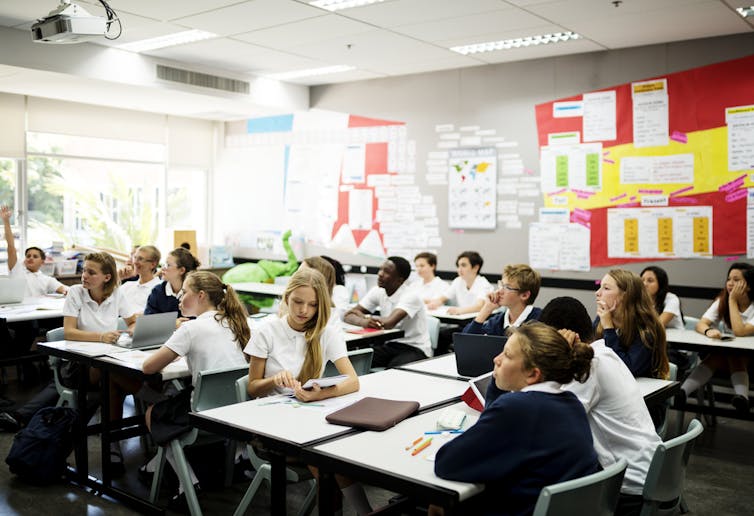 Interest in a lesson alone is to enough to stop all disruption in a classroom.
from www.shutterstock.com
Interest in a lesson alone is to enough to stop all disruption in a classroom.
from www.shutterstock.com
The students surveyed reported experiences of not paying attention, not listening to what the teacher says and excessive noise and disorder. These results align with similar research that asked children about the causes of problematic behaviour.
While such knowledge is not new, the understanding that children themselves are aware of the complexities and dynamics of the school experience does need to be acknowledged. Neither teacher or students enjoy a disrupted class.
Why is Australia so low?
Our schools are busy, vibrant, and filled with lessons that promote interaction between students and teachers. The fact poor discipline is defined as not listening and being off-task is perhaps a little melodramatic compared with some of the more extreme but infrequent outbursts (less than 3%) that can occur. But multiply that by 15 or 20 and there’s a bigger problem.
Education systems that remain in some countries are no longer representative of Australian culture and are not reflective of the accepted standards of educational practice. In many respects, Australia is one of the hardest places to teach because of the importance placed on engagement as well as performance. For example, China and Singapore have high levels of direct instruction, where Australian education focuses on getting the student involved and ensuring the teacher knows the students as individuals.
The classroom management debate has raged for decades and often doesn’t move at the same pace as other society norms. This teacher education video from the 1940s is a good example of how different styles can impact students. It also shows how simple prevention techniques can influence class mood.
In many ways, the best behaviour management relies on what happens when no misbehaviour is present. At these times, effective teachers are building positive relationships, acknowledging, and supporting students, gathering their feedback, and supporting those who need assistance. Most teachers do this well, most of the time, but disruptions still happen.
Problematic behaviour and school success are impacted by a multitude of factors such as bullying, poor motivation, difficulty in understanding, tiredness, competing curriculum priorities and the ever-present cycles of assessment.
There is enormous pressure on teachers to achieve results and the issue of a crowded curriculum is well documented. This pressure is also being felt by students and families, especially in the senior school years. Such pressures can affect a teacher’s ability to manage a class and can also affect a student’s ability to manage themselves.
Classroom management has been sidelined by academic performance
In recent years, teacher education programs have had to respond to government priorities that focus on academic performance. Programs relating to inclusive education and classroom management have drifted to the side.
Unfortunately, the skills of classroom management are far more complex than just “good teaching”. A false assumption made by as many early career teachers as experienced ones is that if their teaching is interesting, there should be no reason for misbehaviour.
Read more: Teachers shouldn't have to manage behaviour issues by themselves – schools need to support them
But interest alone is not enough. Classroom energy fluctuates, ability levels vary and not everyone is motivated by the same content. Teachers have to read the room and respond to many different demands of students to keep things flowing.
Yes, teachers would benefit from more direct instruction in how to deal with behavioural challenges. But they should also be skilled at prevention and should be supported in building those skills.
This report alerts us to the importance of effective teaching, and the fact that students do care about their learning environment. Everyone is on the same page here: students are trying to learn and teachers are trying to teach. Things will still go wrong, but far less frequently when trust and respect flows both ways.
Authors: Jonathon Sargeant, Senior Lecturer in Inclusive Education and Classroom Management, Australian Catholic University


















