

why the rise of multilingual TV is good news for everyone
- Written by: César Albarrán-Torres, Senior Lecturer, Department of Media and Communication, Swinburne University of Technology
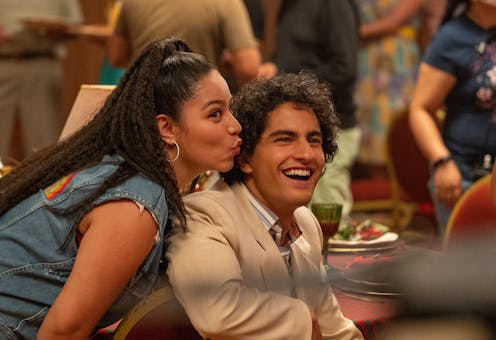
As one of billions of bilingual individuals in the world, it disappoints me when a film or TV show with characters of a non-English-speaking background is spoken entirely in English. This is specially the case when the production has been distributed globally.
It is even more disappointing – borderline insulting – when the lines are delivered by a native English speaker in a fake, over-the-top accent.
That said, there are some encouraging signs linguistic diversity is finally being portrayed in a more faithful and respectful manner. Acapulco, an Apple TV+ comedy now entering its third season, is a good example of how English can be used as a common language in a show without quashing language diversity and authenticity.
Half-baked attempts at diversity
The screen industry’s practice of using fake accents and English-only dialogue is longstanding. Classic Hollywood actors such as Katherine Hepburn, Charlton Heston and Marlon Brando have all played Asian or Latino characters and spoken English in fake accents.
Rather than ditching the accent altogether – such as in Shakespearean adaptations where actors are dressed as Romans but still sound British – we’ve seen several examples where A-listers put on fake accents in a setting where English isn’t the everyday language.
Take the recent Disney+ hit Shōgun. While the Japanese characters speak Japanese among themselves (points for that), the Portuguese and Spanish settlers communicate in English, and do so in heavily imposed accents. This half-baked attempt at linguistic diversity might be because Shōgun is an American show. But as Screen Rant features editor Marcelo Leite points out:
a fully accurate portrayal of the story would be entirely in Portuguese and Japanese, and all of Shōgun would have to include subtitles.
Another example comes from Ridley Scott’s 2021 film House of Gucci, which featured Lady Gaga, Adam Driver and Jared Leto, among others. The film takes place in Italy with characters who would normally speak Italian. Yet the film is spoken mostly in English. Audience reactions to the cast’s heavy, cartoon-like “Italian” accents were quite negative.
Why does Hollywood tend to be monolingual?
English-only productions are made under the premise Hollywood produces content mainly for American audiences, and that these audiences are monolingual.
As of recently, however, two factors are changing how movies and TV shows are conceptualised and brought to life. The first is that the vast linguistic diversity within the United States is increasingly being represented by directors and showrunners who are bilingual themselves.
The second is the global distribution of content through streaming services. It means audiences across the globe are getting used to watching content with subtitles in languages other than English, and other than their own.
As streaming inches us towards a global TV culture, cultural and linguistic representation is becoming an important topic. And this awareness is driving multilingual productions, such as Acapulco, in English-speaking countries.
Some of these productions even explore issues of language and culture loss in diverse communities. For instance, Vida and Gentefied both focus on the impacts of gentrification in Los Angeles – one of which is the loss of bicultural and bilingual character in Mexican-American enclaves. Both shows, created by Latinx showrunners, use English when it is logical to do so, and Spanish (or Spanglish) when non-white characters converse among themselves.
Another mainstream show, ABC’s Jane the Virgin, has a character (Jane’s abuela, Alba) who speaks almost entirely in Spanish.
The linguistic tide is turning
Recent television shows have demonstrated multilingual scripts can be both successful and dignified.
Acapulco, which has been compared to Ted Lasso, sets a precedent for what inclusivity can look and sound like. This light-hearted comedy counters the linguistic complacency that has dominated TV cultures for so long, whereby English is used as a standardising tool that is detrimental to diversity.
Acapulco is shot in Mexico with Latino talent, but also includes white English-speaking actors and a cross-national star, Eugenio Derbez. It is spoken in Spanish, English and Spanglish in a dignified and organic way.

The setting is an all-inclusive resort in the Mexican Pacific. Employees are forced to speak in English among themselves while on the premises, but speak in Spanish outside of the hotel. This in itself is a critique of labour practices in the Global South’s hospitality industry.
Nothing to lose, much to gain
Normalising language diversity onscreen forces creators to seek more multicultural talent behind and in front of the camera, particularly when it is these people’s communities being portrayed.
Beyond this, audiences will be empowered by seeing their own languages represented, or will otherwise benefit from being exposed to new languages they haven’t heard before. Indeed, research has found watching shows and films in foreign languages can help viewers learn them.
The growth in multilingual scripts will also inevitably lead to the normalisation of subtitles, which will help more broadly in making film and TV accessible for all.
Shows like Acapulco demonstrate the paradigm shift that’s taking place across Hollywood and other entertainment industries. And with streaming, it’s easier than ever for this content to go global.
Authors: César Albarrán-Torres, Senior Lecturer, Department of Media and Communication, Swinburne University of Technology


















